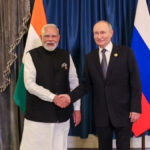
Russian President Vladimir Putin’s arrival in New Delhi has drawn the world’s attention back to one of the most enduring bilateral relationships in global diplomacy. His summit meeting with Prime Minister Narendra Modi comes at a moment defined by shifting power equations, heightened global sanctions pressure, and Washington’s renewed tariff-centric foreign policy. Rather than a routine diplomatic engagement, this meeting stands as a strategic recalibration for both India and Russia as they navigate a world that is politically fragmented and economically unpredictable.

A High-Stakes Visit at a Transformational Moment
Putin’s first visit to India in four years reflects more than ceremonial warmth. It marks an attempt by Moscow to reinforce one of its few remaining stable strategic partnerships after the West’s sweeping sanctions and political isolation. For New Delhi, the timing is equally significant. India is simultaneously negotiating a delicate trade pathway with the United States, trying to secure relaxation in the punitive tariffs imposed due to its continued purchase of discounted Russian crude.
This creates a rare diplomatic intersection where New Delhi must deepen ties with Moscow without undermining prospects with Washington. In this strategic triangle, India is not a passive player. It is actively shaping a foreign policy defined by autonomy, energy security, and diversified defence capabilities.
Energy Security: The Foundation of Today’s Partnership
India’s dependence on affordable Russian oil has grown dramatically over the past few years. As European economies reduced their purchase of Russian energy following the Ukraine conflict, India became one of the largest buyers of Russian seaborne crude. This shift has helped India control domestic inflation, stabilise fuel prices, and buffer the economy against global shocks.

For Russia, India is now a vital market that helps it redirect volumes away from Europe. Expanding this oil relationship further, bringing greater clarity on delivery logistics, insurance frameworks, and currency settlements is expected to be at the heart of the summit discussions.
Defence Cooperation: Legacy Ties, New Directions
Russia has been India’s biggest arms supplier for decades. Although India has increasingly diversified its defence purchases in recent years, legacy systems, co-production programmes, and advanced technology transfers still bind the partnership.
During the visit, Russia’s defence leadership emphasised its willingness to support India’s push for self-reliance in defence manufacturing. This aligns directly with India’s long-term vision to reduce external dependency while retaining technological access to niche platforms such as nuclear submarines, missile systems, and aviation technologies. New agreements are expected to include joint production, maintenance facilities, and long-term spares assurance, particularly for systems already operational in the Indian military.
Nuclear Energy and Civilian Cooperation: The Quiet Cornerstone
Beyond oil and defence, nuclear energy remains a reliable pillar of India–Russia cooperation. Units of key nuclear power projects operating in India today draw heavily from Russian technology. The upcoming talks are likely to evaluate future reactor collaborations, localisation of components, and safety technology partnerships.
Russia’s capability in large-scale civilian nuclear projects complements India’s long-term clean energy goals. The summit is expected to issue fresh announcements that signal continuity in this critical sector.

A Delicate Diplomatic Balancing Act for India
The summit unfolds at a moment when India faces immense pressure from every direction. The United States is expanding its tariff-first strategy, threatening additional trade action if India continues to deepen energy ties with Moscow. Europe remains politically sensitive to any perception of India enabling Russian revenue systems. Russia, meanwhile, sees India as an indispensable partner that can help it counterbalance the economic vacuum created by Western sanctions.
India’s approach is measured and strategic. It continues to call for peace through dialogue without condemning any one party. It maintains that its foreign policy choices must be guided by national interest rather than ideological affiliation or external pressure. This balancing act allows India to keep channels open globally, reflecting a maturing foreign policy that is independent and outcome-driven.
Putin’s Agenda: Reclaiming Economic Ground Lost to Sanctions
Russia’s priorities at the summit are clear. It aims to increase imports of Indian goods, expand two-way trade to the ambitious target of one hundred billion dollars by 2030, and diversify economic engagement beyond energy. Moscow seeks more Indian agricultural produce, pharmaceuticals, textiles, and consumer goods to offset its shrinking access to Western markets.

Additionally, Russia is signalling readiness for deeper cooperation in sectors like shipping, logistics, fintech settlements, and labour mobility. These are expected to feature prominently in the talks.
Strategic Optics: Warmth, Symbolism, and Political Messaging
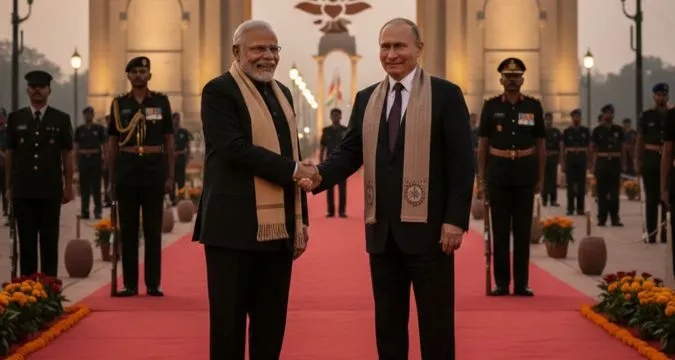
The optics of the visit have generated as many discussions as the agenda itself. Modi’s reception of Putin with a handshake and personal dinner underscores the enduring political trust between the two leaders. At a time when the global order is fractured and alliances are shifting, such symbolism reflects India’s confidence in maintaining long-standing partnerships without compromising new ones.
For Russia, these images are a demonstration to its domestic audience and the world that Moscow retains influential partners even as Western nations attempt to isolate it.
Read This: PM Modi’s Plan Japan Visit
The Ukraine Factor: Diplomacy Continues Without Confrontation
Putin’s visit to India follows his discussions with top officials from the United States on potential frameworks to halt the Ukraine conflict. Although the talks reportedly produced no breakthrough, India’s position remains consistent. It neither condemns nor aligns; instead, it advocates a diplomatic resolution and emphasizes that selective outrage by Western nations should not dictate India’s foreign policy.
This stance helps India maintain access to critical supplies while preserving its global credibility.
Where the India–Russia Partnership Goes Next
The summit is expected to produce several agreements and joint statements demonstrating that the relationship remains resilient despite global turbulence. The future trajectory may include:
- More structured long-term oil purchase contracts
• Expansion in rupee-based or local currency settlement systems
• New joint defence production programmes
• Greater access for Indian exports to Russian markets
• Collaboration in space technologies
• Enhanced cooperation in civilian nuclear projects
India is building a multi-dimensional foreign policy that seeks strategic partnerships without dependency. Russia remains important, but not exclusive. The United States remains essential, but not dominant. India’s rise, therefore, lies in this new ability to engage with multiple power blocs while advancing its core national interests.
More Read

Summit That Reflects India’s Strategic Autonomy
The Putin–Modi summit is more than a bilateral meeting. It is a signal to the world that India is confident in charting its own diplomatic journey. In a geopolitical environment defined by sanctions, tariffs, conflicts, and shifting alliances, India is demonstrating that partnerships can be strengthened without undermining others.
This strategic autonomy is the core of India’s foreign policy in 2025. It ensures that India remains a balancing force between major powers while securing energy flows, technological access, and economic stability for its future.