nyone who has dealt with employment compliance in India knows the old landscape was less a system than a maze. Different thresholds, different registers, different definitions of “worker,” “wages,” and “establishment,” and a legal architecture built layer upon layer over decades. For factory owners, HR managers, labour consultants, and workers themselves, the result was often the same: confusion first, compliance later, and litigation somewhere in between.
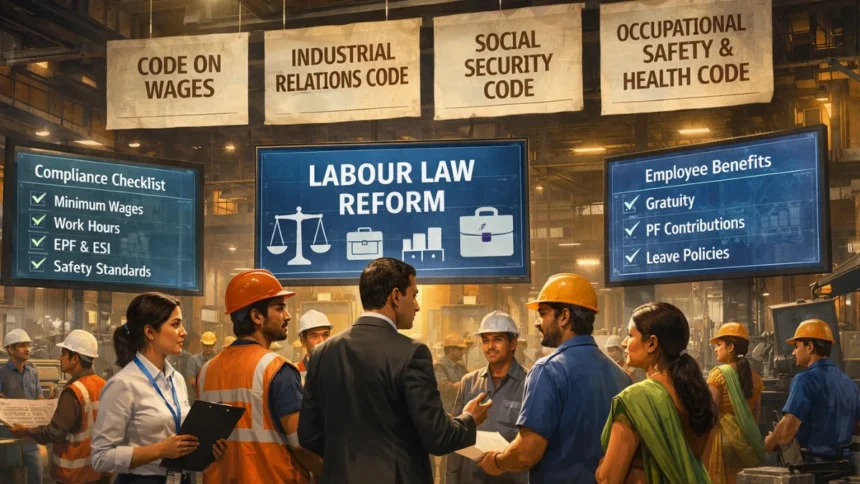
That is why Labour Codes Reform matters beyond policy circles. It is not just another legal tidy-up. It is one of the most consequential attempts in recent years to rewrite the operating grammar of employment law in India by consolidating dozens of central labour laws into four codes: the Code on Wages, 2019; the Industrial Relations Code, 2020; the Code on Social Security, 2020; and the Occupational Safety, Health and Working Conditions Code, 2020. The four-code structure was designed to reduce fragmentation and bring labour regulation into a more coherent framework. The Ministry of Labour and Employment has described the reform as an effort to simplify compliance, improve transparency, and strengthen labour welfare.
The interesting thing is that the debate around the reform has never really been about simplification alone. It has always been about power: who gets flexibility, who gets protection, and how a fast-changing economy should divide risk between employers, workers, and the state.
What Labour Codes Reform Is Trying to Fix
The older labour-law regime grew through historical accumulation. Each new concern produced a new statute. Wages had one law. Industrial disputes had another. Social security obligations were scattered. Working conditions, contract labour, inter-state migrant workers, and occupational safety sat in overlapping legislative silos. This made the system hard to navigate and easy to game.

Labour Codes Reform tries to replace that patchwork with a single architecture. The Code on Wages consolidates wage and payment laws. The Industrial Relations Code brings together laws governing trade unions, standing orders, and industrial disputes. The Social Security Code attempts to unify social protection rules. The Occupational Safety, Health and Working Conditions Code folds several workplace safety and welfare laws into one framework. The broad legislative intent, reflected in the text of the codes and ministry material, is to simplify definitions, reduce multiplicity of authorities, and use technology to make enforcement more transparent.
That sounds sensible on paper. In fact, much of it is. Any serious labour market eventually runs into the same problem: too many rules can weaken the very protections they claim to provide if compliance becomes opaque, selective, or prohibitively burdensome.

Why Labour Codes Reform Has Stayed in the Spotlight
Part of the reason the subject keeps returning is timing. The codes were enacted in 2019 and 2020, but implementation became a long, staggered process tied to rulemaking by both the Centre and the states. That created an odd public conversation in which the reform was legally real yet operationally uncertain for quite some time. Government publications as recently as the 2023–24 annual report still noted that the codes were yet to be implemented, while more recent official materials indicate that provisions have been brought into force from November 21, 2025, with related central rules and FAQs issued around the same period.
That matters because employment law is not like a slogan-driven reform where headlines do the work. Businesses need operational certainty. Workers need clarity about benefits, termination processes, grievance forums, and safety standards. Lawyers need to know what regime governs a dispute. A reform this large becomes meaningful only when companies can actually run payroll, classify employees, calculate benefits, and manage exits under stable rules.
It also matters because the Indian economy has changed faster than its labour-law vocabulary. Gig work, platform-based employment, outsourced staffing, flexible contracting, and digital compliance systems all strain older legal categories. The Social Security Code’s attempt to extend coverage language toward unorganised, gig, and platform workers is one reason the reform has drawn such attention. Whether that promise translates into actual protection is another matter, but the shift in legal imagination is unmistakable.

Labour Codes Reform and the Business Case for Flexibility
Supporters of the reform tend to make a practical argument. India cannot talk about manufacturing growth, labour-intensive industry, formalisation, and ease of doing business while maintaining a compliance environment that many firms experience as fragmented and unpredictable. Standardised definitions, digital filings, and reduced overlap are not anti-worker ideas by default; they are often the precondition for cleaner enforcement.
There is logic to that. A labour regime that is too cumbersome tends to create three predictable outcomes: under-compliance, legal arbitrage, and informalisation. In that sense, Labour Codes Reform is also an economic reform. It aims to make hiring, payroll administration, workplace regulation, and dispute handling more legible for employers. Official ministry documents explicitly frame codification as a way to promote transparency, reduce rigidity, and encourage enterprise creation.
But that argument only goes so far. “Flexibility” is one of those words that sounds elegant in white papers and much less elegant when heard from the position of the worker who can be laid off more easily, shifted into precarious arrangements, or asked to bear more uncertainty in exchange for efficiency gains they do not share.

The Worker Protection Question
This is where the politics of Labour Codes Reform gets sharper. Labour law is not merely a compliance instrument. It is a social bargain about dignity, bargaining power, and the extent to which employment is treated as a commercial transaction versus a protected relationship.
Some parts of the codes are clearly worker-facing. The Code on Wages extends the idea of minimum wages more broadly and embeds equal remuneration principles. The Social Security Code articulates an expansive objective of extending social security across organised, unorganised, and platform-linked work. Official FAQs and compliance materials also reflect operational changes around wage components and gratuity-linked calculations after enforcement.
Yet critics worry that the consolidation story can obscure redistribution of power. When industrial relations rules change, the central question is not whether the statute book looks cleaner. It is whether workers retain meaningful avenues for collective bargaining, dispute resolution, and protection against arbitrary treatment. The law may look modern while still shifting leverage upward.
This is why the reform has triggered such divided reactions. Employers often see simplification. Workers and unions often look for the fine print.
The Psychological Shift Inside the Workplace
There is another dimension that gets less attention. Legal reform changes workplace psychology long before it fully changes workplace outcomes.
When a labour regime becomes more rules-based, digitised, and centralised, companies tend to professionalise HR processes faster. Documentation becomes more systematic. Payroll structures become more disciplined. Employment categories become more visible. That can be good. It can also make labour relations feel colder, more procedural, and less negotiable.
Workers do not experience reform through legislative summaries. They experience it through offer letters, deductions, safety norms, notice periods, contractor arrangements, and whether grievance mechanisms actually respond. A code that looks progressive in official language can still feel remote if enforcement is patchy. Conversely, a reform sold mainly as an investor-friendly clean-up may still help workers if it improves wage clarity, safety compliance, or portability of benefits.
The point is simple: employment law is lived locally, even when drafted centrally.

What Labour Codes Reform Means for the Future of Work
The deeper significance of Labour Codes Reform is that it signals India is trying to update its labour-law model for a more formal, more digital, and more diversified economy. That does not guarantee success. Large reforms often produce a period of adjustment in which legacy habits coexist with new legal forms.
The next phase will depend on three things. First, rule harmonisation across states. Labour remains operationally federal in important ways, and uneven rulemaking can dilute the very simplification the reform promises. Second, enforcement capacity. A beautiful compliance portal means little if inspection, adjudication, and grievance systems are weak. Third, political trust. Labour law works best when workers do not assume every simplification is code for diluted protection.
There is also a bigger question lurking underneath. Can India build a labour framework that is both growth-oriented and socially credible? That is the real test. A country aspiring to scale manufacturing, attract investment, formalise employment, and manage platform work cannot afford either extreme: not a rigid legal fossil, and not a thin rights framework dressed up as reform.

Conclusion
Labour Codes Reform is best understood not as a narrow legal consolidation but as a structural attempt to redefine how India governs work. It promises simpler compliance, broader coverage, cleaner definitions, and a framework better suited to a changing economy. It also raises hard questions about bargaining power, enforcement credibility, and whether labour protection can survive the language of flexibility.
That tension is not a flaw in the conversation. It is the conversation. Employment law sits exactly where economics meets dignity. The real measure of this reform will not be how elegantly the codes are drafted, but whether they create a labour market that is more transparent without becoming more unequal, and more efficient without becoming less humane.
Final Insight
At The Vue Times, we track policy shifts that quietly reshape business, work, and everyday life. Labour law rarely trends like consumer tech, but its impact is often deeper and longer lasting. The smartest way to read this reform is not as paperwork reduction alone, but as a clue to where India thinks the future of work is headed.
Frequently Asked Questions
1. What is Labour Codes Reform in India?
Labour Codes Reform refers to the consolidation of numerous central labour laws into four major codes covering wages, industrial relations, social security, and workplace safety. The goal is to simplify compliance and modernise employment regulation.
2. What are the four labour codes?
They are the Code on Wages, 2019; the Industrial Relations Code, 2020; the Code on Social Security, 2020; and the Occupational Safety, Health and Working Conditions Code, 2020. These codes replace and combine multiple earlier labour laws.
3. Has Labour Codes Reform been implemented?
Implementation has been phased and tied to notified rules. Official materials indicate enforcement activity from November 21, 2025, though the broader rollout has depended on central and state-level rulemaking.
4. How does Labour Codes Reform affect workers?
It can affect wage definitions, social security coverage, workplace conditions, grievance mechanisms, and industrial relations processes. The actual impact depends heavily on enforcement and how employers operationalise the new rules.
5. Why is Labour Codes Reform important for businesses?
Businesses are expected to benefit from simplified definitions, reduced legal overlap, digital compliance, and a more unified regulatory structure. That can lower compliance friction, though transition costs and interpretation issues remain.