
80th Independence Day: ‘Vande Mataram’ Echoes at Red Fort, Modi Warns of ‘Dimaagi Naxals’
New Delhi | 15 August 2026 — India marked its 80th Independence Day on Saturday with a ceremony that broke new ground. For the first time since 1947, the national song ‘Vande Mataram’ was formally rendered at the Red Fort. Prime Minister Narendra Modi hoisted the Tricolour and addressed the nation for the 13th year in a row, laying out a seven-point growth plan, announcing an AI training push for one crore young Indians, and issuing a sharp political warning about what he called “dimaagi Naxals”.
Here is everything that happened, explained simply.
PM Modi Hoists Tiranga At Red Fort On India’s 80th Independence Day, Hails Nation’s Spirit
What Exactly Happened at the Red Fort
The morning followed the familiar order of ceremony, but with fresh touches.
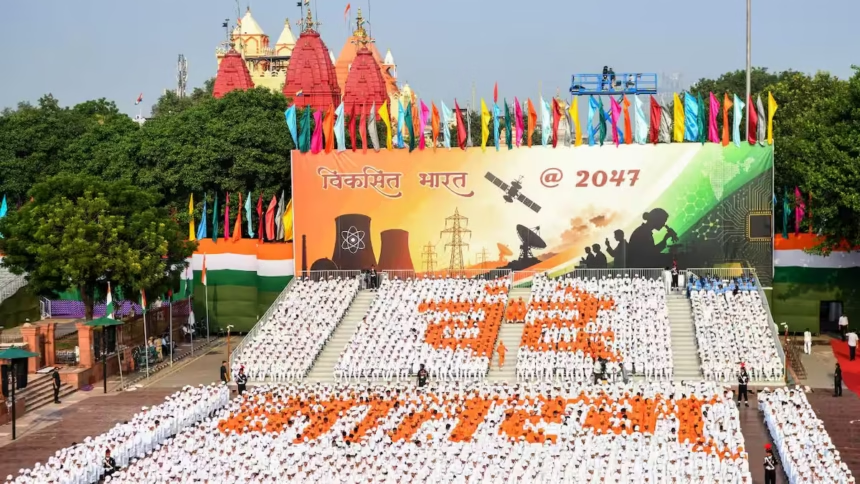
Modi wore a traditional tie-and-dye red turban for his 13th consecutive address to the nation from the historic ramparts of the Red Fort. He was received at the venue, inspected a Guard of Honour, and hoisted the National Flag, followed by a 21-gun salute, ‘Vande Mataram’ and the National Anthem.
The flag-hoisting was synchronised with the 21-gun salute presented by gunners of the 1721 Field Battery (Ceremonial). Two Indian Air Force Mi-17 helicopters showered flower petals after the hoisting — one carrying the National Flag and the other a ‘Vande Mataram’ flag.
The Prime Minister opened his speech by expressing solidarity with families hit by floods, landslides and other natural calamities across the country. He then greeted the nation, saying that today every heart is Tiranga and every household is Tiranga.
The Big First: ‘Vande Mataram’ Sung at the Red Fort
This was the headline moment of the day.
For the first time, the National Song ‘Vande Mataram’ was rendered during Independence Day celebrations at the Red Fort. Modi noted from the ramparts that ‘Vande Mataram’ was echoing at the Red Fort for the first time since Independence, and paid tribute to freedom fighters including Mahatma Gandhi.
Why now? Because 2026 marks a milestone anniversary. The formal singing was tied to 150 years of the song’s legacy. Written by Bankim Chandra Chattopadhyay in 1875 and first published in his novel Anandamath, ‘Vande Mataram’ became a rallying cry of the freedom movement and was later adopted as India’s national song, holding equal status of honour with the national anthem.
The full version of the song was also played at President Droupadi Murmu’s Independence Day eve address on 14 August.
‘Dimaagi Naxal’: The Line That Triggered a Political Storm
The most talked-about part of the speech was not economic — it was political.
Modi called for the identification of ‘dimaagi Naxals’ — a reference to people he described as holding a Maoist mindset — saying such persons had established themselves in the corridors of power and needed to be isolated so the country could keep developing. He said India must stay prepared to confront challenges both within its borders and from across them.
The comment came alongside a broader claim on internal security. The Prime Minister said armed Naxalism has largely been eliminated, while ideological threats continue to persist. Recalling the situation in 2014, he said Naxalism had drenched the earth in blood, and that areas once known for Naxalite violence are now seeing development and greater public trust.
Reactions were immediate. The Congress hit back at the Prime Minister over the remark, while the BJP criticised Rahul Gandhi for not attending the official ceremony, linking his absence to the same “Dimagi Naxal” framing.
The Vue Times note: this is a contested political claim, not a settled fact. We report the statement and the response; readers should weigh both.
80TH INDEPENDENCE DAY CELEBRATION 2026
‘Shakti Ki Sapt Dhara’ — The Seven Streams of Strength
The centrepiece policy announcement was a seven-part framework for the next phase of growth. Modi unveiled the ‘Saptadhara’ reforms — seven streams of India’s strength that he said will power the country’s next phase of growth towards ‘Viksit Bharat’ by 2047.
The seven strengths are: manufacturing; agriculture and food processing; technology and innovation; connectivity and Gati Shakti; defence production; green energy and the Blue Economy; and India’s soft power.
| # | Stream | What it covers |
|---|---|---|
| 1 | Manufacturing | Cost, quality and scale to compete globally |
| 2 | Agriculture & Food Processing | Value addition beyond raw produce |
| 3 | Technology & Innovation | AI, quantum, robotics, space, next-gen communications |
| 4 | Connectivity / Gati Shakti | Infrastructure and logistics backbone |
| 5 | Raksha Shakti (Defence) | Self-reliance and export capability |
| 6 | Green Energy & Blue Economy | Hydrogen, storage, fisheries, ocean tech |
| 7 | Soft Power | Yoga, Ayurveda, films, gaming, tourism |
From ‘Fragile 5’ to Fastest-Growing Major Economy
On the economy, the Prime Minister framed the last twelve years as a turnaround story.
He said India’s progress had often fallen short of its aspirations after Independence, but that the country is now moving with unprecedented speed and confidence, powered by the resolve of 140 crore Indians. The government’s argument — repeated by ministers and by NITI Aayog in recent years — is that India moved out of the “Fragile Five” grouping of vulnerable emerging economies to become the world’s fastest-growing major economy. NITI Aayog Vice Chairperson Suman Bery has previously said India’s ascent from the “Fragile Five” to the fastest-growing major economy holds lessons for other developing countries.
Context for readers: “Fragile Five” was a term coined by a Morgan Stanley analyst in 2013 for five emerging economies — India, Indonesia, Brazil, Turkey and South Africa — seen as overly dependent on foreign investment. Growth rankings shift with global conditions, so this is a comparative claim rather than a permanent status.
Announcements for Youth: AI Skills and Free Coaching
The theme of the day was youth power, and the announcements matched it.
Modi announced that one crore young people will be trained in artificial intelligence skills, and said India must become a global hub for innovation in AI, quantum technology, robotics, space and next-generation communications.
He also announced free online coaching for young people preparing for competitive examinations, stressing that the country’s youth would be the biggest beneficiaries and enablers of the Viksit Bharat vision.
He additionally urged young Indians to take part in the Census exercise. And in a separate appeal, he called for a collective effort to make India drug-free, urging families to join a 100-day nationwide Nasha Mukt Yuva Abhiyan.
33% Women’s Reservation: A Direct Appeal to All Parties
Calling women’s political leadership the “call of the hour”, Modi urged all political parties to ensure 33 per cent representation for women in the Lok Sabha and State Legislative Assemblies, noting that women leaders are already contributing significantly through Panchayats, Municipalities and Municipal Corporations.
Energy, Semiconductors, Defence and the Deep Sea
Four more announcements stood out:
- Nuclear power: A target of 100 GW nuclear capacity by 2047, with five new reactors to become operational in the coming years.
- Semiconductors: Seven to eight new semiconductor plants expected to become operational within the next one to two years.
- Defence: Modi said India cannot remain merely a market for the world and must become self-reliant in defence manufacturing and a global supplier of next-generation defence technology.
- Deep-sea exploration: Areas earlier classified as “no-go areas” for offshore exploration are being opened as “go-ahead areas”, with the Samudra Manthan initiative aimed at strengthening energy security and cutting import dependence.
He also urged MSMEs to use free trade agreements signed with around 40 countries since 2014 to expand exports in textiles, machinery, pharmaceuticals, seafood and traditional food products.
Who Was in the Audience
Nearly 5,000 special guests from different walks of life attended, including women entrepreneurs, young innovators, farmers and beneficiaries of various government schemes. The invitations reflected an effort to make the event more inclusive and representative of different sections of society.
Senior Union ministers including Amit Shah, Rajnath Singh, Nirmala Sitharaman and S Jaishankar attended, along with Chief Justice of India Surya Kant, Chief Election Commissioner Gyanesh Kumar and National Security Advisor Ajit Doval.
Security was tight. Patrolling, vehicle checks, checkpoints and drone surveillance were stepped up across Delhi and the NCR after bomb threat emails were received ahead of 15 August.
The Theme: Yuva Shakti and Viksit Bharat 2047
This year’s celebrations were centred on ‘Yuva Shakti’, highlighting the role of young people in India’s journey to becoming a developed nation by 2047, and recognising their contribution to innovation, growth and social transformation.
Throughout the address, Modi linked each initiative back to the Viksit Bharat 2047 goal and urged citizens, businesses and young people to dream big.
Why This Independence Day Matters
Three reasons this one will be remembered:
- A genuine historical first. ‘Vande Mataram’ at the Red Fort, in its 150th year, is the kind of symbolic moment that outlives a news cycle.
- A framework, not just a list. ‘Shakti Ki Sapt Dhara’ bundles scattered schemes into one story the government will repeat until 2047.
- A sharpened political line. The “dimaagi Naxal” phrase sets the tone for the debate ahead, and the Opposition has already pushed back.