

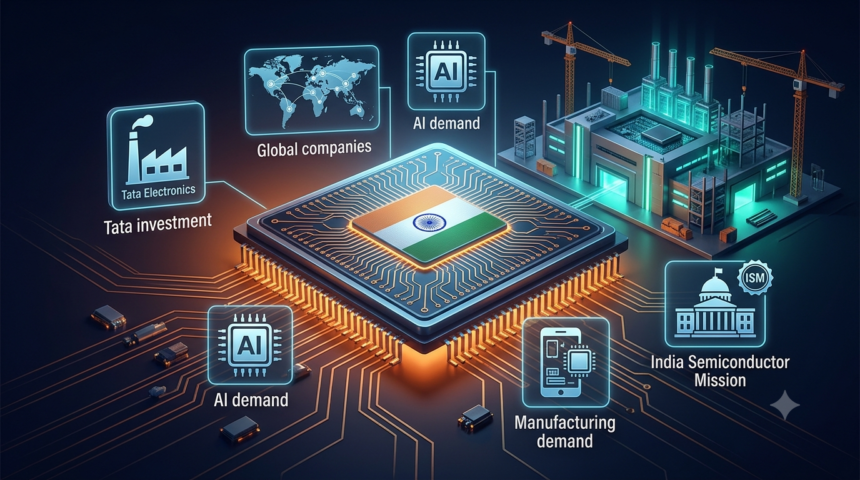
The India Semiconductor industry is entering a decisive phase as billions of dollars in fresh investments continue to strengthen the country’s ambition of becoming a global hub for chip manufacturing. Supported by government incentives, strategic partnerships and rising demand for semiconductors across artificial intelligence, electric vehicles and consumer electronics, India is accelerating efforts to reduce its dependence on imported chips.
Over the past two years, several major domestic and international companies have announced semiconductor projects spanning fabrication plants, assembly and testing facilities, outsourced semiconductor assembly and test (OSAT) units and advanced packaging operations. These investments are expected to create thousands of skilled jobs while strengthening India’s electronics manufacturing ecosystem.
The government’s India Semiconductor Mission (ISM) has played a central role in attracting investors through financial incentives and policy support. At the same time, growing geopolitical concerns over global semiconductor supply chains have encouraged many companies to diversify manufacturing beyond traditional production centres in East Asia.
With multiple projects now moving from announcements to construction and production planning, the India Semiconductor sector is becoming one of the country’s fastest-growing strategic industries. Here are the major developments driving India’s semiconductor race and why they matter for the economy, technology sector and future manufacturing ambitions.
Development 1: India Semiconductor Mission Continues to Attract Major Investments
The biggest driver behind the India Semiconductor push is the government’s ambitious India Semiconductor Mission (ISM), which was launched to establish a comprehensive chip manufacturing ecosystem within the country. Backed by billions of dollars in financial incentives, the programme aims to attract global semiconductor companies while encouraging domestic firms to invest in fabrication, assembly, testing and packaging facilities.
Rather than focusing on a single manufacturing plant, the India Semiconductor strategy covers the entire value chain—from chip design and fabrication to outsourced semiconductor assembly, testing (OSAT) and advanced packaging. This broader approach is expected to strengthen India’s position as a reliable partner in the global electronics supply chain while reducing dependence on imported semiconductors.
Industry experts believe the policy has significantly improved investor confidence, with multiple large-scale projects receiving government approval over the past two years. As global demand for advanced chips continues to rise, the India Semiconductor initiative is increasingly being viewed as one of the country’s most strategically important manufacturing programmes.
Development 2: Tata Electronics Is Expanding India’s Chip Manufacturing Ambitions
Among the companies leading the India Semiconductor race is Tata Electronics, which has announced multi-billion-dollar investments across semiconductor fabrication and chip assembly facilities. The company’s projects represent one of the largest private-sector commitments to India’s semiconductor industry and are expected to play a central role in building indigenous manufacturing capabilities.
The upcoming fabrication plant is designed to produce semiconductor chips for industries including automotive, consumer electronics, telecommunications and artificial intelligence. Alongside fabrication, Tata Electronics is also investing in semiconductor packaging and testing infrastructure, helping establish a more complete domestic supply chain.
The expansion demonstrates how the India Semiconductor programme is encouraging Indian conglomerates to enter one of the world’s most technology-intensive industries, reducing long-term dependence on overseas chip manufacturing.
Development 3: Global Companies Are Choosing India for New Chip Facilities
India’s semiconductor ambitions are no longer driven solely by domestic companies. Several international technology firms have announced investments in chip assembly, testing and packaging facilities as part of the growing India Semiconductor ecosystem.
These projects reflect a broader shift in global supply chains as manufacturers seek to diversify production beyond traditional semiconductor hubs. Rising geopolitical tensions, supply chain disruptions experienced during the pandemic and increasing demand for advanced chips have encouraged multinational companies to establish manufacturing capacity across multiple countries.
For India, attracting international semiconductor investment brings more than financial capital. It also introduces advanced manufacturing expertise, technology transfer, workforce development and stronger integration into global semiconductor supply networks. Analysts believe these partnerships could significantly accelerate the country’s long-term India Semiconductor ambitions while boosting exports and high-skilled employment.
Development 4: AI and Data Centre Demand Is Fueling India Semiconductor Growth
The rapid adoption of artificial intelligence (AI), cloud computing and large-scale data centres is creating fresh opportunities for the India Semiconductor industry. Modern AI applications require advanced processors, memory chips and specialised semiconductors capable of handling complex computing tasks with greater efficiency.
India’s growing digital economy, supported by expanding internet usage and enterprise cloud adoption, is increasing domestic demand for semiconductors across industries. From AI-powered applications and smart manufacturing to autonomous technologies and high-performance computing, chips have become the backbone of digital transformation.
As global technology companies expand their AI infrastructure, industry observers expect the India Semiconductor ecosystem to benefit from sustained investment in chip manufacturing, packaging and design capabilities.
Development 5: Electronics Manufacturing Is Creating Strong Domestic Demand
India has emerged as one of the world’s fastest-growing electronics manufacturing destinations, supported by Production-Linked Incentive (PLI) schemes and rising exports of smartphones, consumer electronics and telecom equipment. This manufacturing expansion is directly strengthening the India Semiconductor sector.
Leading smartphone brands and electronics manufacturers increasingly rely on locally assembled components, creating demand for semiconductor packaging, testing and eventually domestically manufactured chips. As production volumes continue to rise, the availability of a local semiconductor ecosystem can reduce import dependence, improve supply-chain resilience and shorten production timelines.
Experts believe that combining electronics manufacturing with semiconductor production will help India move beyond assembly operations and capture greater value within the global technology supply chain.
Development 6: Skilled Talent and Chip Design Give India a Competitive Edge
While semiconductor fabrication is still developing, India already has a well-established reputation in semiconductor design and engineering. Thousands of Indian engineers work on chip architecture, verification, embedded software and research for many of the world’s leading semiconductor companies.
This strong talent base provides a natural advantage for the India Semiconductor ecosystem. As fabrication plants, OSAT facilities and advanced packaging units become operational, companies will be able to leverage an experienced workforce without building talent pipelines from scratch.
Universities, research institutions and industry partnerships are also expanding specialised semiconductor training programmes to prepare engineers and technicians for future manufacturing roles. Together, these initiatives are expected to strengthen India’s long-term competitiveness in the global semiconductor industry.
Development 7: Challenges Remain Despite Rapid Progress
Despite the optimism surrounding the India Semiconductor industry, several challenges must be addressed before the country can compete with established global chip manufacturing hubs. Semiconductor fabrication is one of the most capital-intensive industries in the world, requiring billions of dollars in investment, highly skilled talent and years of planning before commercial production begins.
Reliable access to ultra-pure water, uninterrupted electricity, advanced manufacturing equipment and a robust supply chain for raw materials are also essential. Building this supporting infrastructure will take sustained public and private investment.
Competition from established semiconductor leaders such as Taiwan, South Korea and the United States remains intense. However, industry experts believe India’s strategy is not to replace these markets overnight but to emerge as a trusted alternative in an increasingly diversified global semiconductor supply chain.
To learn more about another transformative technology shaping India’s future, read our related article on Quantum Computing in India: Dream or Near Future?. For official updates on India’s semiconductor initiatives, visit the Ministry of Electronics and Information Technology (MeitY).
Conclusion
The India Semiconductor industry is moving from ambition to execution, with fresh investments, supportive government policies and increasing participation from both domestic and global companies. Projects involving semiconductor fabrication, chip assembly, testing and advanced packaging are laying the foundation for a stronger and more resilient electronics ecosystem.
Growing demand for AI, electric vehicles, consumer electronics and cloud infrastructure is expected to sustain momentum over the coming years. Combined with India’s established expertise in chip design and engineering, these trends position the country to play a more significant role in the global semiconductor value chain.
While challenges related to infrastructure, technology and supply-chain development remain, the pace of investment suggests that the India Semiconductor sector is entering a transformative period. If current projects are completed successfully and policy support continues, India could become one of the world’s most important semiconductor manufacturing destinations in the coming decade.