

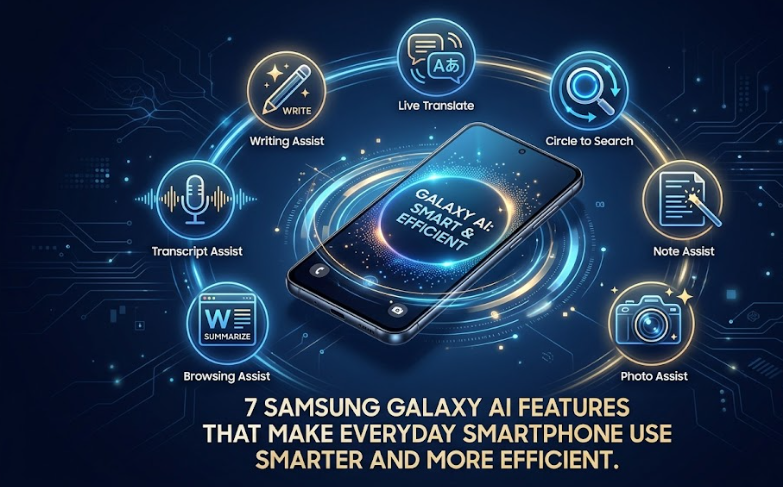
Artificial intelligence is rapidly changing how people interact with their smartphones, and Samsung Galaxy AI has emerged as one of the biggest innovations in the Android ecosystem. Since its introduction, Samsung has steadily expanded its AI capabilities across flagship smartphones, adding intelligent tools that simplify communication, improve creativity and boost everyday productivity.
The latest Galaxy devices including the Galaxy S25 series, Galaxy Z Fold7 and Galaxy Z Flip7 ship with enhanced Samsung Galaxy AI features, while several existing premium devices have also received many of these capabilities through software updates. Rather than focusing solely on flashy demonstrations, Samsung has integrated AI directly into daily smartphone tasks, making it easier to edit photos, summarize documents, translate conversations and search information instantly.
As competition in mobile AI intensifies with Google, Apple and other smartphone makers introducing their own intelligent assistants, Samsung Galaxy AI continues to evolve through regular One UI updates and new partnerships. For users considering a Galaxy devic or those who already own one, these AI-powered features can significantly improve the overall smartphone experience.
Here are seven Samsung Galaxy AI features that are genuinely worth trying today.
Feature 1: Live Translate Breaks Language Barriers Instantly
One of the most impressive capabilities of Samsung Galaxy AI is Live Translate, which enables real-time translation during phone calls without requiring third-party applications. Whether users are speaking with someone in another country or communicating with international clients, the feature translates conversations almost instantly while preserving privacy through on-device processing for supported languages.
Unlike traditional translation apps that require copying text or switching between screens, Live Translate works directly within Samsung’s native Phone application. Users can hear translated speech while simultaneously viewing the conversation as text, making communication smoother for both personal and professional use.
Samsung continues expanding language support with software updates, making Samsung Galaxy AI increasingly useful for travelers, businesses and multilingual households.
Feature 2: Circle to Search Makes Finding Information Effortless
Searching the web has become significantly easier thanks to Circle to Search, one of the most popular Samsung Galaxy AI features developed in partnership with Google.
Instead of taking screenshots or typing lengthy search queries, users simply press and hold the navigation bar before circling, highlighting or tapping any object displayed on the screen. Within seconds, Samsung Galaxy AI identifies products, landmarks, celebrities, plants, animals or text and presents relevant search results without forcing users to leave their current app.
Whether shopping online, reading social media or watching videos, Circle to Search removes several unnecessary steps and has quickly become one of the most frequently used AI tools available on Galaxy smartphones.
Feature 3: Note Assist Turns Long Documents Into Quick Summaries
Managing lengthy notes has become much easier with Note Assist, an AI-powered productivity tool integrated into Samsung Notes.
Using Samsung Galaxy AI, Note Assist can automatically summarize lengthy meeting notes, organize scattered information into structured sections and even generate titles based on the document’s content. Students can quickly review lecture notes, professionals can condense meeting minutes and researchers can organize large amounts of information without manually editing every page.
The feature also helps improve formatting by creating clean layouts that are easier to read and share. As AI becomes increasingly important for workplace productivity, Note Assist demonstrates how Samsung Galaxy AI extends beyond entertainment into practical daily use.
Feature 4: Photo Assist Makes Professional Editing Simple
Editing photos has become faster and more intuitive with Photo Assist, one of the standout tools within Samsung Galaxy AI. The feature uses generative AI to help users reposition, resize or remove unwanted objects from images with just a few taps.
If an object is moved within a photo, Samsung Galaxy AI intelligently fills the empty background using AI-generated content that blends naturally with the surrounding scene. The tool can also straighten tilted images and automatically crop them while recreating missing edges, producing results that previously required advanced photo-editing software.
For content creators and everyday users alike, Photo Assist reduces the time needed to produce polished images suitable for sharing on social media or preserving personal memories.
Feature 5: Browsing Assist Saves Time While Reading
For users who frequently browse lengthy articles or research online, Browsing Assist is among the most practical Samsung Galaxy AI features available.
Integrated into Samsung Internet, the tool can summarize long webpages into concise highlights, allowing users to grasp key information without reading every paragraph. It can also translate entire webpages into supported languages, making international news, research papers and travel information easier to understand.
Instead of switching between translation apps or manually copying text, Samsung Galaxy AI performs these tasks directly within the browser. The result is a smoother browsing experience that helps users consume information more efficiently while reducing unnecessary distractions.
Feature 6: Transcript Assist Turns Voice Recordings Into Organized Notes
Meetings, interviews and lectures often generate hours of audio that can be difficult to review later. Transcript Assist, powered by Samsung Galaxy AI, simplifies this process by automatically converting voice recordings into searchable text.
Beyond basic transcription, the feature can distinguish between different speakers in supported scenarios and generate concise summaries of lengthy conversations. This allows users to quickly identify key discussion points without replaying entire recordings.
Professionals, journalists, students and business users stand to benefit significantly from Transcript Assist, as it transforms spoken conversations into organized documents that are easier to reference, edit and share.
Feature 7: Writing Assist Improves Everyday Communication
Completing the list is Writing Assist, a productivity feature that showcases how Samsung Galaxy AI is becoming an intelligent writing companion across Galaxy devices.
Writing Assist helps users rewrite messages in different tones, correct grammar and spelling, summarize text and generate polished replies directly from the Samsung Keyboard in supported applications. Whether drafting a professional email, replying to a client or sending a casual message, the feature can adapt writing style to suit the situation.
The tool is particularly useful for users who communicate frequently across multiple platforms, reducing the need for separate grammar-checking or AI writing applications. As Samsung continues expanding its AI ecosystem through One UI updates, Writing Assist is expected to become even more capable, further strengthening the everyday value of Samsung Galaxy AI.
How Samsung Galaxy AI Continues to Evolve
Samsung has made it clear that Samsung Galaxy AI is not a one-time feature but a growing ecosystem that will continue to improve through regular software updates. With each new version of One UI, the company has introduced additional AI-powered capabilities while refining existing tools based on user feedback.
The latest Galaxy flagship devices including the Galaxy S25 series and Samsung’s newest foldable smartphones feature deeper AI integration across communication, productivity, photography and device management. Samsung is also working closely with Google to expand Gemini-powered experiences, enabling users to perform more complex tasks using natural voice commands and contextual AI assistance.
Another major advantage is Samsung’s commitment to bringing selected Samsung Galaxy AI features to older premium Galaxy devices through software updates. While hardware limitations mean some advanced capabilities remain exclusive to newer smartphones, many existing Galaxy users have already gained access to several AI tools without purchasing a new device.
As competition intensifies with Apple Intelligence, Google’s Pixel AI and other generative AI platforms, Samsung continues investing heavily in on-device AI processing to improve privacy, reduce latency and deliver faster responses without always relying on cloud-based servers.
Why Samsung Galaxy AI Matters More Than Ever
Artificial intelligence is becoming one of the most important factors influencing smartphone purchasing decisions, and Samsung Galaxy AI has positioned Samsung among the leaders in this rapidly evolving market.
Unlike standalone AI applications that require users to switch between different services, Samsung Galaxy AI integrates intelligence directly into everyday smartphone activities. Features such as Live Translate, Circle to Search, Note Assist and Photo Assist are designed to save time rather than simply demonstrate technological capabilities.
For professionals, the productivity tools help organize information and improve communication. Students benefit from automatic summaries and transcription services, while travelers gain instant translation capabilities that simplify conversations abroad. Content creators also have access to advanced image editing tools without requiring expensive desktop software.
This broad range of practical applications explains why Samsung Galaxy AI has become one of Samsung’s strongest selling points across its latest Galaxy smartphones.
For more insights into the latest AI innovations transforming the tech world, explore our related article on Top Viral AI Tools in 2025: ChatGPT Hacks, Canva AI Tricks & MidJourney Mastery. To learn more about Galaxy AI and its latest features, visit the Samsung Galaxy AI.
Conclusion
Samsung Galaxy AI is transforming the Galaxy smartphone experience by making artificial intelligence genuinely useful in everyday life rather than treating it as a novelty. From breaking language barriers with Live Translate and simplifying online searches through Circle to Search to enhancing productivity with Note Assist and Transcript Assist, Samsung has created an ecosystem that helps users work smarter and communicate more effectively.
The seven features highlighted in this article demonstrate how Samsung Galaxy AI goes beyond photography and voice assistants to improve nearly every aspect of smartphone use. As Samsung continues expanding its AI capabilities through future One UI updates and new Galaxy devices, users can expect even more intelligent tools that blend seamlessly into their daily routines.
Whether you’re considering upgrading to a new Galaxy smartphone or exploring features already available on your device, Samsung Galaxy AI offers practical innovations that make modern smartphones more capable, efficient and enjoyable to use.