
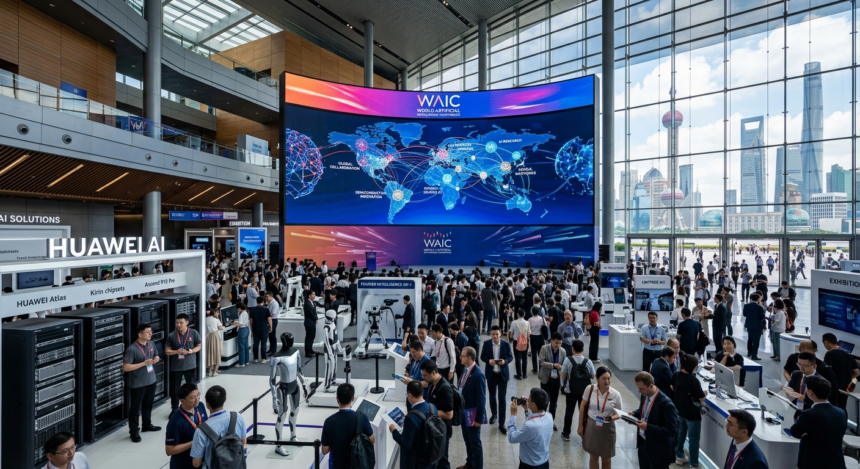
China has unveiled its boldest vision yet for the future of artificial intelligence, using the 2026 World Artificial Intelligence Conference (WAIC) in Shanghai to position itself as the champion of an alternative global AI order. At the center of the announcement is a sweeping China AI Strategy that combines open-source artificial intelligence, international cooperation, advanced domestic hardware, and new global governance initiatives.
Chinese President Xi Jinping used his keynote address at WAIC to present Beijing’s long-term AI ambitions, arguing that artificial intelligence should remain accessible, collaborative, and beneficial to all countries rather than being dominated by a handful of technology companies or governments. His remarks also challenged growing U.S. influence over AI regulation and semiconductor policy, signaling that competition between the world’s two largest economies has entered a new phase.
The conference comes as both Washington and Beijing accelerate investments in frontier AI technologies while tightening control over advanced chips, foundation models, and digital infrastructure. Against that backdrop, China’s latest AI strategy is not simply about technology—it is also a geopolitical statement about who will shape the future rules governing artificial intelligence.
China AI Strategy Puts Open-Source AI at the Center
A defining feature of the new China AI Strategy is Beijing’s commitment to expanding open-source artificial intelligence.
During his address, Xi described open-source AI as a historic opportunity capable of accelerating innovation worldwide. He urged countries to embrace collaboration rather than technological isolation and warned that unequal access to AI could create “new historical injustices” between developed and developing nations.
Unlike many leading Western AI companies that continue developing proprietary large language models, China is increasingly promoting open-weight models that researchers, startups, and governments can adapt for local needs.
Chinese AI companies have rapidly embraced this approach over the past year, releasing increasingly powerful open-source models that compete directly with closed commercial systems developed in the United States.
Officials believe wider access to AI technology will accelerate innovation while strengthening China’s influence across emerging markets seeking affordable AI solutions.
Huawei Showcases China’s Growing AI Hardware Strength
While software dominated many discussions at WAIC, hardware remained equally important.
Huawei used the conference to showcase its Atlas 950 SuperPoD, one of the company’s most advanced AI computing platforms designed to support large-scale model training despite continuing U.S. export restrictions on advanced semiconductors. The system highlights China’s determination to reduce dependence on foreign AI infrastructure while building a competitive domestic ecosystem.
The unveiling reflects years of investment in homegrown semiconductor technologies following Washington’s restrictions on high-end chip exports.
Although Chinese companies continue facing challenges obtaining the world’s most advanced AI processors, firms including Huawei have significantly expanded domestic computing capabilities through indigenous hardware development and optimized software architectures.
Industry analysts view these efforts as critical to China’s long-term AI competitiveness, particularly as access to foreign chips becomes increasingly uncertain.
Xi Jinping Expands China’s AI Diplomacy
Beyond announcing domestic initiatives, Xi Jinping used WAIC to outline a broader international vision for artificial intelligence. The Chinese leader called for stronger global cooperation on AI development, emphasizing that advanced technologies should not become exclusive tools controlled by a small group of nations or corporations.
As part of the new China AI Strategy, Beijing proposed deeper collaboration with developing economies, expanded cross-border AI research, and the creation of international governance mechanisms aimed at establishing common standards for responsible AI development. Chinese officials argued that AI should remain an open platform for economic growth rather than becoming fragmented by geopolitical tensions or export restrictions.
Xi also criticized what he described as technological barriers that limit access to advanced AI capabilities. While he did not directly name the United States, his remarks were widely interpreted as a response to Washington’s tightening export controls on advanced AI chips and semiconductor technologies. The speech reinforced China’s position that global AI development should prioritize openness, fairness, and shared innovation rather than technological containment.
A Direct Response to U.S. AI Policies
The latest China AI Strategy arrives at a time of intensifying competition between Beijing and Washington over artificial intelligence.
Over the past several years, the United States has imposed multiple rounds of export controls targeting advanced AI chips, semiconductor manufacturing equipment, and high-performance computing technologies destined for China. American officials argue that these restrictions are necessary to protect national security and prevent sensitive technologies from supporting military modernization.
China, however, views many of these measures as attempts to slow its technological progress.
Rather than reducing investment, the restrictions have accelerated Beijing’s efforts to build an independent AI ecosystem. Massive funding has flowed into domestic semiconductor manufacturers, cloud computing providers, AI startups, and research institutions as China seeks to reduce reliance on foreign technology.
Industry experts say the result has been a dramatic increase in China’s self-sufficiency across the AI supply chain. While challenges remain, Chinese companies are rapidly improving both AI hardware and foundation models, narrowing the technology gap with leading Western firms.
Global AI Competition Is Entering a New Era
The announcements made at WAIC underscore how artificial intelligence has become one of the defining geopolitical issues of the decade.
Instead of competing solely through commercial innovation, governments are increasingly shaping AI through industrial policy, investment incentives, export controls, and regulatory frameworks. The China AI Strategy reflects Beijing’s belief that leadership in AI will influence economic growth, scientific research, national security, and global political influence for decades to come.
At the same time, the United States continues to strengthen partnerships with allies while investing heavily in advanced semiconductor production and frontier AI research. Europe is pursuing its own approach through comprehensive AI regulations, while countries including India, the United Kingdom, Japan, South Korea, and the Gulf states are expanding investments in AI infrastructure and talent.
This growing competition suggests that the future of artificial intelligence will be shaped not only by technology companies but also by governments seeking to define the rules, standards, and ecosystems that power the next generation of digital innovation.
Readers can also explore our article on Top Viral AI Tools in 2025: ChatGPT Hacks, Canva AI Tricks & MidJourney Mastery to discover how the latest AI technologies are transforming industries and everyday life. For authoritative insights into global AI trends and governance, OECD AI Policy Observatory.
What China’s AI Strategy Means for the World
The latest China AI Strategy demonstrates that Beijing is no longer focused solely on catching up with global AI leaders. Instead, it is positioning itself as an architect of the future AI landscape by promoting open-source development, investing in domestic hardware, and expanding international cooperation.
Whether these initiatives ultimately reshape the balance of global AI leadership remains uncertain. However, the announcements at WAIC make one point clear: the competition over artificial intelligence is no longer just about building better models. It is increasingly about determining who sets the global standards, controls the underlying infrastructure, and defines how AI technologies are shared around the world.
As governments and technology companies race to secure leadership in artificial intelligence, China’s latest strategy signals that the global AI contest is entering an even more competitive and consequential phase.
What China’s AI Strategy Means for the World
The latest China AI Strategy demonstrates that Beijing is no longer focused solely on catching up with global AI leaders. Instead, it is positioning itself as an architect of the future AI landscape by promoting open-source development, investing in domestic hardware, and expanding international cooperation.
Whether these initiatives ultimately reshape the balance of global AI leadership remains uncertain. However, the announcements at WAIC make one point clear: the competition over artificial intelligence is no longer just about building better models. It is increasingly about determining who sets the global standards, controls the underlying infrastructure, and defines how AI technologies are shared around the world.
As governments and technology companies race to secure leadership in artificial intelligence, China’s latest strategy signals that the global AI contest is entering an even more competitive and consequential phase.