

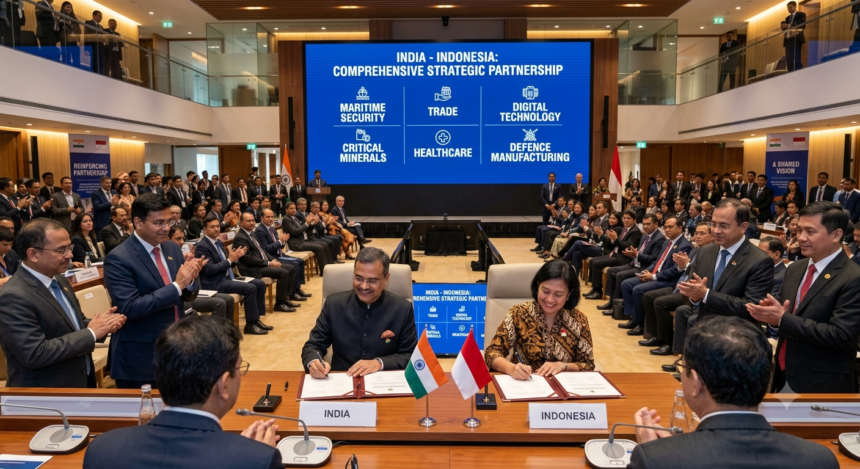
The Indonesia BrahMos deal marks one of India’s biggest defence export achievements in recent years, signalling a major strategic shift in the Indo-Pacific. India’s ambitions of becoming a global defence manufacturing powerhouse received a significant boost as Indonesia agreed to procure the BrahMos supersonic cruise missile during Prime Minister Narendra Modi’s official visit. It reflects a deepening strategic partnership between two major Indo-Pacific nations at a time when regional security dynamics are rapidly evolving. Alongside the missile agreement, both countries expanded cooperation across maritime security, trade, digital technology, critical minerals, and defence manufacturing, signalling that the relationship is entering an entirely new phase.
For India, the development reinforces years of efforts to transform from one of the world’s largest arms importers into a trusted exporter of advanced defence systems. Successive governments have invested heavily in domestic defence manufacturing under the ‘Make in India’ initiative, encouraging indigenous production and technological innovation. The BrahMos missile has emerged as the flagship symbol of that ambition. Already regarded as one of the fastest operational supersonic cruise missiles in the world, its growing international demand demonstrates increasing global confidence in India’s defence industry. Indonesia’s decision therefore carries significance well beyond bilateral relations, it showcases India’s ability to compete in a market traditionally dominated by established defence exporters.
The announcement also comes at a strategically sensitive moment for the Indo-Pacific region. Maritime security has become a defining issue as countries strengthen naval capabilities, diversify defence partnerships, and seek greater resilience against emerging geopolitical challenges. Situated along some of the world’s busiest sea lanes, both India and Indonesia recognise the importance of maintaining a free, open, and rules-based Indo-Pacific. The latest agreement reflects shared interests in safeguarding regional stability while expanding cooperation in areas extending beyond defence alone.
Official details of the bilateral agreements are available through the Prime Minister’s Office
If you’re following India’s growing diplomatic outreach in the Gulf and beyond, you can also read our related coverage:
Mukesh Ambani Meets Donald Trump and Qatar Emir in Doha
Why the Indonesia BrahMos Deal Is a Turning Point
The Indonesia BrahMos deal represents a milestone because it demonstrates how India’s foreign policy and defence strategy are increasingly working together. Defence exports are no longer viewed simply as commercial transactions; they have become instruments of strategic diplomacy. Countries purchasing advanced military equipment typically engage in long-term cooperation involving training, maintenance, technology support, joint exercises, and intelligence exchanges. As a result, the BrahMos agreement is expected to deepen institutional ties between the armed forces of both nations for years to come.
Indonesia occupies one of the most strategically significant geographical positions in the Indo-Pacific. The country sits astride several critical maritime chokepoints, including routes that connect the Indian Ocean with the Pacific Ocean. A substantial portion of global trade passes through these waters each year, making maritime stability a shared priority for regional powers. By strengthening defence cooperation with Indonesia, India reinforces its broader objective of promoting secure sea lanes while expanding partnerships with ASEAN countries that play increasingly important roles in regional security.
The agreement also aligns with India’s vision of becoming a reliable security partner for friendly nations rather than merely a purchaser of foreign military equipment. Over the past decade, New Delhi has expanded defence cooperation with countries across Southeast Asia, the Middle East, Africa, and Europe through joint military exercises, defence dialogues, capacity building, and equipment exports. The BrahMos sale is among the clearest examples yet of India’s transition from a defence consumer to a defence provider.
BrahMos: The Missile Behind India’s Defence Export Success
The centrepiece of the agreement is the BrahMos supersonic cruise missile, jointly developed by BrahMos Aerospace, an Indo-Russian joint venture. Renowned for its exceptional speed, precision, and versatility, the missile is capable of being launched from land, sea, and air platforms, making it one of the most flexible weapons systems currently available. Travelling at nearly three times the speed of sound, the BrahMos significantly reduces reaction time for potential adversaries while providing highly accurate strike capability against both land and naval targets.
For India’s defence sector, the missile has become much more than a technological achievement. It symbolises the country’s growing confidence in indigenous research, manufacturing, and export capabilities. Following the successful export of BrahMos systems to the Philippines, Indonesia’s decision further strengthens India’s reputation as a credible supplier of advanced defence technology. Industry experts believe the agreement could encourage additional interest from other countries seeking modern missile systems while diversifying defence procurement beyond traditional suppliers.
The expanding international acceptance of BrahMos also supports India’s broader defence industrial objectives. Increased exports create opportunities for domestic manufacturing, high-skilled employment, research and development, and greater private-sector participation in defence production. As India seeks to position itself among the world’s leading defence manufacturers, successful exports such as this serve both economic and strategic interests.
Beyond Missiles: A Partnership Expanding Across the Indo-Pacific
While the Indonesia BrahMos deal has understandably captured global attention, the bilateral relationship announced during Prime Minister Narendra Modi’s visit extends far beyond defence exports. India and Indonesia signed and discussed cooperation across trade, maritime security, digital transformation, energy, critical minerals, healthcare, and emerging technologies. Together, these initiatives indicate that both countries are pursuing a comprehensive strategic partnership rather than limiting cooperation to military matters.
Trade remains one of the strongest pillars of this relationship. Indonesia is India’s largest trading partner within ASEAN, while India has become an increasingly important destination for Indonesian exports, particularly coal, palm oil, and minerals. At the same time, Indian companies continue to expand investments in pharmaceuticals, information technology, infrastructure, and manufacturing across Southeast Asia. Leaders from both countries reiterated their commitment to increasing bilateral trade while encouraging greater private-sector collaboration in sectors that will define the global economy over the next decade.
Another major focus of the discussions was critical minerals, which have become indispensable for electric vehicles, semiconductor manufacturing, renewable energy technologies, and advanced electronics. As nations seek to diversify supply chains away from overdependence on a handful of suppliers, partnerships involving resource security are becoming central to economic diplomacy. Indonesia possesses some of the world’s largest reserves of nickel and other strategic minerals, making cooperation in this sector particularly significant for India’s clean energy ambitions and manufacturing ecosystem.
Maritime cooperation also featured prominently in bilateral discussions. As two major Indian Ocean nations, India and Indonesia share common interests in ensuring secure shipping routes, combating piracy, supporting humanitarian assistance and disaster relief, and maintaining freedom of navigation. Their geographical positions place them at the heart of the Indo-Pacific, where maritime trade continues to drive global commerce. Strengthening naval cooperation and information-sharing therefore serves not only national interests but also contributes to broader regional stability.
Official information on India’s bilateral engagement with Indonesia is available through the Ministry of External Affairs.
Why the Indo-Pacific Strategy Is Becoming Increasingly Important
The Indonesia BrahMos deal cannot be viewed in isolation from the broader geopolitical landscape. Over the past decade, the Indo-Pacific has emerged as one of the world’s most strategically significant regions, accounting for a substantial share of global trade, manufacturing, and maritime transportation. Countries across the region are strengthening defence capabilities while simultaneously expanding economic partnerships to safeguard critical supply chains and promote regional stability.
India’s Indo-Pacific strategy has consistently emphasised openness, inclusivity, respect for international law, and freedom of navigation. Rather than pursuing military alliances, New Delhi has focused on building trusted partnerships with countries that share similar interests in maintaining a stable regional order. Defence cooperation, joint naval exercises, technology partnerships, and infrastructure development have all become important components of this approach.
Indonesia occupies a uniquely important position within this framework. Its control over key maritime passages connecting the Indian and Pacific Oceans makes it indispensable to regional security and international trade. Deepening cooperation with Jakarta therefore strengthens India’s engagement with ASEAN while reinforcing its vision of a secure and prosperous Indo-Pacific. Analysts believe the BrahMos agreement also sends a broader message that India’s defence partnerships are increasingly based on long-term strategic trust rather than short-term commercial interests.
A Milestone for India’s Defence Industry
Beyond diplomacy, the Indonesia BrahMos deal represents a significant achievement for India’s domestic defence manufacturing ecosystem. For decades, India depended heavily on imported military equipment, making it one of the world’s largest defence importers. Recent policy reforms, however, have prioritised indigenous design, manufacturing, and exports under initiatives such as Make in India and Atmanirbhar Bharat. The objective has been not only to reduce dependence on foreign suppliers but also to establish India as a competitive exporter of advanced defence technologies.
Successful international sales such as BrahMos contribute directly to that vision. Defence exports stimulate investment in research and development, create highly skilled employment opportunities, encourage private-sector participation, and strengthen domestic industrial capabilities. They also enhance India’s credibility as a technology partner capable of supplying sophisticated military platforms that meet international standards.
Industry observers believe Indonesia’s procurement could encourage other Southeast Asian nations to explore similar partnerships as countries seek reliable defence suppliers capable of providing advanced technology, long-term maintenance support, and strategic cooperation. If additional agreements materialise, the BrahMos programme could become one of the defining success stories of India’s expanding defence export sector.
Conclusion
The Indonesia BrahMos deal is far more than another defence contract. It reflects India’s growing confidence as both a strategic partner and a global defence exporter at a time when the Indo-Pacific is becoming increasingly central to international politics and commerce. By combining defence cooperation with expanded engagement in trade, technology, maritime security, and critical minerals, India and Indonesia have laid the foundation for a partnership that extends well beyond military collaboration.
For New Delhi, the agreement reinforces years of investment in indigenous defence manufacturing while strengthening its position as a trusted partner in Southeast Asia. For Indonesia, it represents an opportunity to modernise defence capabilities while deepening ties with one of the region’s fastest-growing major economies. As geopolitical competition and economic transformation continue to reshape the Indo-Pacific, partnerships such as these are likely to play an increasingly important role in defining regional stability and long-term growth.