Introduction: Reality of online fraud in India
The Indian economy has been revolutionized by digital payments. The convenience has been taken to a new level, with the vendors on the street taking UPI and businesses operating solely online. But this quick adoption has brought about an equally quick-expanding threat space, online fraud.
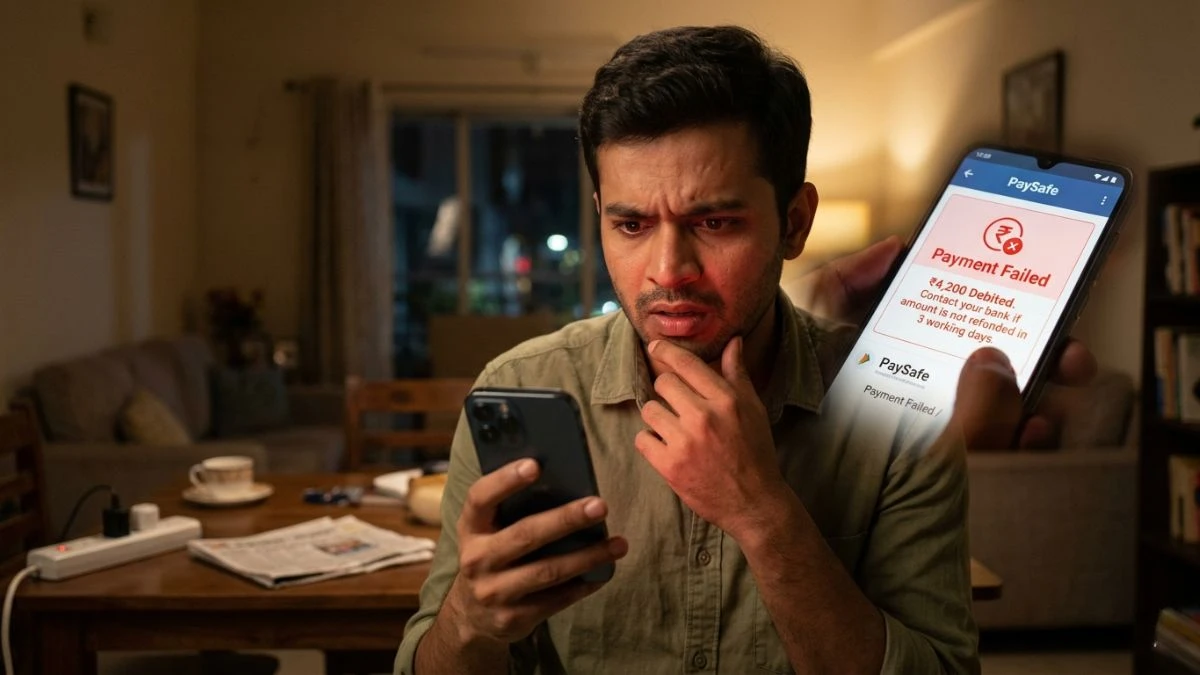
Thousands of Indians become victims of scams based on fake links, UPI requests, impersonation calls, and fraudulent investment platforms every day. The first effect is panic, confusion and the one question pressing:
Is it possible to get back online fraud money?
The answer is yes, but you need to do it fast, strategically and via the right channels. This is not merely a guide, but a recovery system of lost money from online fraud that will guide you, step by step, to the greatest likelihood of receiving all your money back.

Learning Online Fraud: Why It Is Harder to Recover
Online fraud is difficult to undo, before plunging into recovery, it is worth knowing why:
- Fraudsters transfer funds in real time to numerous accounts.
- Money is frequently taken out in a couple of minutes.
- Fake identities make tracing difficult
- Transactions across borders make jurisdiction difficult.
Nonetheless, India has developed an effective response mechanism that includes banks, law enforcement, and centralized reporting. Recovery can be highly feasible in the event that you act within the golden window (first few hours).
The Golden Hour: Speed is the Key to Recovery
Timing is of the essence in the response of cybersecurity incidents. When fraud occurs:
- The initial 30–60 minutes are crucial.
- Funds can be traced (within 2–3 hours).
- The probability of recovery decreases significantly after 24 hours.
Consider it a contest between you reporting the fraud and the scammer taking off with the money.
Step-by-Step Recovery Process (Action Blueprint)
Action 1: Dial Cybercrime Helpline (1930 Immediately)
The initial and the most important step is to call 1930, a special helpline in India that addresses cyber fraud.

When you call:
- Your complaint is registered in real time.
- Banks, which are concerned, are informed by the authorities.
- An application is made to freeze the account of the beneficiary.
Key Tip:
Never wait, though you may be uncertain. It is advisable to report a suspected fraud but not wait to be sure.
Step 2: Cybercrime Portal: Make a complaint
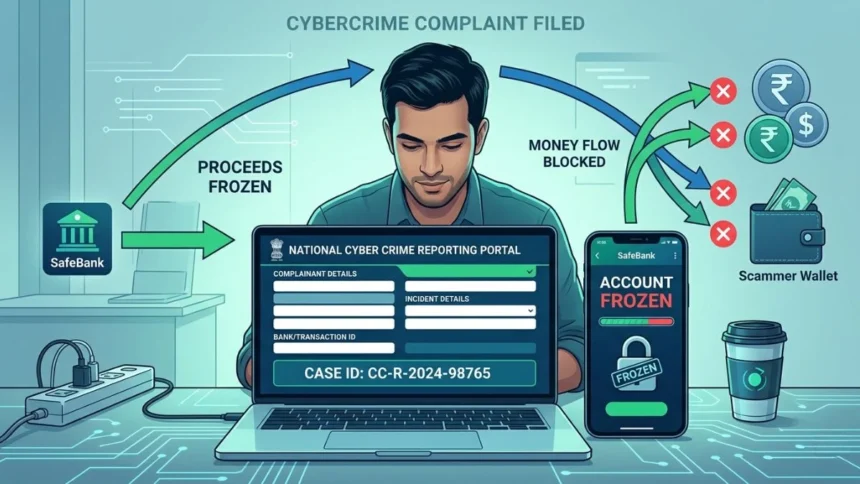
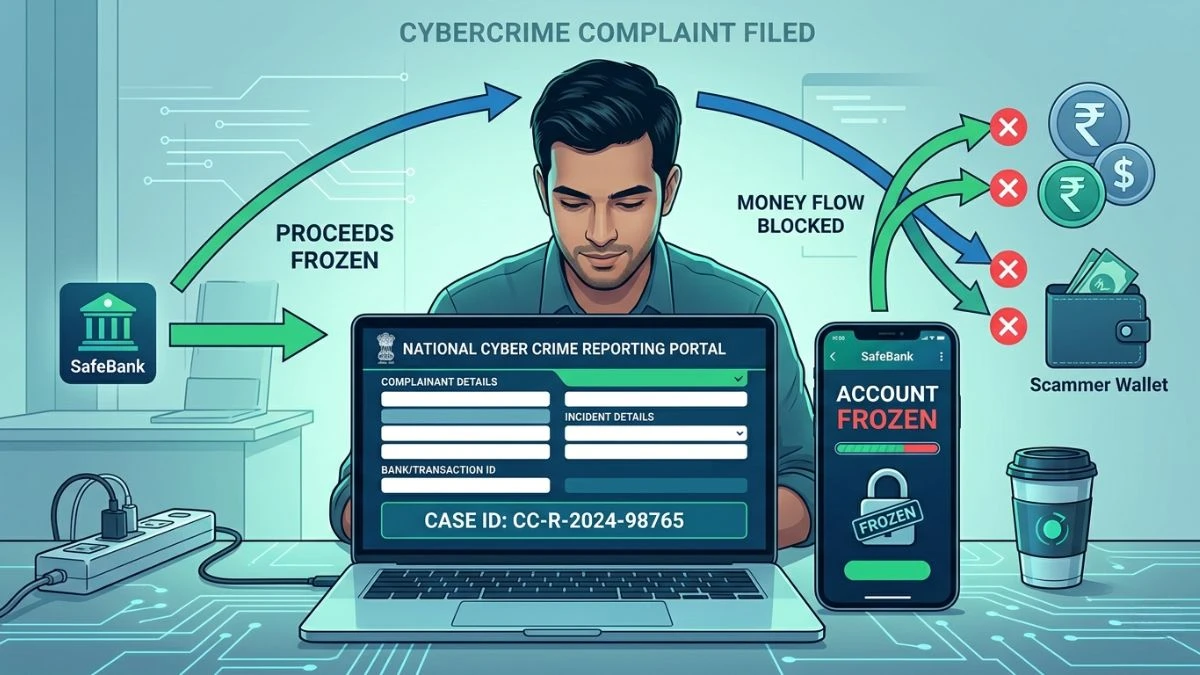
Then, file your case on the National Cyber Crime Reporting Portal.

Steps:
- Click on Report Financial Fraud.
- Enter transaction details
- Add evidence (messages, screenshots)
- Enter and save a complaint ID.
This forms a formal online record, which is necessary to both banks and the police.
Step 3: Notify Your Bank or Payment Service.
Call your bank or payment application. Key institutions include:
- State Bank of India
- HDFC Bank
- ICICI Bank
- Google Pay
- PhonePe
- Paytm
Ask for:
- Request to freeze account.
- Transaction tracking
- Chargeback initiation
- Complaint reference number
Pro Insight:
Banks do tend to respond more swiftly when you state that the complaint is already registered through 1930.
Step 4: Request Fund Freezing (Important Step)
This is the fundamental healing process.
When reported quickly:
- The account receiving is indicated.
- Funds are ordered to be frozen.
- Withdrawal is blocked
Recovery is much simpler when the money is still in the account.
Step 5: File an FIR (Larger Frauds)
In case of a large amount or a slow recovery:
- Go to your closest police station.
- Provide all documentation
- Order FIR based on cybercrime laws.
This enhances your case in court and fast-tracks investigation.
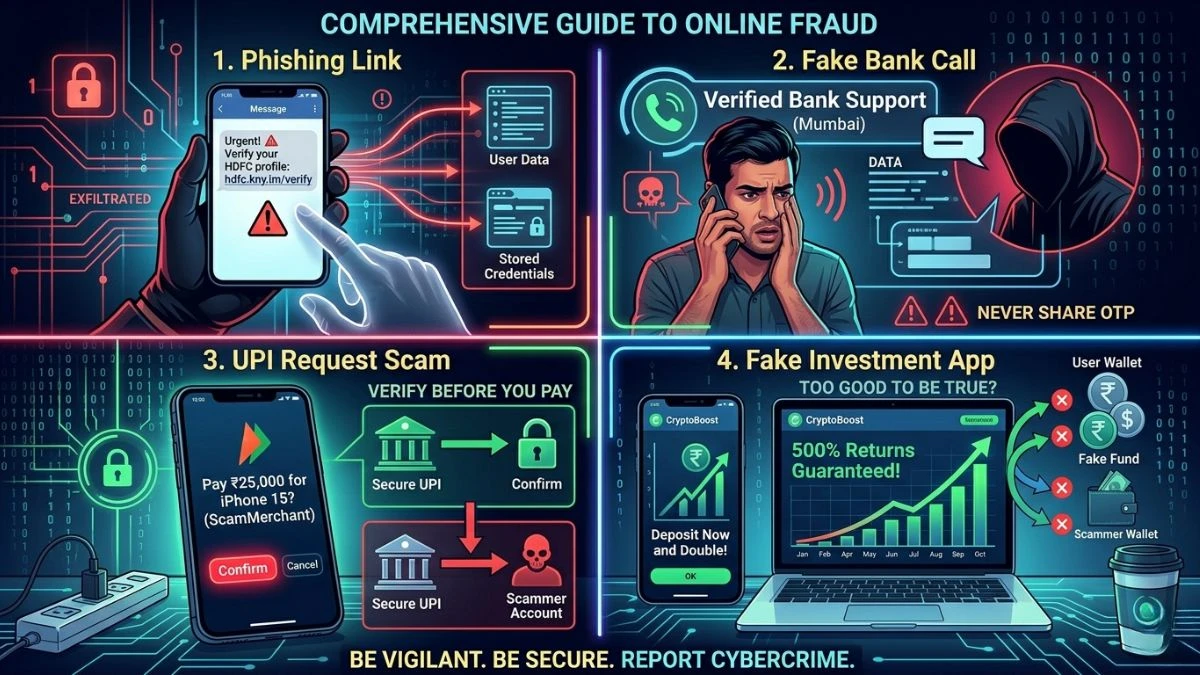
Online Fraud in India (And How They Work)
UPS Collect Request Scam.
Instead of payment, fraudsters send out a request.
Mistake: Victim agrees to believe that they are getting money.
2. Phishing Attacks
Fraud websites replicate banks or KYC portals.
Purpose: Rob a login or credit card information.
- OTP Fraud
Fraudsters use the identity of bank officials.
Trick: Fool you to give OTP.
4. Investment Scams
False trading applications offer large returns.
Fact: Money is lost after investment.
5. Job & Loan Scams
Processing fees are paid in advance by victims.
RBI Rules: Your Lawful Security
There are customer protection regulations established by the Reserve Bank of India.
Zero Liability
You have no responsibility in case:
- Fraud is due to bank negligence
- You report within a 3-day period
Limited Liability
If delayed:
- Limit on loss varies based on the type of account.
Resolution Timeline
Complaints should be addressed within 90 days by banks.
Documentation Checklist (Do This Properly)
Good documentation enhances recovery success.
Prepare:
- Transaction ID / UTR
- Bank statement
- Screenshots of fraud
- Call logs/messages
- Portal complaint ID.
- Identity proof (for FIR)
Timeline of recovery: Expectations.
| Stage | Time |
| Complaint registration | Immediate |
| Bank action | 24–48 hours |
| Fund freezing | 2–5 days |
| Investigation | 7–30 days |
| Final resolution | Up to 90 days |
Take An Example
Imagine this:
You are called by someone who states that he is your bank. They request you to confirm a transaction. You share OTP. ₹50,000 is debited instantly.
Within 1 hour, will you do:
- Call 1930
- The bank freezes the accounts of receivers.
- Money is likely recovered
When you do it later than 24 hours:
- Funds likely withdrawn
- Recovery becomes difficult
Complex Plans to enhance recovery opportunities.
1. Multi-Channel Reporting
Use:
- Helpline
- Portal
- Bank
Simultaneously.
2. Daily Follow-Ups
Do not think the system will solve itself.
3. Escalate If Needed
If bank delays:
- Contact Banking Ombudsman
- Raise complaint via RBI
4. Preserve Evidence
Never delete:
- Chats
- SMS
- Emails
Prevention Framework: Be Ahead of Fraudsters
Behavioral Rules
- Do not share OTP, PIN, CVV.
- Always confirm payment requests.
- Avoid unknown links
- Official apps should be used only.
Technical Measures
- Enable 2-factor authentication
- Install security updates
- Install antivirus on computers.
Financial Discipline
- Set transaction limits
- Make online payments using different accounts.
The Ugliness of Recovery.
Despite good systems, it is not possible to recover all the money.
Why?
- Money sent in and out of various accounts.
- Immediate ATM withdrawals
- International transfers
Nonetheless, early reporting has a drastic impact on the results.
Fraud Prevention Future in India
India is in the process of reinforcing its cybersecurity infrastructure:
- Artificial intelligence (AI) fraud detection systems.
- Real-time transaction monitoring
- Faster inter-bank coordination
This implies that recovery systems will be enhanced with time.

Conclusion
Online fraud is a bitter consequence of the digital era, and it does not imply that it is time to give up.
The recovery is based on three factors:
- Speed
- Accuracy
- Persistence
Take action, go through channels and chase it to the end. One right move and you are likely to have a good chance at recovering your money.
FAQs
1. Am I able to reclaim money lost in online fraud in India?
Yes, particularly by putting it through immediately before 1930 and your bank.
2. How do we report fraud as quickly as possible?
Dialing 1930 is the quickest way.
3. Is FIR necessary?
Not always, but recommended for large amounts.
4. What is the recovery time?
Typically between 15 to 90 days.
5. Can banks repudiate?
Only in case of negligence on the side of the customer.
Final CTA
Do it now in case you or a loved one fell victim to online fraud. Every second matters.
Keep on the news, keep on the lookout, and continue to read The Vue Times because of the real world, practically oriented cybersecurity knowledge that does do something.