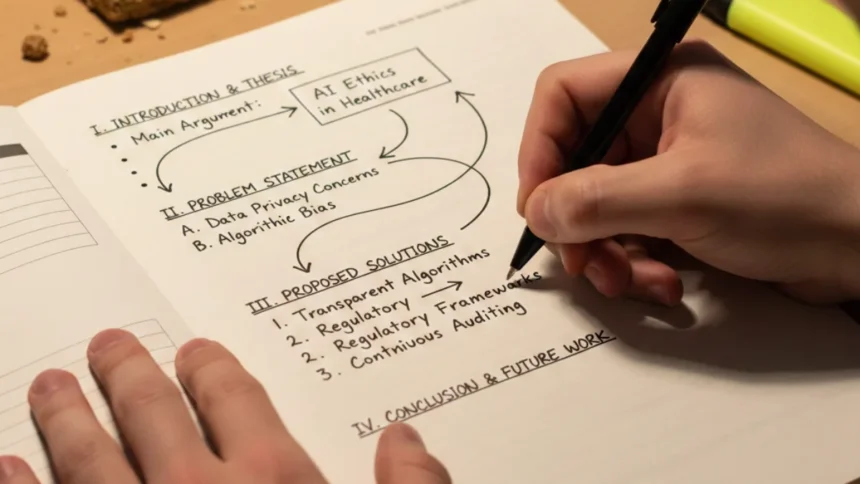
Why this topic matters in today’s exams
Across examination systems, something important has changed. Questions may look similar and the syllabus may feel the same, but results often surprise students. Many write correct answers with proper terms and neat presentation, yet their marks do not match their effort. The real issue is not lack of knowledge, but lack of clear structure. Modern exams are checked under time pressure, so examiners look for answers that show relevance, logic, and clear prioritisation. Students usually focus on collecting more content, not organising it well. Without proper structure, even good knowledge becomes crowded, unclear, and harder for evaluators to reward fairly.
How examiners actually think about this area
Think about how examiners actually read your answers – it’s often quite different from how you write them. They’re not really trying to soak up everything you know. Instead, they’re quickly scanning your work for specific signals.
Basically, when they’re evaluating, they make a few quick decisions right off the bat:
- Did the candidate actually answer what was being asked
- Is there a clear line of thinking or argument presented?
- Does the answer really back up the grade or mark it’s aiming for?
Using a good structure makes these initial judgments much easier for the examiner. From their point of view, a well-organized answer is less mentally taxing. Things like headings, a logical flow, and clear transitions act like signposts, showing the examiner that you understand not just the topic itself, but also what the question was actually asking for.

Remember, exam questions are usually designed to test your ability to discriminate and select important information, not just recall facts from memory. They often include more potential points than you actually need to cover. The examiner’s job is to reward how well you choose and organize the relevant information, not whether you’ve listed absolutely everything possible.
This is why two answers with similar information can end up with very different marks. One might present those ideas in a logical order that directly addresses the question. The other might just list the same points or tell a story without any clear structure or hierarchy.
So, in a way, the structure of your answer is evidence of your thinking process. The content itself just shows you’ve been exposed to the material.
How the same concept appears across different papers
The importance of structure does not belong to any one format. It appears everywhere, though in different disguises.
Essay-style questions

You can really see the structure here. The introductions clearly outline what the essay will cover. The body paragraphs then develop the main points. Finally, the conclusions wrap things up neatly. Examiners are always looking for balance, smooth transitions, and relevance. An essay with a solid structure can still be good even if it has a few small factual errors, but a paper packed with information won’t cut it if it’s poorly organized.
Objective or short-answer formats
Even when you’ve got a strict word count to stick to, how you organize your thoughts still counts. You’ll do better by starting with a quick definition and then jumping straight to the main takeaway, rather than trying to cram everything into one rambling sentence. Examiners really appreciate it when you lead with the most important point right off the bat.

Case-based questions
These tests really put your judgment to the test. It’s all about the structure—how you organize your thoughts determines whether your analysis comes across as clear and logical or all over the place. Pinpointing the main problem, using a solid framework to tackle it, and reaching a well-reasoned conclusion is far more valuable than just rattling off every single angle you can think of.
Interviews or personality assessments
Structure here is all about showing clear thinking. Answers that smoothly go from the background info, to the logic, and then to the final point come across as trustworthy. Even if a response has good insights, if it’s all over the place, it feels unsure. No matter the format, having a solid structure helps bridge the gap between what you’re thinking and what the person grading it can understand.
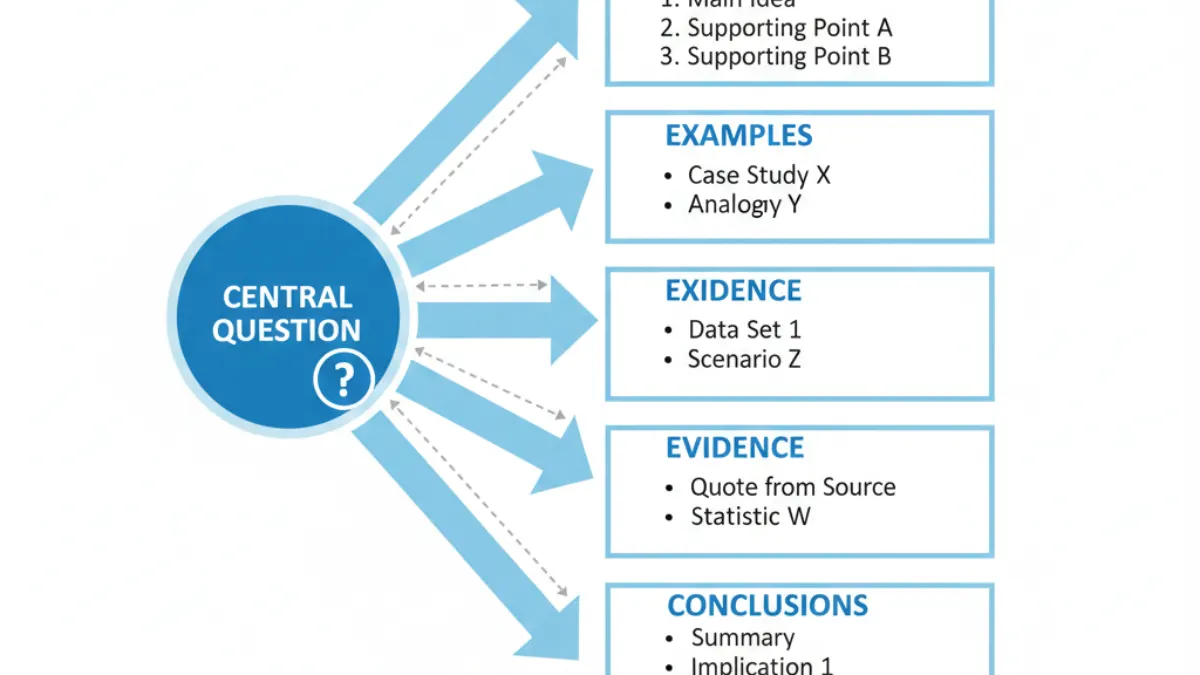
Where most students go wrong
Most mistakes here are not due to negligence. They stem from understandable misunderstandings.
Equating completeness with quality
A lot of students think that adding more points will make their answers safer or more complete. Unfortunately, this often results in overly packed responses where the main ideas get lost in the shuffle
Writing while thinking
Plus, many students only figure out what they really want to argue partway through writing their answer. This tends to create uneven, repetitive, and sometimes only loosely relevant responses.
Ignoring question hierarchy
Not all parts of a question are equally important. Without a clear structure, students tend to give every aspect the same amount of attention. You might tell a story that flows well, but it can still be missing the kind of logical structure that really counts. Examiners are looking for the steps of your reasoning, not just a good narrative.
Confusing flow with logic
These mistakes keep happening because feedback often doesn’t point them out directly. Students might get comments like “be clearer” or “focus more,” but they aren’t necessarily shown that what’s missing is the overall structure to tie it all together.
How toppers approach this differently
Top students don’t always know more facts than others. Instead, they’re really good at managing and using the knowledge they *do* have.
Their way of thinking is quite focused. They pinpoint exactly what the question is asking before they start dredging up information.
You can see this in how they shape their answers. They put a much higher value on relevance than trying to cover everything. Each paragraph serves a specific purpose.
Their choices are very strategic. They consciously decide what information to leave out, and this is a key part of what makes their answers effective. Getting the structure right is just as much about knowing what to exclude as it is about including the right things.
Interestingly, you can spot this method even in answers that aren’t particularly long. The real difference isn’t the amount they write, but rather the order they present things in and the emphasis they place on certain points.
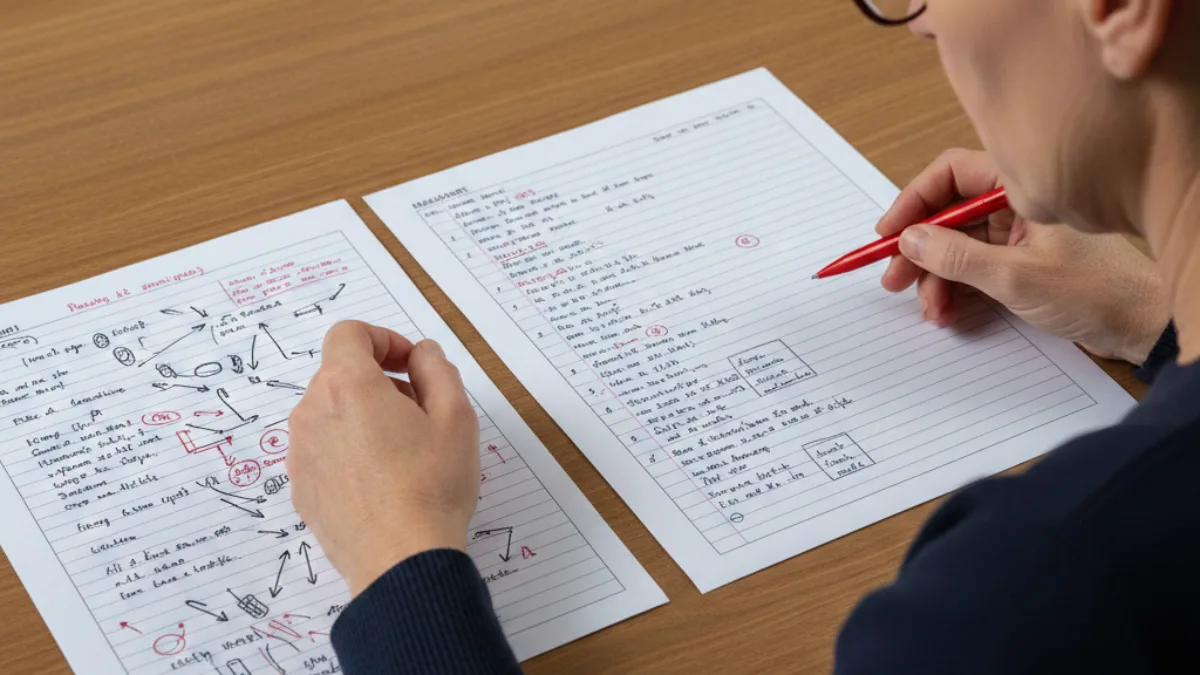
A practical framework students can reuse
Structure can be practiced deliberately. The following framework is simple and adaptable.
Identify the decision the examiner must make
Ask: what judgment is this question inviting?
Select 2–4 core points
More than this dilutes focus.
Order points logically
From definition to implication, cause to effect, or general to specific.
Allocate space intentionally
Spend more words on higher-value points.
Signal structure explicitly
Use brief headings, numbering, or transitions.
This framework works across subjects because it is about thinking, not content.
How this way of thinking helps beyond exams
Structured thinking really clears things up, even when it’s not about test answers.
When it comes to making decisions, it’s great for filtering out what doesn’t matter so you can focus on what does.
In writing, it helps build trust with your readers.
When communicating, it cuts down on those frustrating misunderstandings.
Students who get comfortable with structure often find that explaining things becomes smoother, not more difficult. Their minds feel less crowded because their ideas have a clear home.
This isn’t about being stiff or inflexible. It’s all about making sense.
If you’re curious to dive deeper into how we think and evaluate, you might want to check out The Vue Times. They look at exam questions from the perspective of the person grading them.
More Read

Final takeaway
What you know comes through in the content of your work. How you put your ideas together reveals your thought process.
Tests are placing more emphasis on the latter because it’s harder to fake a genuine way of thinking, and it’s simpler to assess. If you feel like you’re putting in the effort and really know the material, but your results aren’t reflecting that, the problem might not be your effort or knowledge. Perhaps the way you think just isn’t showing up clearly on the paper.
Making your structure obvious isn’t an additional chore; it’s the crucial link connecting all your preparation to how well you actually perform
FAQs
Is this approach useful across different exams?
Yes. Because it focuses on thinking and organisation, it applies wherever answers are evaluated by humans.
Can this help students who feel stuck despite regular study?
Often, yes. Many plateaus are structural, not informational.
Why do correct answers still score poorly?
Because correctness without prioritisation is hard to evaluate quickly.
How long does it take to see improvement using this approach?
Some students notice changes within a few tests once structure is practiced consciously.
Can beginners apply this way of thinking?
Absolutely. In fact, early adoption prevents bad habits from forming.