

The Importance of This Question (Why Laws In India Look Strong on Paper but Fail on the Street) at This Point in Time
Today India boasts of one of the most elaborate legal frameworks in the world. With constitutional rights guarantees and progressive criminal statutes, industry-specific legislation addressing labour, the environment, finance, and online, intelligent readers might see themselves in the country legislation as rights-centred and up-to-date. India, on paper, is very well prepared in a bid to manage most of its most persistent social and economic problems.
However, in the street, where citizens come into contact with the state in the form of police stations, courts, municipal offices, and regulatory bodies, the experience often is of a different nature. Protective laws do not prevent abuse. Rules that are supposed to create safety, fairness or accountability are not equally applied. Justice is postponed, watered down, or unattainable by a significant portion of the population.
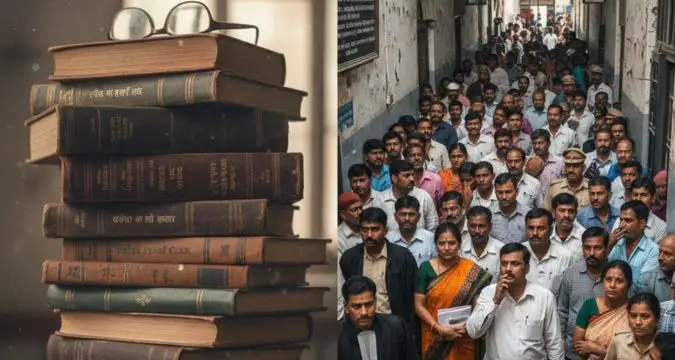
Such is not the first instance of incompatibility of legal desire with lived reality. The only difference is the magnitude with which it is being challenged. Even as the pace of law making increases, court backlogs are increasing. Both high profile and daily impunity coexist. On the one hand, there are digital transparency tools, and on the other hand, there is informal power structure. A combination of these signals is the indication of a structural trend instead of single failures.
The article looks at the reasons why the laws in India look strong on paper but fail on the street, is anything in the relationship changing and which factors are gaining momentum to reform or reduce the pace of meaningful reform.

Pattern: The Strong Statutes, Weak Translation
The core problem identified concerning this matter is that there has always been a trend of creating laws faster than implementing them.
The laws made in India have grown more susceptible to social pressure, courtroom suggestions, and international standards. Laws which conform to the constitutional values and international standards are passed routinely in parliament and state assemblies. Anyone who tries to implement such laws, however, is submerged into a new ecosystem of implementation with limited capacities, institutional fragmentation, and skewed incentives.
What does come about is not complete failure, but partial performance, laws that play in certain situations but fail in a systematic way in others.
The prominent features of this trend are:
- Law drafting of high quality, bleak enforcement of low quality.
- Courts being on the attack, administrative inertia.
- Operational weakness, policy ambition.
To grasp the reason why this occurs we must analyze not just individual laws but rather examine the machine that is intended to propel them along.
Historical Background: A Tradition of Rulebook Government
The laws in India were based on control and administration and not the delivery of mass services to the people. The colonial era laws focused more on order, revenue-gathering and obedience, frequently through a centralised bureaucracy which was not answerable to the citizens.

The reforms after Independence broadened the rights and welfare requirements but did not change the administrative spine to a great extent. With time, the legal system expanded, and the mechanism used to enforce the law failed to keep up with such expansion.
A number of historical aspects continue to influence results nowadays:
- Excess centralisation of decision-making, restricted on-the-job flexibility.
- The generalist bureaucracy which was supposed to implement intricate, specialised legislations.
- The administrative risk, on non-enforcement, is low in comparison with the administrative risk, on action, which is high.
Such institutional characteristics facilitate enactment of laws compared to the application of the law.
What Is Changing Now: The New Strain on the Old System
Observing three intersecting changes, the implementation gap experienced a more direct challenge in the last few years.

Volume and Velocity of Lawmaking
There is an acceleration of law drafting and law amendment in India. Criminal codes are being restructured. Labour laws consolidated. Electronic and information laws came in place. Each new statute requires:
- Training of officials
- Updated procedures
- Budgetary support
- Public awareness
Practically, most laws are implemented without these preconditions being in their entirety, amounting to confusion and biased action.
Increased Public Sensitivity and Expectation
Present citizens are more conscious of their rights in law than the earlier generations. Social media, litigation at interest, and investigative journalism have reduced the height of scrutiny. This has two effects:
- More pressure on institutions to do.
- Increased publicity on enforcement failures.
The disconnection is now so plainly apparent when the laws on the street fail, politically to the point of cost.
Judicial Load Judicial Capacity
The need to enforce rights that may be unattainable to the administration system has made courts center stage. But judicial capacity has not increased in the same proportion.
India continues to face:
- Severe judge shortages
- Mounting case pendency
- Procedural delays
When courts become more responsible, there is more delay, which further undermines deterrence and compliance.

The Enforcement Bottleneck: Where Things Fall Apart
In order to comprehend the issue of failure of strong laws, it is essential to trace down where enforcement usually drops.
First-Point Enforcement and Police.
In both crime and regulation legislation, the starting point of law enforcement is usually frontline personnel. In this case, there are several dangers that coincide:
- Workload stress and understaffing.
- Poor practices in training on new laws.
- Processes susceptible to influence in discretion.
- Political and social compulsion.
Even the statutes that are well-written require proper registration of the cases, proper investigation, and proper action after which is often compromised.
Regulation Agents and Inspectors
It enforces areas like environment, labour and consumer protection where regulators are presupposed to review compliance in huge jurisdictions.
Common constraints include:
- The shortage of manpower in comparison with scale.
- Use of old systems based on paper.
- Competing requirements in between growth and regulation.
This makes enforcement reactive and not preventative.
Drift in Local Administration and Implementation.
Numerous laws need district-level authorities to implement them. In the course of time. priorities change, the instruction is watered down, chains of accountability are weakened. Legally, the laws are still in existence but they are inoperative.
Statistics Are pointing in the right direction
There are a few things that can be measured and support the idea that it is not anecdotal but a systemic issue.
- There is also an increasing case pendency on courts which indicates delays in enforcement.
- The low conviction rates in a high number of categories decrease deterrence.
- Audit reports put poor performance of statutory schemes on many occasions under examination.
- Formal regulations do not stop compliance gaps.
A combination of these indicators can help to propose that the bottleneck is not in law design but in the ecosystem to execute.
Industry and Institutional behaviour: adapting to Weak Enforcement.
In the long run, citizens and institutions change towards realities of enforcement.
- Enforcement inconsistency is a risk in calculation of businesses.
- The people on the ground use informal mediation instead of lawful solutions.
- Administrators focus on paper work compliance as opposed to result based enforcement.
This is a self-fulfilling cycle, as low levels of enforcement result in low expectations, which lowers reform pressure.
Misconceptions Often Made to Blur the Picture
“India Needs More Laws”
Laws exist in lots of areas, but in lots of areas, India lacks operational follow through. Institutions that are not reinforced with more statutes tend to make matters more complicated.
Courts Will Iron Out Implementation.
Courts cannot replace day-to-day governance because particular inadequacies can be corrected by judicial intervention. The system is further slowed by over-use of litigation.
“The Problem Is Awareness”
Even though public awareness is important, it cannot break capacity limitations, incentive misalignment, or bottlenecks created by procedures.
The Importance of This to Everyday Life
This gap has factual implications:
- Regulations on safety do not help to avoid accidents.
- Informal workers are not afforded labour protections.
- The environmental laws are finding it hard to contain local violations.
- Inequality in social justice laws provides unequal consequences.
It is not an abstract debate on governance to the readers. It defines confidence in institutions, economic certainty and social security.
Driving forces: These factors increase change through the individual and societal level
In spite of these adversities, there are a number of trends mounting pressure in terms of improvement.
- Record digitisation and process digitisation.
- The use of performance-based surveillance in certain departments.
- Exposure and transparency wikis.
- Interstate comparative benchmarking.
They are not components that wipe out structural problems but only make the issues accountable.
Slowing Forces The forces that Slow Down the Transition
Meanwhile, there is still opposition:
- Institutional inertia
- Apprehension of being sacked.
- Political interference in implementation.
- Uneven state capacity
Without being able to deal with these limitations, reforms will be superficial.

Recommended on Trend following: Signals of Real Momentum
The readers interested in monitoring the change in this trend should pay attention to:
- Investments on enforcement capacity, but not lawmaking.
- Streamlining of the process and new laws.
- A reduction of pendency and reduction of compliance gaps.
- Coordination of incentives among frontline officials.
These are more signals than the declaration of new laws.
Report on Trend’s Current Status
The law system of India has not collapsed due to weak laws. It is in tension since the systems intended to translate those laws in everyday life have not changed at the same rate. The present time is characterized by increased conscious efforts about this disparity, pushed by the presence of data, judicial pressure, and social criticism.
The question of whether or not this will result in any lasting change will remain based on the shifting priorities towards both institutional implementation and legislative ambition.
More Read

Frequently Asked Questions
What is it about this issue that is generating so much attention?
This gap has been decades old, yet there is increased awareness among people, digital transparency, and information about the failures to enforce, thus making it a more difficult gap to overlook. Without the corresponding capacity, legal reforms have enhanced the opposition between promise and performance.
Does this imply that the laws of India are ineffective?
Not entirely. There are numerous laws that operate in certain contexts or areas. The problem is haphazard implementation, disparate capacity, and insufficient execution as opposed to incorrect legal intent.
Does technology in itself resolve the issue of enforcement?
Technology assists in tracking and transparency but cannot substitute training personnel, clear incentives and institute accountability. Digital tools do not provide solutions but enable solutions.
What are the impacts on the economic and social outcomes?
Enforcement improbably compliance costs, deterrence, raises compliance costs, and lowers trust. And in the long term, it impacts the choices of investments, social justice provision, and trust in the institutions among citizens.
What is showing the true difference in improvement in future?
The most obvious signs of improvement would be maintained investment in enforcement capacity and procedural simplicity, as well as improvement in measured outcome improvements and not simply the introduction of a new law.
The Vue Times published this article, providing background on the headline.



