
Why confidence drops despite regular study explains the hidden thinking gaps students miss, how examiners frame questions, and how learners can regain clarity and trust their preparation without increasing study hours.
Why this topic matters in today’s exams
Lately, it seems like a familiar situation is cropping up in competitive exams. Students are hitting the books consistently, finishing their syllabi, and tackling mock tests. But here’s the twist: their confidence is taking a hit, not all at once, but slowly and almost without them noticing.
It’s not that they’re slacking off. The problem lies in the gap between what regular studying achieves and what these exams are increasingly asking for. Today’s exams aren’t just about remembering facts or covering material. They’re testing a student’s ability to make smart choices when things are tricky—like when information is incomplete, questions are complex, and the expectations aren’t spelled out clearly.
At the same time, whenever people talk about performance—whether it’s in school, job applications, or evaluating institutions—they keep emphasizing “application,” “clarity,” and “decision-making.” You hear these terms all the time, but rarely does anyone actually break them down for students.

- This leaves many students feeling a particular kind of confused:
- They know they’ve put in the study time.
- They can usually spot the questions they’ve seen before.
- But they still feel hesitant when it’s time to answer.
- And once the exam is over, they’re left wondering exactly where they went wrong.
Confidence tends to dip not because students aren’t prepared, but because what they’ve studied doesn’t always come across smoothly when they’re actually taking the exam. This mismatch is especially significant now, since exams aren’t as lenient about minor errors anymore. Nowadays, a student feels confident when there’s a strong connection between their way of thinking and the way the exam expects them to express those thoughts on paper.
How examiners actually think about this area
When an examiner looks at a student’s performance, they don’t really see confidence as a feeling. Instead, they notice clear patterns in how the student approaches the work.
Examiners don’t focus on whether a student feels anxious or unsure. What they notice are the actual results: things like answers that lack a clear structure, explanations that go into too much detail on simple points, avoiding making any firm judgment, or giving responses that are safe but not very deep.
When examiners create their questions, they aren’t just wondering if the student studied the material. They’re really asking, “Can this student take a clear stand and defend it, even with limited space, time, and clues?”
The questions are often designed to test how well a student handles situations that might make them uncertain. This can include questions with wording that’s a bit unclear, prompts that have several layers, or questions that could be answered in multiple ways but really reward one well-thought-out approach. This is all on purpose.

- Examiners expect a student who’s well-prepared to be able to:
- Figure out what’s most important versus what’s less relevant.
- Know what to leave out of their answer.
- Stick to their reasoning without having to over-explain every single step.
When a student lacks confidence, their answers often seem defensive. They try to cover all their bases to avoid losing points, instead of aiming for a clear and direct answer. Examiners see this as a lack of control, not a lack of understanding.
It’s really important to understand that examiners aren’t looking for bold or reckless answers. They’re looking for clear thinking even when things feel stressful. To them, confidence is simply the ability to move forward with an answer without constantly second-guessing whether what you’re saying is “okay.”
How the same concept appears across different papers
Essay-style questions
In longer answers, a lack of confidence often shows up as too much setup. Students spend way too much time laying the groundwork and not enough time getting to the main point. The examiner can spot this when:

- The main argument comes too late
- There are multiple attempts to introduce the topic within the same response
- The conclusion just repeats basic information
The problem isn’t usually about what the student knows—it’s about hesitation in deciding what’s most important to emphasize.
Objective or short-answer formats
For objective or short-answer questions, confidence issues tend to manifest as second-guessing. Students often:
- Keep changing their answers
- Overcomplicate simple reasoning
- Worry about hidden tricks that aren’t actually there
Examiners create these types of questions with the understanding that clear thinking is more valuable than being overly clever. But when confidence wavers, students end up doubting their initial, correct instincts.
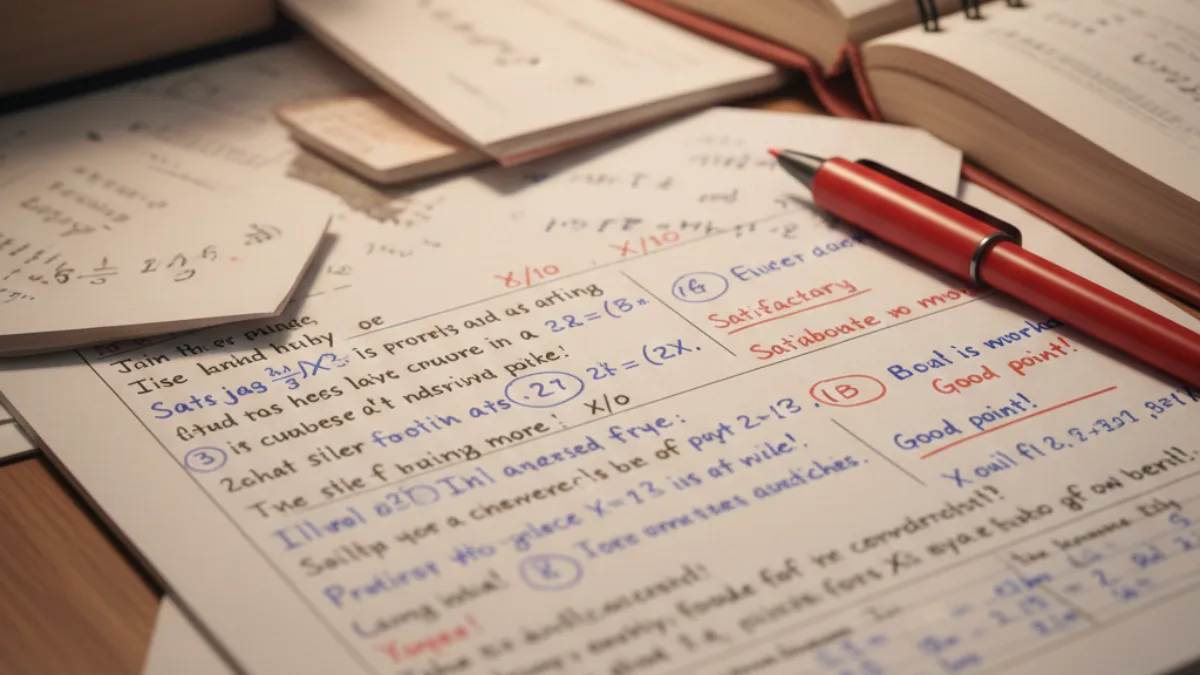
Case-based questions
Case questions really put a student’s practical confidence to the test. Often, students grasp the underlying concepts just fine, but they struggle to connect those ideas to the specific details of the case. Some common pitfalls include:
- Just listing out a bunch of potential solutions without actually picking one to focus on.
- Talking about theoretical frameworks without showing how they can be applied to the situation.
- Trying to avoid making tough choices between different options.
Keep in mind, the examiners are much more interested in seeing how you make a decision and justify it, rather than just showing you’re aware of all the possible options.
Interviews or personality assessments
Here, dips in confidence become noticeable when things aren’t quite consistent.
Students tend to:
- Fixate on correcting their earlier answers.
- Change their minds partway through their response.
- Seems uncertain about the reasoning they’ve already laid out.
Keep in mind, the panels aren’t grading whether the candidate’s views are right or wrong. They’re simply watching to see if the candidate genuinely trusts and sticks with their own thought process.
Where most students go wrong
Equating regular study with exam readiness
Studying regularly helps you get comfortable with the material. Come exam time, knowing what to focus on is key.
Many students believe that the more they learn, the more confident they should feel. When that confidence doesn’t come naturally, they often feel like something’s wrong with them, instead of questioning that belief.
Treating doubt as a sign of weakness
Doubt is natural in complex questions. But students interpret doubt as failure and respond by either over-writing or withdrawing.
Examiners expect controlled uncertainty—not its absence.
Over-valuing completeness
It’s perfectly normal to feel unsure when tackling tricky questions. However, students often see doubt as a sign they’ve failed, leading them to either write way too much or simply give up and stop trying.
What examiners are really looking for is a balanced approach to uncertainty, not absolute certainty. Many students attempt to cover their bases by trying to include “everything,” but this just waters down their answer.
True confidence during an exam often means knowing what to leave out—showing that you can be selective and concise.
Confusing calm presentation with certainty of content
You know, some students write really well—clear, neat, and easy to follow—but they just don’t commit to a clear point of view. It almost feels like they’re playing it safe, but in reality, they often end up scoring quite low.
The issue isn’t really how they express themselves; it’s more about a lack of solid judgment or a clear take on the topic.
This tends to happen because students aren’t usually taught how to gauge and convey confidence in their arguments. Instead, the focus is almost entirely on what’s factually correct.
How toppers approach this differently
Toppers are not free from doubt. They relate to it differently.
Thinking style
They treat uncertainty as a normal condition, not a personal flaw. This allows them to keep thinking instead of freezing.
Answer framing
Their answers move early toward a position. Even if the position is nuanced, it is visible.
They do not attempt to pre-empt every objection.
Prioritisation
- They make sure to hit the main point the question is asking for.
- They back it up with one or two really solid supporting points.
- They prioritize a clear, logical flow over trying to cover every single detail.
- This gives the impression of being confident because their answers are well-structured and move smoothly from one idea to the next.
Crucially, these top performers aren’t necessarily more confident beforehand. They come across as confident during the evaluation because their thought process matches how the answers are expected to be presented.
A practical framework students can reuse
The “Decide–Support–Limit” Model
Step 1: Decide
Before writing, ask:
- What is the main decision this question is asking me to make?
Write one sentence in your mind. This anchors confidence.
Step 2: Support
Choose only the most relevant support:
- One example
- One implication
- One contrast
Avoid piling.
Step 3: Limit
Consciously exclude:
- Secondary facts
- Defensive explanations
- Unused frameworks
Limitation is not risk. It is clarity.
This framework works across subjects because it mirrors examiner evaluation logic: decision first, reasoning next, restraint throughout.
How this way of thinking helps beyond exams
This method helps you feel more at ease when you don’t have all the details. It’s useful for more than just tests—it also helps you with:
- Writing clearly in a professional setting
- Making organized decisions
- Speaking up without constantly apologizing
- Calmly handling disagreements
When it comes to confidence in this context, it’s not about being forceful. It’s about inner consistency—truly understanding the reasoning behind your choices. This is definitely a skill you can carry over into other areas.

Final takeaway
Confidence drops despite regular study because exams are not measuring effort. They are measuring judgment under constraints.
When students understand that confidence is something examiners infer from structure, choice, and restraint—not emotion—the confusion begins to lift.
Nothing extra needs to be added. Something unnecessary needs to be removed.
Clarity follows.
More Read

FAQs
Is this approach useful across different exams?
Yes. Because it focuses on how decisions are presented, not on subject-specific content.
Can this help students who feel stuck despite regular study?
It often helps such students most, because their issue is translation, not preparation.
Why do correct answers still score poorly sometimes?
Because correctness without prioritisation can appear directionless to an evaluator.
How long does it take to see improvement using this approach?
Usually within a few answer-writing attempts, once the thinking shift is internalised.
Can beginners apply this way of thinking?
Yes. In fact, it can prevent early formation of unhelpful habits.
Internal reference: Readers exploring similar examiner-focused analysis may find related discussions on The Vue Times helpful when reflecting on answer evaluation patterns.