
Why this topic matters in today’s exams
You know, the most dedicated students definitely do read the syllabus. Lots of them even give it more than one look, and some go so far as to mark it up, compare it to past assignments, and keep track of which topics keep coming up. But here’s the thing: year after year, we see the same old pattern play out. Students leave the exam room feeling like the questions were “out of left field,” “tricky,” or “totally off the syllabus,” even when those questions were actually right there in the material.
This gap between the syllabus and the exam experience has really started to show itself more in recent times. These days, exams across all sorts of subjects are increasingly about testing your judgment, interpretation, and ability to prioritize, rather than just how much you can remember. You’ve got all these big-picture things happening—public debates, policy talks, economic changes, tech advancements, and all the complexities of society—they’re all pushing the folks who make the exams to see if candidates can actually *use* what they’ve learned, not just if they’ve heard of it before. In this new light, the syllabus isn’t really a guidebook anymore; it’s more like a boundary.
The trouble isn’t that students are ignoring the syllabus. The real issue is that many see it as just a checklist of topics they need to get through, instead of a set of tools or a framework for understanding the subject matter. They focus on what’s *included* in the syllabus, but they miss the whole point of how they’re supposed to actually engage with and apply that information.
How examiners actually think about this area
Examiners don’t start by asking, “Which chapter does this question come from?” Their thinking process begins quite differently.

Essentially, examiners are tackling three key challenges all at once:
- How to tell apart different levels of understanding.
- How to test if students can apply their knowledge, without making the questions too vague.
- How to be fair while still picking out the strongest candidates.
The syllabus helps them decide what topics to cover, not how to structure the exam questions. Within those topics, they look for points where a student really has to think: deciding what’s truly important, what needs to be addressed first, and what can be left out.
This is where many students get confused about the syllabus. They see it as a simple list of things to learn. But examiners see it as a set of guidelines for thinking. The syllabus tells the examiner what kind of logical reasoning they can reasonably expect from a student.
When examiners write a question, they’re rarely checking if the student has simply “covered” a topic. Instead, they’re testing whether the student can:
- Figure out which part of the topic actually matters for that specific question.
- Ignore information that’s related but not needed.
- Use their knowledge effectively within the time and format of the exam.
This is why exam questions often feel a bit indirect. They aren’t meant to be tricky puzzles, but they are designed to force students to prioritise their knowledge. If a question could be answered just by listing everything you know about a subject, it wouldn’t be doing its job properly.

In short, examiners aren’t really asking, “Do you know this stuff?” They’re asking, “Okay, you know this stuff, but can you use it effectively when you’re under pressure?”
How the same concept appears across different papers
A great way to see what students are missing is to look at how they handle the same core expectation across different types of questions.
Essay-style questions
No longer answers, the syllabus topic usually serves as a starting point, not the end goal. The examiner wants to see:
– How the student defines the problem.

– What framework they’re using, even if it’s not explicitly stated.
– Whether their argument builds up logically or just lists points.
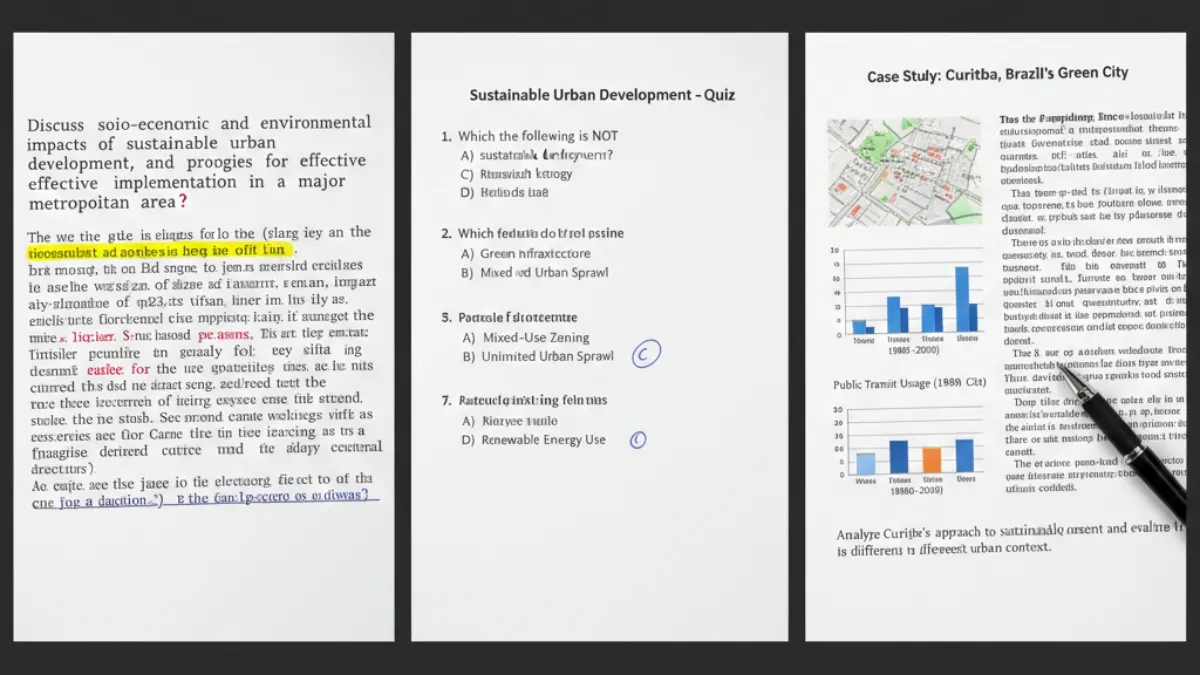
Students who don’t quite get the point often write correct but unfocused essays. They see it as a chance to show off what they know rather than to make a clear argument. The syllabus gives them the topic, but the question asks for their position.
Objective or short-answer formats
Here, the same conceptual misunderstanding shows up differently. Students focus on memorised statements without evaluating whether those statements answer the specific prompt.
The examiner is testing precision, not memory. The correct option or short response often depends on identifying a condition, limitation, or implication embedded in the question.
Reading the syllabus does not automatically train this skill.
Case-based questions
These formats really highlight where students struggle. Even when all the necessary information is right there, they still find it tough.
Why? Because the syllabus trains them to recognize concepts in isolation, while a case study asks them to decide which concept applies here. The examiner is looking for judgment in context, not just familiarity with the material.
Interviews or personality assessments
Even if there isn’t a formal, written syllabus in the usual way, the same principle still applies. Candidates who just recite memorized stories can often sound a bit distant or disengaged. On the other hand, those who grasp what’s really being looked for tend to answer with clear thinking and just the right amount of detail. No matter the format, the fundamental challenge is always the same: showing you can provide relevant information while working within certain limits.
Where most students go wrong
These mistakes are common, understandable, and largely structural. They are not signs of carelessness.
Mistake 1: Treating the syllabus as a checklist
A lot of students think that if they’ve covered every single point mentioned in the syllabus, they’re good to go. But this usually results in knowing a wide range of things without really understanding what’s most important.
Here’s why this happens: Syllabuses are often written in a very neutral, all-inclusive way. They don’t really highlight what’s crucial or what takes priority. Students fill that void by assuming every little detail is just as likely to come up and just as significant as everything else.
Mistake 2: Confusing correctness with adequacy
Many answers are factually correct, but they don’t really address the specific question asked. They might cover the general topic, but they miss the point of the actual task. This happens because students are often taught to focus on getting everything right and avoiding mistakes, rather than learning how to make smart choices about what information is most important. However, exams usually reward students for making those selective choices, not just for knowing a lot of facts
Mistake 3: Over-answering to feel secure
When students aren’t sure about what they’re writing, they tend to write more. They’ll often include points that aren’t directly relevant, just hoping that something they say will hit the mark with the examiner.
Why this happens:
It’s a logical way to deal with uncertainty. But, it usually shows a lack of clarity rather than depth of understanding.
Mistake 4: Ignoring the implied comparison or judgment
A lot of questions have these hidden contrasts built into them—you know, things like the difference between theory and real-world application, or the trade-offs between short-term gains and long-term benefits, or even the gap between what someone intended to do and what actually happened.
Here’s why this happens:
Students tend to read things very literally, while examiners often write questions in a more nuanced or implied way. It’s not about intelligence; it’s really just a difference in how they’ve been trained.
How toppers approach this differently
High-performing students are not necessarily those who know more content. They are those who understand what the exam is asking them to demonstrate.
Thinking style
Toppers read questions as decisions to be made, not prompts to be filled. They ask themselves:
“What is being evaluated here?”
Answer framing
Their answers are structured around relevance. Each point earns its place. Even when knowledge is limited, the response feels aligned.
Prioritization
They instinctively rank ideas. What comes first is intentional. What is left out is as deliberate as what is included.
This difference is subtle but decisive. It is not about confidence; it is about orientation.
A practical framework students can reuse
The following framework is not subject-specific. It is a way of thinking.
Step 1: Identify the decision behind the question
Ask: If I were evaluating this answer, what would I be looking for?
Step 2: Define the boundary
What is clearly inside the scope, and what is adjacent but unnecessary?
Step 3: Choose a central axis
Is this about cause-effect, comparison, evaluation, or implication?
Step 4: Allocate space intentionally
More marks do not mean more points. They mean clearer development.
Step 5: Re-read from the examiner’s angle
Does this answer show judgment, or just information?
This framework works because it mirrors examiner logic rather than content order.
How this way of thinking helps beyond exams
This method helps build habits that naturally stick around long after the test is over. It fosters:
- Clear thinking: Distinguishing what’s important from what’s not.
- Effective decision-making: Picking what matters most, even when you’re limited on time or resources.
- Strong writing and communication: Clearly stating your main points and priorities.
These aren’t just theoretical advantages; you’ll actually see them pay off in job interviews, when you write professionally, and in how you think through things daily. In this way, the exam acts like a practice field for real-life skills.
More Read

Final takeaway
What many students overlook when they read the syllabus isn’t a topic—it’s an expectation. The syllabus outlines what the exam will cover, but it doesn’t explain how you’ll be graded. Your grade is determined by how relevant your answers are, how well you prioritize information, and how effectively you apply what you’ve learned. Once you start studying with this understanding in mind, the exam feels less confusing. The questions might seem challenging, but they won’t feel random anymore, and clarity will gradually take the place of confusion.
FAQs
- Is this approach useful across different competitive exams?
Yes. While formats vary, the underlying evaluation logic—judgment under constraint—remains consistent. - Can this help students who feel stuck despite regular study?
Often, yes. Many plateaus are caused by misalignment, not lack of effort. - Why do correct answers still score poorly sometimes?
Because exams reward relevance and structure, not just accuracy. - How long does it take to see improvement using this approach?
Some students notice changes within a few practice answers, especially in clarity and focus. - Can beginners apply this way of thinking?
Absolutely. In fact, early adoption can prevent many common preparation traps.