Introduction: Why Judicial Review Matters Today
Judicial review is one of the most powerful and yet most misunderstood concepts in a constitutional democracy. Every time a court strikes down a law, questions a government decision, or asks authorities to follow constitutional limits, judicial review comes into action. For students, competitive exam aspirants, and informed readers of The Vue Times, understanding judicial review is not merely about learning a definition—it is about understanding how democracy protects itself from misuse of power.
In recent months, judicial review has repeatedly appeared in news headlines. Courts have examined delays in granting assent to Bills, reviewed executive actions, scrutinized environmental clearances, and clarified constitutional boundaries between institutions. These developments have renewed public interest in a question that lies at the heart of democratic governance: who watches the government, and how?
This article offers a detailed, easy-to-understand, and original explanation of judicial review. Written for readers at all levels, including school students, it breaks down complex constitutional ideas into simple language, supported by real-life examples, clear headings, and structured bullet points.
What Is Judicial Review?
Judicial review is the power of the judiciary to examine the actions of the legislature and the executive and determine whether those actions are lawful and constitutional. If a law or government decision violates the Constitution, courts have the authority to declare it invalid.

In simple words, judicial review means:
- Courts checking whether laws and government actions follow the Constitution
- Courts stopping unconstitutional or illegal actions
- Courts protecting citizens’ rights against misuse of power
Judicial review does not mean that judges run the country. Instead, it ensures that everyone, including the government, follows the Constitution.
Judicial Review in Simple Terms: A Child-Friendly Example
Imagine a school where:
- The school rules are like the Constitution
- The principal is like the government
- The teachers make classroom rules
- The school monitor ensures rules are followed
If a teacher makes a rule that clearly breaks school rules—such as punishing students unfairly—the school monitor steps in and says the rule cannot be followed. The monitor does not make new rules but ensures fairness.
In a country, courts act like that monitor. This role is called judicial review.

Constitutional Basis of Judicial Review in India
In India, judicial review is not mentioned in one single Article. Instead, it is derived from multiple constitutional provisions that together give courts this power.
Key Constitutional Articles Supporting Judicial Review
- Article 13: Declares that laws violating fundamental rights are void
- Article 32: Gives the Supreme Court power to enforce fundamental rights
- Article 226: Empowers High Courts to issue writs for enforcement of rights
- Articles 131–136: Provide appellate and original jurisdiction
- Basic Structure Doctrine: Protects core constitutional values from amendment
Together, these provisions make judicial review a cornerstone of Indian constitutional democracy.
Scope of Judicial Review
Judicial review is broad but not unlimited. Courts review actions on specific legal grounds rather than personal opinions.

What Courts Can Review
- Constitutional validity of laws
- Executive orders and administrative actions
- Government policies affecting rights
- Election-related disputes
- Actions of constitutional authorities

What Courts Generally Avoid
- Political wisdom of a decision
- Policy choices unless unconstitutional
- Administrative efficiency unless arbitrary
This balance ensures that courts act as guardians, not rulers.
Types of Judicial Review
Judicial review can be classified based on the nature of the action being reviewed.
1. Judicial Review of Legislative Actions
This occurs when courts examine laws passed by Parliament or State Legislatures.
Example:
If a law restricts freedom of speech beyond reasonable limits, courts may strike it down.
2. Judicial Review of Executive Actions
Courts examine decisions taken by the government or its officials.
Example:
Cancelling licenses without giving reasons or hearing affected parties.
3. Judicial Review of Administrative Actions
Courts check whether public authorities have acted fairly and within legal limits.
Example:
Unfair selection processes in government recruitment.
Judicial Review vs Judicial Activism
These terms are often confused but are different.
Judicial Review
- Based on constitutional authority
- Ensures legality and constitutionality
- Reactive in nature
Judicial Activism
- Proactive judicial approach
- Courts step in when other institutions fail
- Sometimes fills governance gaps
Judicial review is accepted globally, while judicial activism remains debated.
Landmark Judicial Review Cases in India
Understanding cases helps make the concept clearer.
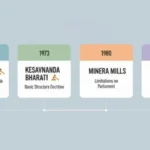
Kesavananda Bharati Case (1973)
- Introduced the Basic Structure Doctrine
- Held that Parliament cannot amend the Constitution’s basic features
- Strengthened judicial review significantly
Minerva Mills Case (1980)
- Reinforced balance between Fundamental Rights and Directive Principles
- Prevented excessive parliamentary power
Maneka Gandhi Case (1978)
- Expanded scope of personal liberty
- Made judicial review more rights-oriented
Why Judicial Review Is in the News
Judicial review becomes newsworthy whenever courts intervene in major public or constitutional matters.
Recent Reasons for Judicial Review in Headlines
- Delays by constitutional authorities in granting assent to Bills
- Review of environmental and infrastructure approvals
- Scrutiny of executive discretion and administrative delays
- Clarification of powers of Governors and Presidents
- Protection of civil liberties and due process
These cases highlight judicial review as a living and evolving constitutional tool.
Judicial Review and the Separation of Powers
Democracy works on the principle of separation of powers:
- Legislature makes laws
- Executive implements laws
- Judiciary interprets laws
Judicial review does not violate this separation. Instead, it maintains balance by preventing overreach by any branch.
Criticism of Judicial Review
Despite its importance, judicial review faces criticism.
Common Criticisms
- Judges are unelected
- May delay policy implementation
- Risk of judicial overreach
Counter-Arguments
- Constitution is supreme, not Parliament
- Courts protect minorities and rights
- Judicial review prevents abuse of power
The debate itself reflects a healthy democracy.

Judicial Review in Other Countries: A Brief Comparison
United States
- Originated judicial review in the famous Marbury v. Madison case
- Supreme Court has strong review powers
United Kingdom
- Parliamentary sovereignty dominates
- Judicial review focuses on administrative actions
India
- Combines written Constitution with strong judicial review
- Unique Basic Structure Doctrine
Why Judicial Review Is Important for Students and Exams
Judicial review is a recurring topic in:
- School civics
- UPSC and State PSC exams
- Judiciary and law entrance exams
- Current affairs analysis
Understanding judicial review helps students connect theory with real-world events.
Judicial Review and the Future of Democracy
As governance becomes more complex, judicial review will play an even bigger role. Technology, environmental challenges, data privacy, and social justice will increasingly come under constitutional scrutiny.
Courts will continue to:
- Interpret constitutional values
- Protect individual rights
- Ensure accountability
Judicial review is not an obstacle to democracy—it is its shield.
Conclusion
Judicial review is the silent strength of a constitutional democracy. It works not through headlines alone, but through principles, procedures, and protections that ensure power is exercised responsibly. Its presence in current news is not accidental; it reflects growing constitutional awareness and institutional accountability.
For readers of The Vue Times, understanding judicial review means understanding how democracy defends itself—not with force, but with law, reason, and constitutional morality.
In a world of rapid political and administrative change, judicial review remains the steady compass guiding governance back to constitutional values whenever it drifts.
More Read

Frequently Asked Questions
1. What is judicial review in simple words?
Judicial review is the power of courts to check whether laws made by the government or actions taken by authorities follow the Constitution. If a law or decision violates constitutional rules or fundamental rights, courts can cancel or correct it. Simply put, judicial review ensures that the government does not act above the law.
2. Who can exercise the power of judicial review in India?
In India, the power of judicial review is exercised mainly by the Supreme Court and the High Courts. The Supreme Court derives this authority primarily from Articles 32 and 13 of the Constitution, while High Courts exercise it under Article 226. These courts act as guardians of the Constitution.
3. Can Parliament remove or limit judicial review?
Parliament cannot completely remove judicial review. According to the Basic Structure Doctrine, judicial review is part of the basic structure of the Constitution. While Parliament can amend laws and even constitutional provisions, it cannot take away the core power of courts to review the constitutionality of laws and executive actions.
4. Why is judicial review often in the news?
Judicial review appears in the news whenever courts examine major government decisions, controversial laws, delays by constitutional authorities, or issues affecting fundamental rights. It becomes especially prominent during constitutional disputes, policy challenges, or cases involving public interest and governance accountability.
5. Is judicial review good for democracy?
Yes, judicial review strengthens democracy. It protects citizens’ rights, prevents misuse of power, and ensures that all branches of government function within constitutional limits. While debates exist about judicial overreach, judicial review remains essential for maintaining the rule of law and constitutional balance.