In a development that could mark a historic turning point in Middle Eastern diplomacy, U.S. President Donald Trump arrived in Israel on October 13, 2025, to celebrate a U.S.-brokered ceasefire between Israel and Hamas. The ceasefire agreement, hailed by many as a significant step toward ending two years of devastating conflict in Gaza, represents not only a potential path to peace but also the culmination of complex negotiations involving multiple stakeholders in the region. The ceasefire is accompanied by a phased prisoner exchange, the release of hostages, and the promise of a long-term plan for stability in Gaza, signaling a possible end to one of the most prolonged and destructive periods of violence in recent Israeli-Palestinian history.
The Ceasefire Agreement: Overview and Key Provisions
The ceasefire agreement, brokered by the United States with support from Egypt, Qatar, and Turkey, represents a multi-layered diplomatic achievement. Its provisions cover critical areas including hostage release, prisoner exchange, governance reforms in Gaza, and a phased disarmament process.
Hostage and Prisoner Exchange
One of the most significant aspects of the ceasefire is the exchange of hostages and prisoners. Over the past two years, Hamas had held dozens of Israeli civilians and soldiers in Gaza. Under the new agreement, the remaining 20 Israeli hostages have been released and returned to Israel through a coordinated process overseen by humanitarian organizations.
In return, Israel has committed to releasing 1,718 Palestinian prisoners, which includes detainees held since October 2023 and 22 minors. Additionally, Israel will return the remains of 28 deceased hostages, offering closure to families who had endured years of uncertainty and grief. This aspect of the agreement is seen as a humanitarian milestone, reflecting a rare moment of mutual concession by both sides.

Disarmament and Governance in Gaza
A particularly sensitive aspect of the ceasefire is the requirement for Hamas to disarm and relinquish its governance of Gaza. The plan envisions a technocratic administration taking over governance responsibilities, laying the foundation for reconstruction and the restoration of civil order. This administrative transition is part of a broader 20-point peace plan designed to stabilize the region politically and economically, while preventing the resurgence of militant operations.
The process of disarmament, however, presents a complex challenge. Hamas has historically been a deeply entrenched political and military force in Gaza, and ensuring that the group fully complies with the ceasefire’s requirements will require robust monitoring and international oversight.
Continuation of Military Operations
While the ceasefire provides a framework for peace, Israel has indicated that targeted military operations against Hamas infrastructure may continue temporarily, even after the release of hostages. This approach aims to prevent the re-emergence of militant capabilities while allowing the humanitarian aspects of the ceasefire to proceed without disruption. Balancing security measures with diplomatic agreements remains one of the most delicate aspects of the ceasefire’s implementation.
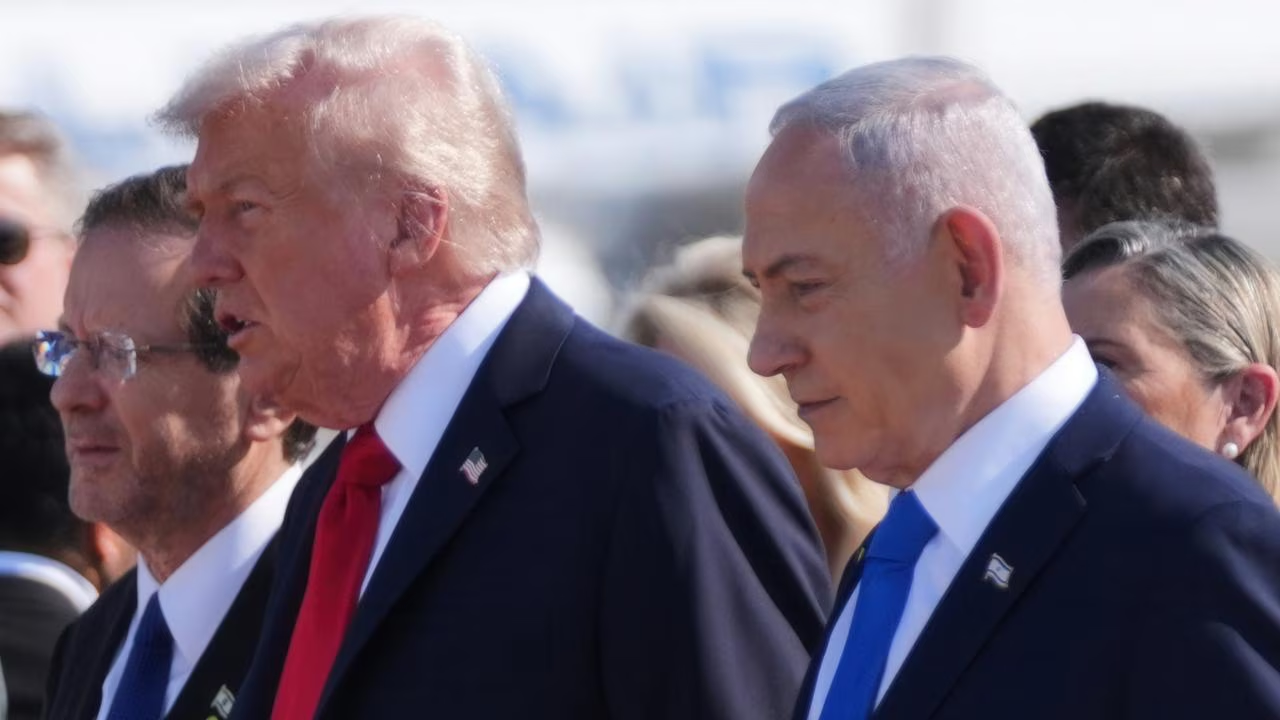
Trump’s Historic Visit to Israel
President Trump’s visit to Israel is significant not only for its symbolism but also for its practical implications for peace negotiations. Upon his arrival at Ben Gurion International Airport, Trump was greeted by Israeli Prime Minister Benjamin Netanyahu and President Isaac Herzog. The visit emphasized the United States’ central role in brokering the ceasefire and underscored Trump’s personal investment in the peace process.
During his address upon arrival, Trump declared, “The war is over,” expressing optimism that the ceasefire could pave the way for lasting peace in the region. His statements reflected a broader vision of diplomatic engagement, aiming to consolidate gains from the ceasefire and build momentum for a sustainable peace initiative.

Later, Trump addressed the Israeli Knesset, highlighting the historical significance of the ceasefire and emphasizing the importance of cooperation among regional stakeholders. His speech was met with applause, illustrating widespread support among Israeli leaders and citizens for the peace initiative. The visit also included high-level meetings with military officials and key diplomatic partners, further underscoring the multifaceted nature of the ongoing peace process.
Humanitarian Impact in Gaza
The humanitarian consequences of the conflict in Gaza have been devastating. Over the past two years, the fighting displaced approximately 1.5 million people, many of whom have returned to find their homes destroyed or severely damaged. Infrastructure across the region, including hospitals, schools, and public utilities, has suffered significant damage, complicating efforts to restore normalcy.
Humanitarian agencies are actively engaged in providing aid, including food, medical assistance, and temporary housing. Additionally, demining operations are underway to remove unexploded ordnance and restore safety in affected areas. The international community has pledged financial and technical support to aid in reconstruction, recognizing that sustainable peace requires addressing the immediate humanitarian needs of the population alongside political and security considerations.

The Role of Regional Stakeholders
The ceasefire agreement has been facilitated not only by the United States but also by key regional actors including Egypt, Qatar, and Turkey. These countries have played essential roles in mediating negotiations, providing diplomatic cover, and ensuring compliance with ceasefire provisions. Their involvement highlights the regional dimensions of the conflict and underscores the importance of multi-lateral cooperation in achieving lasting peace.
Egypt, in particular, has been instrumental in coordinating the logistics of the hostage release and prisoner exchange, leveraging its strategic position and historical ties with both Israel and Palestinian authorities. Qatar has contributed both financial resources and mediation channels, while Turkey has offered diplomatic engagement aimed at reinforcing the ceasefire’s credibility.
Upcoming Peace Summit in Egypt
Looking ahead, a peace summit in Sharm el-Sheikh, Egypt, is scheduled to consolidate the ceasefire and discuss the next stages of the peace process. President Trump, Palestinian President Mahmoud Abbas, Israeli Prime Minister Netanyahu, and other world leaders are expected to participate. The summit will focus on several key objectives:
-
Solidifying the terms of the ceasefire.
-
Establishing frameworks for long-term governance in Gaza.
-
Discussing reconstruction efforts and humanitarian aid.
-
Exploring pathways for regional cooperation and economic development.
The summit represents an opportunity for leaders to translate the ceasefire from a temporary military arrangement into a comprehensive political settlement. Achieving this goal will require addressing deeply rooted political divisions, security concerns, and historical grievances, all of which have complicated peace efforts for decades.

Challenges to Long-Term Peace
Despite the optimism surrounding the ceasefire, several challenges remain.
Implementation of Disarmament
Ensuring that Hamas fully disarms and relinquishes control of Gaza is perhaps the most immediate and complex challenge. Failure to achieve complete disarmament could undermine the ceasefire and provoke renewed violence, jeopardizing both humanitarian and diplomatic gains. Effective monitoring mechanisms, potentially involving international observers, will be critical in mitigating this risk.
Political Dynamics in Israel and Palestine
Internal political pressures in both Israel and Palestine could affect leaders’ willingness to adhere to the agreement. In Israel, political factions differ on approaches to Gaza and the Palestinian territories, with some advocating for continued military measures. In Palestine, divisions among political factions, including Hamas and Fatah, may complicate efforts to enforce the ceasefire and participate in reconstruction initiatives.
Regional Stability
The broader Middle East remains a complex environment, with non-state actors, rival countries, and external powers capable of influencing the peace process. Ensuring that the ceasefire holds requires careful diplomatic engagement and contingency planning to address potential disruptions.
Humanitarian and Economic Reconstruction
Rebuilding Gaza’s infrastructure, restoring basic services, and reviving the local economy are essential components of long-term stability. International support, coordinated reconstruction efforts, and careful management of resources will be necessary to prevent renewed social unrest and economic collapse.
International Reactions
The international community has largely welcomed the ceasefire, with statements emphasizing support for diplomatic efforts and humanitarian assistance. Many countries have expressed readiness to provide aid for reconstruction and to assist in monitoring compliance with the agreement. Analysts suggest that the success of the ceasefire could serve as a model for future conflict resolution in the region, reinforcing the importance of diplomatic intervention and multi-lateral cooperation.