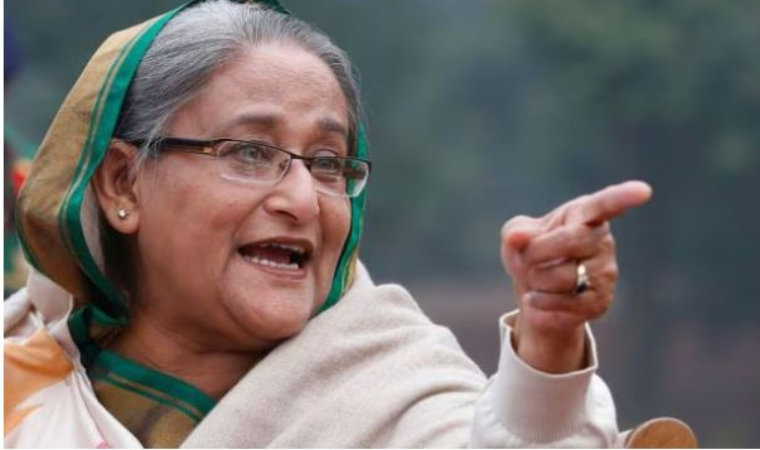
New Delhi / Dhaka, In a ruling that seems ripped from the pages of a political thriller, Bangladesh’s International Crimes Tribunal (ICT-BD) has sentenced former Prime Minister Sheikh Hasina to death, dealing a historic and deeply destabilizing blow to South Asia’s geopolitical equilibrium. The judgement, handed down in absentia while she lives in exile in India, raises urgent questions: Will New Delhi hand her over? What is at stake for Bangladesh’s fragile transition? And how could this reshape India’s influence in Dhaka, and beyond?
As the dust settles, each line of this verdict demands reconciling legal responsibility, political retribution, and strategic calculation. It is a moment of reckoning for Bangladesh, and a crucible of choice for India.
The Verdict That Shook Dhaka
On the day of the verdict, the tribunal’s courtroom, and much of Dhaka, was locked down. Judges delivered their judgment in a tense, packed chamber. According to the court, Hasina was found guilty on three counts: incitement, issuing orders to use lethal force, and failing to prevent crimes against humanity. The tribunal said she approved the use of helicopters, drones, and other deadly methods. These were used against largely unarmed student protesters. The crackdown later grew into a nationwide uprising in July and August 2024.
Presiding Judge Golam Mortuza Mozumder declared that “all the elements constituting crimes against humanity have been fulfilled” and announced a single sentence: death.

For victims’ families and many in Dhaka, it was a moment of catharsis. Some wept openly; others folded their hands in prayer. But for Sheikh Hasina, now in exile, the sentence is nothing short of political vengeance.
Hasina’s Rebuttal: Biased Tribunal and Political Past
Speaking from her base in New Delhi, Hasina rejected the entire tribunal process. She accused the court of being “rigged” and politically driven, arguing that it was presided over by a government that has “no democratic mandate.” She insisted she was never given a fair opportunity to defend herself.
In her statement, she acknowledged that her government had “lost control” during the protest surge. But she strongly rejected the characterization that the unrest was a “premeditated assault” on civilians. She argued she had tried “to minimize loss of life,” not to orchestrate mass violence.
Hasina also laid claim to a positive political legacy: she pointed to her government’s achievements in providing electricity, improving education, and sheltering Rohingya refugees. In her view, the court’s motive was not justice, but the permanent erasure of her and her party, the Awami League, from Bangladesh’s political future.

Dhaka’s Narrative: Justice, Accountability, and a Warning to Power
Meanwhile, Muhammad Yunus, leading the interim Bangladeshi government, hailed the verdict as “historic.” In his statement, he argued that Hasina’s sentencing affirms a central principle: no one, no matter how powerful, is above the law.

Yunus framed the crackdown and the deaths not just as political repression, but as a rupture in the bond between the state and its citizens: particularly young students who rose up against entrenched exclusion and corruption. He insisted that this tribunal was not a purge, but a foundation for a new institutional order, one anchored in justice, accountability, and democratic norms.
India’s Measured Reaction: Engagement Without Fallout
India’s response to the verdict has been careful and calculated.
The Ministry of External Affairs (MEA) issued a statement saying that New Delhi “noted” the tribunal’s decision. But rather than offering explicit support or condemnation, it emphasised India’s commitment to the “best interests of the people of Bangladesh,” particularly in terms of peace, democracy, inclusion, and stability. According to Indian officials, New Delhi will continue to “engage constructively with all stakeholders” in Dhaka.

This posture, cautious and non-committal, is strategic. While Dhaka has formally requested Hasina’s extradition, calling her return an “obligatory responsibility” under bilateral agreement, India has refrained from making any firm commitment.
Domestically, the verdict has drawn reaction from Indian political figures as well. Senior leader Shashi Tharoor expressed deep concern, calling the death sentence and trial in absentia “troubling” and underscoring his personal opposition to capital punishment. He noted that trials in absentia carry a particular risk: the defendant lacks the chance to adequately present their case.
The Human Rights Burden: International Eyes and Legal Weight
The United Nations human rights office responded to the verdict with a mixed message. While acknowledging that the ruling is “an important moment for victims,” it also expressed regret over the imposition of the death penalty. The UN highlighted concerns that Hasina’s trial in absentia may not have aligned with full international standards of due process.
These criticisms pose a reputational risk to Bangladesh, and they also unsettle countries watching the situation closely, including India. India must manage its image carefully as a regional power, and it presents itself as a defender of democratic values, which makes the issue even more sensitive.
India’s Legal and Strategic Calculus: Why Extradition Is Highly Unlikely
Beyond the moral question, there is a deeply pragmatic analysis in New Delhi: returning Sheikh Hasina now could do more damage than sheltering her.
- Extradition Treaty and Political-Offense Exception
India and Bangladesh are bound by a bilateral extradition treaty. But this treaty includes a political-offense exception, which allows India to refuse extradition if it believes the charges are politically motivated. In this case, many legal analysts argue Hasina’s conviction can be framed precisely in that light. - Fair Trial Concerns
Extraditing her to a tribunal widely criticised for political influence would expose India to accusations that it is complicit in facilitating a verdict that lacks procedural fairness. Many in New Delhi view the tribunal as deeply entangled with the interim government’s political strategy. - Death Penalty Risk
Handing her over would mean handing her over to a system that could execute her. For a democratic India, with its own contested views on capital punishment, such a decision carries not just legal risk but moral and diplomatic costs. - Strategic Leverage
Hasina was long considered one of India’s closest partners in Dhaka. By sheltering her, India retains leverage, not just as a host, but as a stakeholder in Bangladesh’s political future. Her presence in exile gives India a voice in the new political order, especially as Bangladesh prepares for upcoming elections. - Political Backlash
Extraditing her could provoke anger among her supporters and be perceived as New Delhi aligning with the interim government against a former ally. On the other hand, if India refuses, Dhaka may accuse it of undermining justice. However, the cost to New Delhi may still be lower than surrendering her.
The Regional Stakes: More Than a Bilateral Dispute
The Hasina verdict is not just a legal matter, it is potentially transformational for South Asia.
- Elections on the Horizon: Bangladesh is expected to hold elections soon. How this verdict influences voter sentiment, party dynamics, and campaign narratives could reshape the political landscape.
- Institutional Rebuilding: Yunus’ government is using the tribunal to signal a break from the centralized, personalistic style of Hasina’s rule. But reinstitutionalising democracy is fraught; how Dhaka balances accountability with reconciliation will determine long-term stability.
- India’s Influence: New Delhi’s handling of this case could define how its influence in Bangladesh evolves. If it refuses extradition, it may strengthen its diplomatic grip; if it complies, it could undermine its own regional standing.
- Human Rights Precedent: The case sets a precedent for how democracy, justice, and political transition intersect. The international community will be watching not just for what happens in Dhaka, but for how it reverberates across other countries with fraught democratic histories.
Intelligence and Assessment: What Do India’s Strategists Think?
While public Indian statements focus on diplomatic engagement, behind the scenes, New Delhi’s intelligence and policy establishment is likely grappling with several assessments:
- Risk of Instability: Analysts will be evaluating whether the internment and possible return of Hasina could trigger unrest, both in Bangladesh and on the border.
- Long-term Leverage: Hasina’s continued presence in India gives New Delhi a bargaining chip. If political winds shift in Dhaka, say with a revived Awami League, India could still influence outcomes.
- International Backlash: India must weigh how continued protection of Hasina might affect its relations with global powers, especially those critical of human rights.
- Domestic Credibility: New Delhi must navigate its own domestic narratives. Sheltering Hasina may be seen by some as moral hypocrisy; extraditing could alienate broader constituencies.
Worst-Case and Best-Case Scenarios: What Could Happen Next
Worst-Case Scenario:
- Hasina remains in India, Dhaka ramps up diplomatic pressure, protests escalate, and cross-border tensions rise.
- International organisations condemn both the death sentence and India’s refusal to surrender her, framing the standoff as a human rights freeze.
- Bangladesh’s elections are marred by violence or boycott, undermining the interim government’s legitimacy and destabilizing the country.
Best-Case Scenario:
- India maintains a firm but balanced stance, offering diplomatic engagement without capitulation.
- Bangladesh forms a truth and reconciliation commission that includes prosecution, reparations, and a roadmap for political reconciliation.
- Over time, Hasina’s case became part of a negotiated transition, allowing Dhaka and New Delhi to stabilise ties with a framework for future cooperation.
Wildcard:
- Hasina could mount a legal appeal via proxies or international legal channels, perhaps invoking diplomatic mediation or leveraging third-party actors.
- Alternatively, renewed instability could invite external mediation, from regional powers or international institutions, to broker an outcome that balances justice with stability.

The Human Story: Victims, Families, and Memory
Beyond legal arguments and diplomatic stratagems, the verdict resonates most in the corridors of memory, in tear-streaked faces of families who lost children, in the empty seats of university auditoriums where young lives once gathered, in the photographs of students who never came home.
For many families, this is not merely about punishment; it is about truth. The tribunal’s decision, whatever its political implications, has given them a concrete acknowledgment of the pain they endured. But for reconciliation to take root, Bangladesh must now decide whether this verdict will be the end or the beginning of a deeper national reckoning.
A Final Reckoning: What This Means for India
For India, the death sentence demands a choice, not just of policy, but of identity and influence. New Delhi must balance its commitment to regional stability with its own democratic and legal norms. The question is not whether to act, but how, and how much.
Sheltering Hasina could be framed as defending a former ally, preserving long-term leverage, and avoiding a politically dangerous precedent. Extraditing her, meanwhile, risks projecting weakness, enabling a politically charged death sentence, and undermining India’s standing as a guardian of democratic values.
In that sense, this is more than a judicial verdict. It is a test of India’s role in South Asia: as a power that protects, that judges, or that compromises, and whether it is ready for the consequences of all three.
Conclusion
Sheikh Hasina’s death sentence is not just a legal outcome. It is a geopolitical earthquake. It challenges the foundations of Bangladesh’s political future and places India at a crossroads: power vs principle, influence vs morality, stability vs justice.
Moreover,the coming months will demand high-stakes diplomacy, strategic patience, and moral clarity. For India, the choice it makes could define its relationship with Bangladesh for the next decade, perhaps for a generation.
Sources
- Al Jazeera, report on the tribunal’s verdict and India’s likely refusal
- The Guardian, in-depth coverage of the conviction and political reactions
- Indian Express, India’s Ministry of External Affairs response
- Times of India, Hasina’s reaction and legal challenges she may pursue
- Livemint, casualty estimates, details of the tribunal, and analysis
- Economic Times, Hasina’s statement calling the tribunal “politically motivated”
- Hindustan Times, Shashi Tharoor’s response and India’s internal debate on the death penalty
- The Statesman, Hasina’s detailed rebuttal and her critique of the tribunal