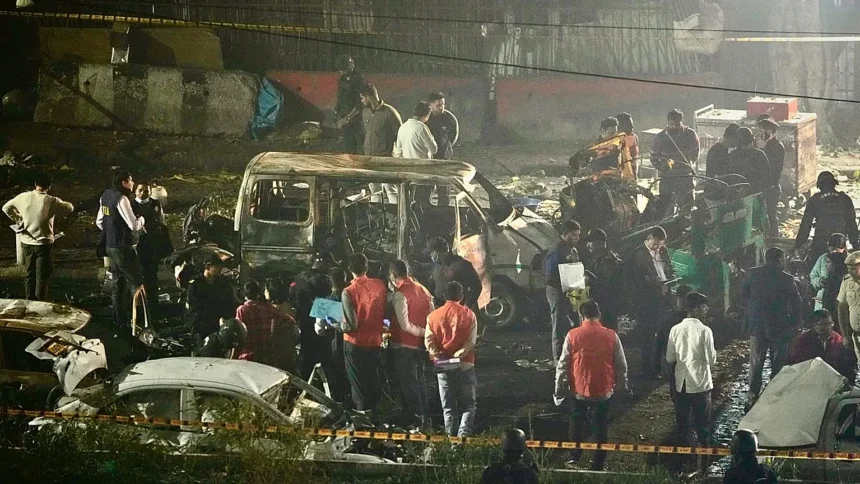
A powerful car explosion near the gates of Delhi’s historic Red Fort on the evening of Monday, November 10, 2025, killed at least eight people and wounded dozens more, turning a bustling part of India’s capital into a scene of smoke, mangled vehicles and frantic rescue operations. The blast — which struck close to the Lal Qila (Red Fort) metro entrance and a busy traffic junction — prompted authorities to immediately cordon off the area, dispatch fire and emergency services, and launch a high-priority counterterrorism investigation under India’s stringent Unlawful Activities (Prevention) Act (UAPA).
What happened — immediate facts
According to official briefings and multiple news outlets, the explosion occurred when a slow-moving white car — reported in several accounts as a Hyundai i20 — detonated at or near a traffic signal close to the Red Fort’s outer wall and the Lal Qila metro station in Old Delhi. Witnesses described a “deafening blast,” a sudden sheet of flame and black smoke, and an immediate scene of chaos: bystanders running for cover, vehicles set alight and injured people being carried away by passersby until ambulances and firefighters arrived. Local police and emergency teams evacuated the area and began treating the wounded at nearby hospitals. Initial casualty figures varied as the situation unfolded, with the earliest official counts citing at least eight dead and many others injured.
Because the blast happened at a high-profile location — the Red Fort is not only a UNESCO World Heritage monument but also an active symbol of national identity and a site for major state ceremonies — the response was swift and extensive. Authorities sealed off roads around the monument, summoned forensic teams, and put additional security on alert at major transportation hubs and government buildings across the capital and other large cities.
The terrorism angle: UAPA invoked and probe widened
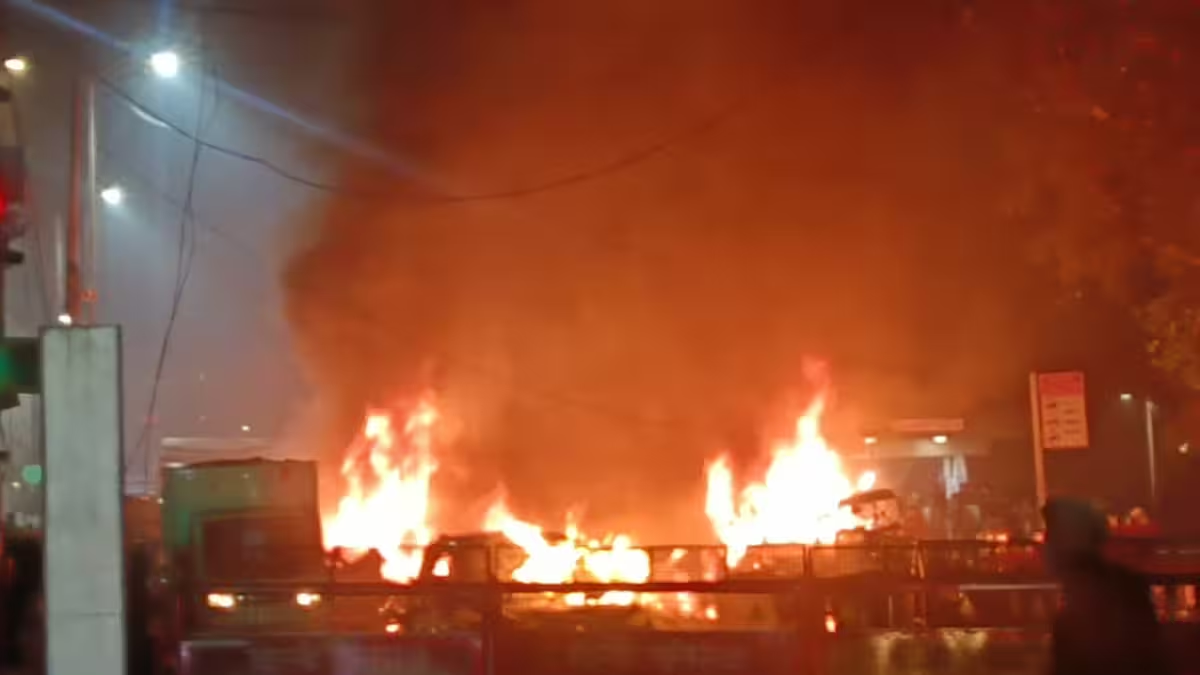

Within hours of the explosion, Delhi police and national agencies signaled that the incident was being investigated as a suspected terrorist act. An FIR (First Information Report) was registered under sections of the UAPA — India’s primary anti-terrorism legislation — and under explosives-related statutes, as investigators worked to establish whether the blast was caused by an improvised explosive device (IED) inside the vehicle or by some other mechanism. The invocation of UAPA elevates the probe, allowing federal agencies to coordinate evidence-gathering, detentions and intelligence work more intensively than in ordinary criminal cases.
Officials reported that forensic teams were combing through CCTV footage, vehicle registration records and fragments recovered from the wreckage to determine the blast’s origin and whether any militant group or local extremist network was responsible. Early news reports and police briefings suggested the possibility of a suicide or “fidayeen”-style attack, though investigators emphasized that their work was ongoing and that definitive attribution would require conclusive forensic and intelligence evidence.
Detentions, leads and the vehicle’s trail
As part of the investigation, police detained individuals connected to the vehicle — including the car’s registered owner — for questioning and, in some reports, took family members for DNA verification where bodies or badly damaged remains were found at the scene. Media outlets reported that the registered owner was taken into custody and that investigators were working to establish who was driving or inside the car at the time of the explosion. The vehicle’s movements and how long it had been parked near the site before the blast became critical lines of inquiry, with some reports noting the car had been stationary in the area for hours prior to the detonation.
Investigators also reviewed nearby CCTV and traffic surveillance footage, as well as cellphone and digital-payment trails that might place suspects at the scene. The National Investigation Agency (NIA) and other federal units were reported to be involved or standing ready to take over parts of the probe, reflecting the gravity of an attack near a national monument and in the heart of the capital.
Human cost and eyewitness accounts
Eyewitnesses recounted horrifying scenes: bystanders rushing to pull people from burning cars, local shopkeepers and commuters assisting the wounded, and the struck junction strewn with wreckage and, in some accounts, body parts. Hospitals reported receiving burn victims and people with severe blast injuries, and emergency responders described the operation as complicated by fires and the risk of secondary explosions. Those who were in the vicinity during the blast have described a sudden, unnatural silence afterward — a brief calm in which shock and grief displaced the routines of a densely packed neighborhood in Old Delhi.

Families of victims — many of whom were reportedly local commuters, shopkeepers and passersby — began arriving at hospitals and police stations seeking information. Officials urged citizens to remain calm yet vigilant, and appealed for anyone with footage or information to hand it over to investigators to hasten identification and attribution.
Political and security responses
India’s central and Delhi state leadership responded publicly to the attack. Home Minister and other senior officials promised a thorough investigation and assured the public of enhanced security. Prime Minister Narendra Modi expressed condolences, and security agencies raised alert levels across transport hubs and critical infrastructure, including airports, railway stations and metro networks, while scrutinizing public events and ceremonial venues. These steps reflected immediate caution in the face of uncertainty and the high symbolic stakes of an attack so near a monument associated with national sovereignty.
Across the country, police and intelligence units were ordered to heighten surveillance and step up patrols in sensitive areas. The central government’s coordination with state police forces and federal investigative bodies underscored the coupling of local crime-scene work with national counterterrorism capabilities — a standard posture when an incident is investigated under UAPA.

Historical context: why Red Fort matters
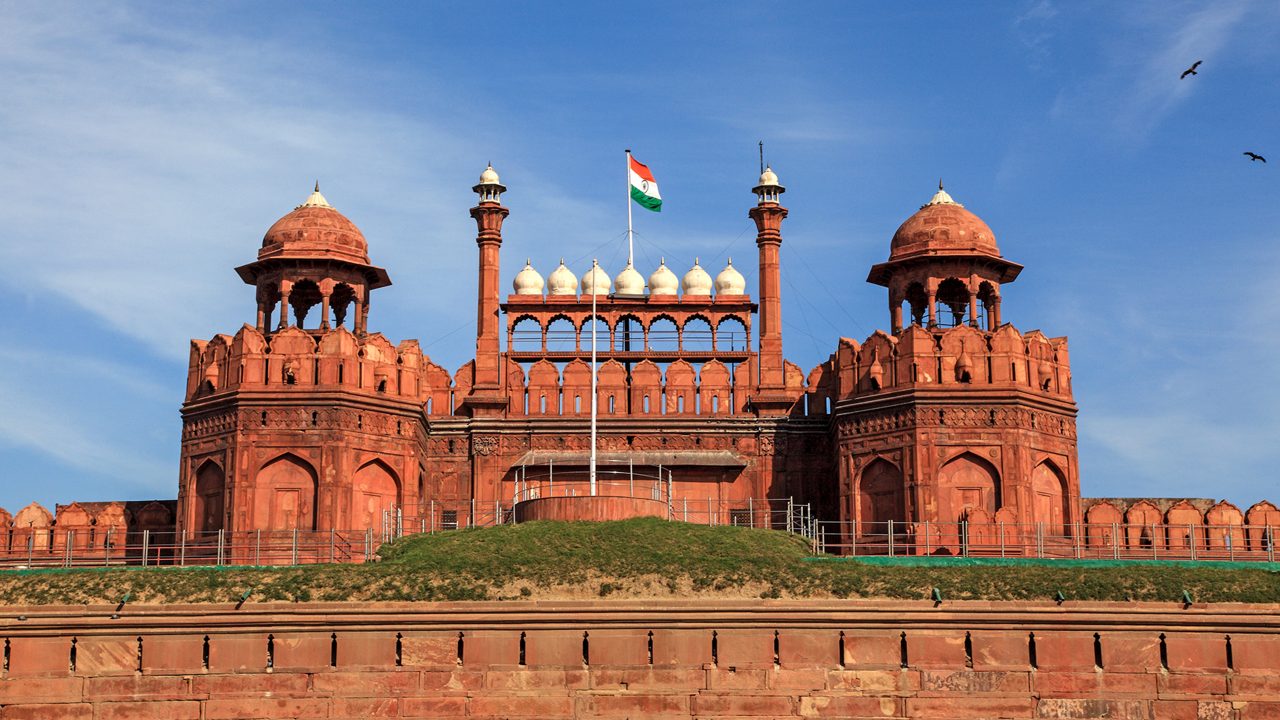
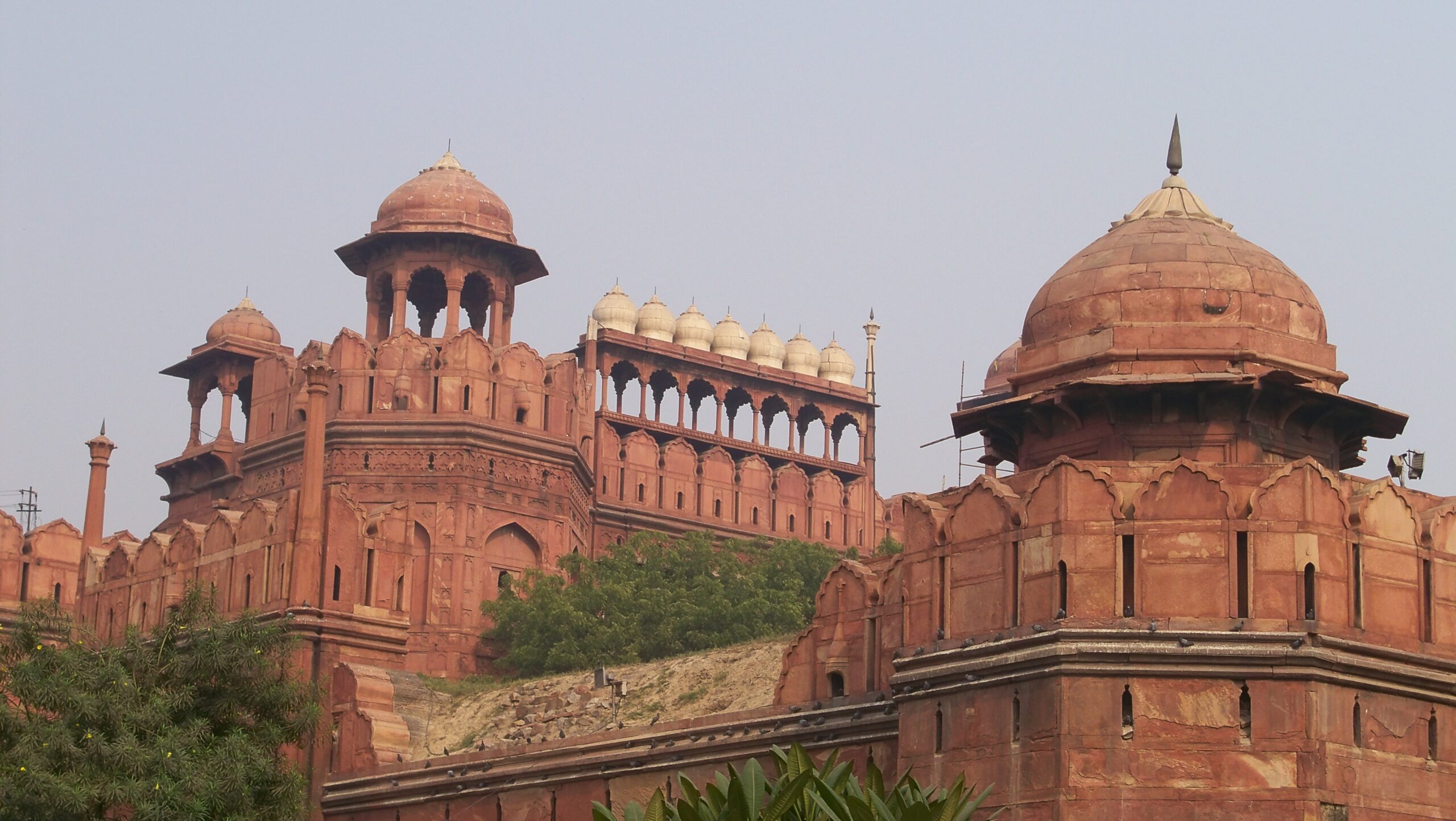
The Red Fort (Lal Qila) is more than a tourist attraction. Built in the 17th century by the Mughal emperor Shah Jahan, it is a symbol of India’s layered history and modern democracy: the Prime Minister hoists the national flag on its ramparts every Independence Day. Its location in Old Delhi makes it a focal point for both domestic and international visitors, as well as a busy hub of commerce and transport near Chandni Chowk and other crowded marketplaces. Because global and local extremist groups often aim for high-impact symbolism, an attack near such a site inevitably carries weight far beyond the immediate casualties.
India has endured several deadly attacks on public spaces and transport in the past decades, and the country’s counterterrorism architecture — from state police to federal agencies — has evolved accordingly. Incidents that occur in densely populated urban centers or at symbolic sites compound political and social pressures, prompting debates about intelligence failures, law enforcement preparedness and the balance between civil liberties and security measures.
What investigators will look for next
Forensic and intelligence priorities in an attack like this include:
(1) conclusively identifying the occupants of the blown vehicle through DNA and medical records
(2) determining the explosive’s construction and whether it was a vehicle-borne IED or another device
(3) tracing the procurement of materials — including explosive precursors, wiring and triggering mechanisms — to find suppliers or handlers
(4) analyzing communications and financial footprints to detect co-conspirators or handlers
(5) determining any linkages to local or transnational extremist networks.
Analysts also typically look for any “signature” elements that could link the attack to a previously known module or modus operandi. xample, coordination with cells in other cities or planned follow-up attacks — authorities will likely move to detain suspects in other locations and issue advisories to foreign governments and international agencies. Conversely, if evidence points to a lone actor or an individual with limited support, the investigative focus shifts to mapping a shorter chain of radicalization and support networks.
Societal impact and media environment
Attacks in major urban centers have both immediate and longer-term societal impacts. In the short term, there is fear, disrupted commerce, and intensified security checks that affect daily life. In the longer term, such events tend to provoke political debates about counterterrorism policy, intelligence coordination, community policing and the socio-economic roots of radicalization. Media coverage — particularly in the age of social platforms and pervasive phone-camera footage — accelerates the spread of images and rumors, which can complicate investigations and inflame public sentiment. Careful, verified reporting is therefore vital; officials have repeatedly asked the public to avoid spreading unverified information and to cooperate with authorities.
International reactions and diplomatic dimensions
An attack near a national symbol draws international attention. Foreign governments typically issue travel advisories, offer condolences, and sometimes intelligence assistance, particularly if evidence suggests external links. Depending on the outcome of the probe, the incident could affect India’s diplomatic posture and counterterrorism cooperation with other states. Historically, attacks have at times heightened cross-border tensions, especially when groups claim responsibility or when evidence points to external support; investigators will therefore be meticulous in building an evidentiary case before assigning blame publicly.
The path forward: accountability, resilience and prevention
As the investigation proceeds, families of the dead and injured will seek answers and accountability. Authorities will face pressure to explain how such an attack occurred in a heavily policed area and what lessons are being learned. Policy responses may include reviews of vehicular checkpoints, traffic and parking restrictions near sensitive sites, and investments in surveillance and counter-IED capabilities. Community engagement and targeted interventions aimed at preventing radicalization also form part of the broader prevention toolkit — but these are long-term and politically sensitive measures that require sustained commitment.
More Read

For residents and commuters in Delhi, practical precautions and calm adherence to official advisories remain essential. For journalists and analysts, balancing the need for timely information with caution about unverified claims is crucial to avoid misinforming the public and compromising investigations.
Conclusion
The car blast near Delhi’s Red Fort is a grim reminder that even highly secure, symbolically charged urban spaces are vulnerable to violence — and that the human cost of such attacks is immediate and devastating. The invocation of anti-terror laws and the involvement of federal investigative agencies signal that India treats the incident as a serious act of terror until proven otherwise. The coming days and weeks will be critical: forensic and intelligence work must establish the facts, identify perpetrators and dismantle any networks involved. Meanwhile, families mourn, the city absorbs another trauma, and national authorities face the twin tasks of delivering justice and reassuring a shaken public.