Bangladesh-India Relations in Flux: Unpacking the Recent Exchange Between Defence Minister Rajnath Singh and Chief Adviser Muhammad Yunus
Introduction
A minor and yet significant diplomatic shaker took place in South Asia in the early part of November 2025. The Defence Minister of India on his part took some strong words against Bangladesh and instructed the interim Chief Adviser, Muhammad Yunus, to watch his tongue, which provoked an assertive Bangladesh countering with the words that the comments were not only incorrect but also unproductive and not very respectful of propriety and diplomatic courtesy.
Considering that there were strong historical, cultural, economic and geopolitical relationships between India and Bangladesh, any such outburst by a section of society should be analyzed. To the audience of The Vue Times, it is high time to take a closer look at what is on the table, other than on the headlines.

This article attempts to do just that: it tracks the instant storyline, functionalizes it into larger bilateral frames (into trade, security, geopolitics and personalities), investigates the fault-lines under it, and evaluates what this present might portend about the nature of the future between India and Bangladesh relations.
The Incident: What and Why It Happened.
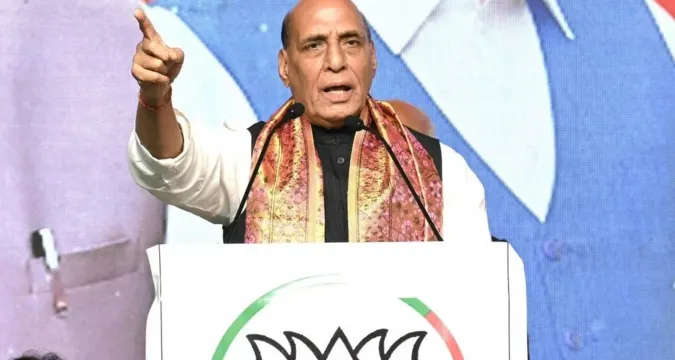
The Indian defense minister challenged the Bangladesh interim government in an exclusive interview with the Network18 Group Editor-in-Chief. He said: We do not want tense relations with Bangladesh, but Yunus must be careful in what we say.

Reacting to this, the Bangladeshi Ministry of Foreign Affairs, with Spokesperson SM Mahbubul Alam, condemned these words as wrong, undiplomatic and unbefitting.
The key issues:
- The comments were aimed at one of the interim leaders of Bangladesh publicly, creating a sensation with regard to sovereignty and tone of diplomacy.
- The timing is also important: both nations are maneuvering in a changing geopolitical landscape in South Asia (more on it below).
- Business and economic relationships between India and Bangladesh, which are already strong, are threatened by reputational spillover in case bilateral relationships turn tense.
- Stated briefly, even such a mild admonition, as is spent upon a neighbour such as the present, is not an empty matter. It promises future tensions in one of the most crucial neighbouring relationships in India.
Historical and Structural Context
To interpolate this episode, it is informative to observe the pillars and the current trends of the relations between India and Bangladesh.

Historical Foundations
Bangladesh is the product of a war that India had a central role in in 1971. Geographical proximity (India bears more than 4,100 km of a border with Bangladesh) and cultural, linguistic and economic connections have traditionally contributed to a unique relationship.
Throughout decades, India was a large economic partner, investor, transit route and interlocutor security to Bangladesh. On the other hand, Bangladesh relies on India for connectivity, some transit/access rights, and the sphere of mutual strategic interest.
Economic and Trade Linkages
One of the biggest trading allies of Bangladesh is India. Numbers may change and fluctuate but the mere size and diversity, be it in clothing, raw materials to bi-lateral services, highlights the economic interdependence.

Meanwhile, issues of trade imbalances and market-access complaints have been consistent in the bilateral agenda. The export-oriented garment industry found in Bangladesh relies on the port access, transit routes that occasionally pass via India and favourable tariff or non-tariff barriers.
Security Concerns and Geopolitics
India perceives Bangladesh as a strategic side on its eastern flank (northeast India) and a participant on maritime/Indo-Pacific security platforms (e.g., through Bay of Bengal Initiative of Multi-Sectoral Technical and Economic Cooperation or BIMSTEC).
In Bangladesh, whose policies have been progressively seeking more diversified associations, such as closer links with China, all this sometimes causes alarm in New Delhi about being infiltrated into the Indian neighbourhood. (See later section)

The topic of water, border control, refugee movements, minority rights and transit privileges is a contentious issue in the bilateral agenda.
Recent Politico-Environmental
This has gotten more complicated with the emergence of an interim government of Yunus after Sheikh Hasina left. His administration has focused on equality, justice and sovereignty in terms of relationship with India.
On the Indian part, Delhi has never been more sensitive to the dynamics of security around its northeast, China-India rivalry, nor has it been more sensitive to the role of Bangladesh as a transit/access corridor in the region. This makes them more sensitive to any public comment.
So, the recent flood of remarks can not be interpreted outside of a context of the multi-dimensional and changing relationship between India and Bangladesh.
Breaking Down the Fault-Lines Behind the Comments
What are the sub currents that could have resulted in this official warning by India and the swift reaction of Dhaka? Several stand out.

Communicative Tone and Diplomatic Etiquette
Even a defence minister of one nation publicly threatening an interim government official of a neighboring nation to mind his tongue is a territory into which diplomatic decorum and sovereignty sensibilities begin to interfere. The response of Bangladesh specifically referred to the deficiency in diplomatic nicety.
Simply put: when a diplomatic actor feels that the interlocutor is speaking out of a superiority position (or believing they should be subservient), it tends to be counter-attacked by the other party. Such reaction may have been induced by the tone of the remarks made by Rajnath Singh.
Bangladesh: Fairness and Equity as per demand
Yunus has reiterated several times that the relations between Bangladesh and India have to be pegged on equity as well as fairness and not vertical expectations.
To the interim government of Dhaka, comments that sound like instructions or admonitions run the risk of being read out inconsistent with said narrative of equality.
Strategic Diversification of Bangladesh
Bangladesh has openly been sending more signals that it is going to have a more diversified foreign policy – involving China more, reviewing transit/water, playing its geographical advantage vis-a-vis the northeast of India. In one instance, Yunus was reported to comment on how Bangladesh serves as an opening into the land-locked northeastern states of India, providing alternative access points, the comment being made.
Such changes can be perceived by India as a threat to its vital interests, which will warrant a more aggressive diplomatic stance.
Shared and Domestic Pressure on Security
Cross-border infiltration, North-East India insurgency, border stability, and maritime security are some of the issues looming large in the mind of India. Indian voices might have an urge to retaliate when a neighbour chastises in public or does anything which might be seen as a threat to those interests.
Simultaneously, Bahrainese domestic politics, the shift to an interim government, strains of governance, minority problems, force it to follow a more assertive approach towards sovereignty in its foreign policy.
Why the Timing Matters
- A number of contextual factors render this incident timely and meaningful.
- India is engaged in tightening competition with China over the influence of the region. Bangladesh is configured in geostrategic junctions: the Bay of Bengal, the Indian northeast corridor, and connectivity corridors.
- The current interim government headed by Yunus in Bangladesh is relatively new and struggling to find domestic legitimacy, economic challenges, and foreign policy credibility.
- There are trade, infrastructure and connectivity projects being negotiated, any diplomatic wrangling can be translated to stalling or escalation of costs in these fronts.
- Public diplomacy and media discourse in both nations has become more aggressive; words and deeds are exaggerated and become a symbol instead of a statement.
Possible Implications and Situations
Considering this incidence and context and dynamics, there are hints of possible implications of bilateral relations.
A. Short-term Diplomatic Cooling
It can be a cooling-off exercise of high-level engagements. Bangladesh has stressed positive interaction yet also added that the differences should be treated respectfully. India can retaliate through curbed proffers or political war.
The effects: duplication of bilateral forums, reduction in decision taking on connectivity or trade initiatives and more hedging by both sides.
B. Economic & Trade Repercussions
- Considering the interdependence, deterioration of goodwill may influence:
- Transit and logistics efficiency of cross-border movement between India and Bangladesh.
- Application of strategic infrastructure or connectivity initiatives (ports, intercontinental connectivity).
- The interest of Indian investors in Bangladesh and the reverse particularly in case regulatory or non-tariff barriers re-emerge.
The garments industry of Bangladesh, as an example, is export-oriented and transit/logistics-dependent. Any weakening of Indian queuing cooperation or regional alliances might increase expenses.
C. India Strategic Realignment Risk
When Bangladesh feels that India has been heavy-handed or unaccommodating, Dhaka will shift more towards China, or at least it will employ its relationship with China as a counter-balance. This would pose a strategic challenge to India at its eastern (northeast) periphery (connectivity, Bay of Bengal).
As an example: Chinese investment in Bangladeshi ports, or closer cooperation between Bangladesh and China would change the equilibrium in the region. (See more recent news of China’s so-called charm offensive in the region.)
D. Diplomatic Standards and Soft Power Reflection
In the case of India, reputation as a respectful and fair neighbor is a key element of the soft-power strategy in South Asia. Admonitions in public and heavy-tone diplomacy may destroy that image. To Bangladesh, sovereign dignity against a bigger neighbour is not only important domestically but internationally as well.
So this rhetoric is not merely a matter of the words – it concerns the implicit ethos of the bilateral relationship.
Read More: PM Modi Urges Unity Ahead For Parliament
What Do Both Parties Need to Take into account?
To prevent the outbreak of a rhetorical hi-fi into a more strategic drift, there are feasible alternatives that can be adopted by both India and Bangladesh.
For India
- Restate in very tangible terms appreciation of the sovereignty and equality of Bangladesh. Decolouring language issues: Situations where one offers to negotiate instead of publicly warning could work better.
- Crossover via economic connections: speed up connectivity in the pipeline, cooperation in infrastructure, facilitation of trade. Avoiding negative perceptions through the development of positive outcomes can help.
- Be involved at a bureaucratic level but with tangible political displays of respect invite, high-level visits, cultural interchanges, etc. with the interim government of Bangladesh.
- Control strategic processes (e.g., Bhutan-China partnership) and make sure that Indian interests are to be preserved by proactive approach instead of being addressed by reactive measures.
For Bangladesh
- At the same time as insisting on its independence, stress on the fact that cooperation with India is also a fundamental strategic concern including the message that collaboration is desirable to conflict.
- Control attitude and diplomatic language so as to preclude gratuitous antagonism, particularly in view of the size and geographical distance of India.
- Expand relations with China (setting up partnership / alternative ports / transits) but without that diversification being publicly a positioning of antagonism towards India. The art of diplomacy is best achieved with silent hedging instead of active signal-wars.
- Use economic cooperation with India (e.g. transit, energy, connectivity) as a tool to reinforce domestic economic resilience – solidifies the frame of a positive partnership.
An Introspection: Will this be a Turning Point?
At this point the event has manifested itself in the form of a warning bell but not, intrinsically, a developing point. It remains to be seen how far it goes as the follow up is taken by each party.
Key variables to watch:
- The existence of a visible bilateral meeting (political or ministerial) between India and Bangladesh in the next 3-6 months.
- Advancements (or time lags) to large connectivity/infrastructure projects (such as ports, land transit, power exchanges) between the two countries.
- Rhetoric by both parties: does it larval or is it kept at bay?
- Actions by Bangladesh towards China or other alternative partners in visible ways, reaction of India to actions of Bangladesh.
- Bangladesh domestic politics: any changes in the political politics within the country such as the adoption of interim government to elected government (should this happen) can re-establish a relationship.
When skillfully utilized, this moment has the potential to be the first step towards re-establishing the relationship on more solid footing (mutual respect, shared prosperity, strategic balance). Left unchecked, the danger is that the goodwill will be manipulated away, there can be more strategic competition, and economic tensions.
Conclusion
The recent open confrontation between the Defence Minister of India and the Chief Adviser of Bangladesh can appear a comparatively harmless incident in itself but given the more profound structural, historical and strategic levels of the relations between India and Bangladesh it should be scrutinized keenly.
To the audience of The Vue Times the most important insight is probably as follows: not about words between two leaders, but about questions, which are as old as time how a big neighbour and a small neighbour deal with equality, respect, cooperation and sovereignty in a time of emerging regional competitiveness.
Moving forward, what is more important than this single statement will be how both of them transform goodwill into legitimate collaboration; how each handles disputes with delicacy instead of confrontations; and whether each perceives each other as colleagues instead of chess pieces.