The Role of the President in the Indian legislative process is one of the most misunderstood yet constitutionally significant aspects of India’s parliamentary democracy. While the President of India is often described as a ceremonial head, this description does not fully capture the depth, nuance, and strategic importance of the President’s legislative functions. From summoning Parliament to giving assent to laws, from promulgating ordinances to safeguarding constitutional morality, the President plays a vital role in ensuring that legislation in India follows democratic principles, constitutional limits, and procedural discipline.
This blog offers a comprehensive, original, and deeply structured explanation of the Role of the President in the Indian legislative process, written for students, informed citizens, policy enthusiasts, and anyone seeking clarity beyond surface-level explanations. It avoids technical overload, uses real-life analogies, and explains how constitutional theory translates into practical governance.
Understanding India’s Legislative Framework
Before exploring the President’s role, it is important to understand where legislation fits within India’s constitutional structure.
India follows a parliamentary system of government, where legislative power primarily lies with Parliament. Parliament consists of:

- The Lok Sabha (House of the People),
- The Rajya Sabha (Council of States),
- And the President of India.
This structure itself highlights a fundamental truth: Parliament is incomplete without the President. The Constitution deliberately places the President as an integral part of the law-making authority, not as an external or symbolic figure.
Why the President Is Part of Parliament
Article 79 of the Indian Constitution states that “There shall be a Parliament for the Union which shall consist of the President and two Houses…”.
This is not accidental wording. The framers of the Constitution wanted:
- A constitutional guardian,
- A neutral authority above daily politics,
- And a stabilising figure who could ensure balance and restraint.
Thus, the Role of the President in the Indian legislative process is rooted in constitutional design, not political convenience.
Summoning, Proroguing, and Dissolving Parliament
Summoning Parliament
The legislative process cannot even begin without Parliament being in session. Under Article 85, the President has the power to summon each House of Parliament.

In practice:
- The President summons Parliament on the advice of the Council of Ministers.
- No more than six months can pass between two sessions.
While this may appear procedural, it ensures:
- Legislative accountability,
- Regular law-making,
- And continuity of democratic debate.
Prorogation of Sessions
Once legislative business for a session is complete, the President may prorogue either House or both Houses.

Prorogation:
- Ends a session,
- Clears pending notices (except Bills),
- And prepares Parliament for the next phase of legislative work.
Dissolution of the Lok Sabha
The President has the power to dissolve the Lok Sabha, effectively ending its term.
Although exercised on ministerial advice, this power becomes crucial:
- During political instability,
- Hung Parliaments,
- Or when no government commands majority support.
In such moments, the President’s constitutional discretion becomes especially significant.
The President’s Address: Setting the Legislative Agenda
Address to Parliament
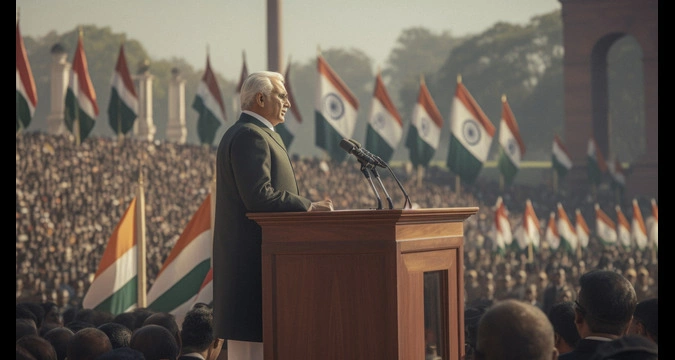
At the beginning of the first session after a general election and the first session of every year, the President addresses a joint sitting of Parliament under Article 87.
This address:
- Outlines the government’s legislative agenda,
- Highlights proposed policies and Bills,
- Sets priorities for the upcoming year.
Although the speech is drafted by the government, its constitutional importance lies in:
- Providing a formal roadmap of legislation,
- Allowing Parliament to debate and critique government intentions,
- Reinforcing democratic transparency.
The President’s Role in the Passage of Bills
The most visible and decisive aspect of the Role of the President in the Indian legislative process lies in how Bills become laws.
What Is a Bill?
A Bill is a proposed law. It must pass through:
- Introduction,
- Discussion,
- Voting in both Houses,
- And finally, Presidential assent.
Without the President’s assent, no Bill can become law.
Assent to Bills: The Final Constitutional Check
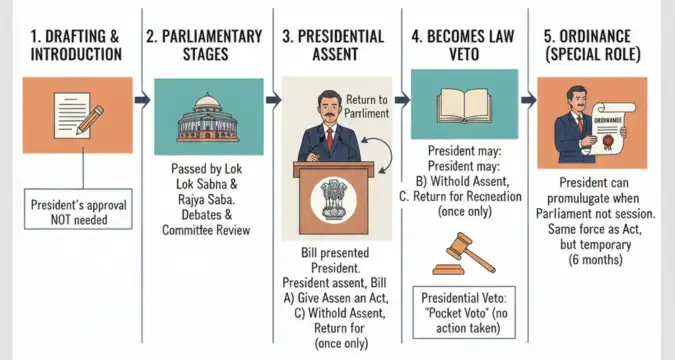
Once a Bill is passed by Parliament, it is presented to the President. The President has several options under Article 111.
1. Giving Assent
When the President gives assent:
- The Bill becomes an Act,
- It is notified and enforced.
This is the most common outcome and reflects constitutional harmony between the executive and legislature.
2. Withholding Assent
The President may withhold assent, effectively vetoing the Bill.
This power:
- Is rarely used,
- Acts as a constitutional safety valve,
- Prevents hasty or unconstitutional legislation.
3. Returning the Bill for Reconsideration
For non-Money Bills, the President can return the Bill to Parliament with recommendations.
If Parliament passes the Bill again, with or without amendments:
- The President is constitutionally bound to give assent.
This mechanism ensures:
- Dialogue between constitutional authorities,
- Legislative reflection,
- And democratic maturity.
Special Case: Money Bills and the President
Money Bills follow a unique process.
Key features:
- They can only be introduced in the Lok Sabha,
- They require the President’s prior recommendation,
- The Rajya Sabha can only make recommendations, not amendments.
In the case of Money Bills:
- The President cannot return the Bill for reconsideration,
- The President can either give or withhold assent.
This reflects the financial sovereignty of the elected House while retaining constitutional oversight.
Ordinance-Making Power: Legislating in Emergencies
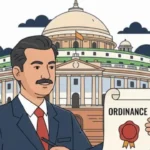
One of the most debated aspects of the Role of the President in the Indian legislative process is the power to promulgate ordinances under Article 123.
What Is an Ordinance?
An ordinance is a temporary law issued when:
- Parliament is not in session,
- Immediate legislative action is necessary.
An ordinance:
- Has the same force as an Act of Parliament,
- Must be approved by Parliament within six weeks of reassembly.
President’s Role in Ordinances
Although issued on the advice of the Council of Ministers, the President:
- Must be satisfied that circumstances require immediate action,
- Can question or seek clarification before promulgation.
This power ensures:
- Governance continuity during emergencies,
- But also raises concerns if misused.
The Supreme Court has clarified that ordinances should not replace regular legislation.
Joint Sitting of Parliament
When a Bill is deadlocked between the Lok Sabha and Rajya Sabha, the President can summon a joint sitting under Article 108.
A joint sitting:
- Is chaired by the Speaker of the Lok Sabha,
- Allows members of both Houses to vote together,
- Resolves legislative deadlocks.
This power:
- Ensures legislative efficiency,
- Prevents prolonged paralysis,
- Reinforces democratic decision-making.
The President as Guardian of the Constitution
Beyond formal powers, the President’s legislative role carries a moral and constitutional responsibility.
The President:
- Takes an oath to preserve, protect, and defend the Constitution,
- Acts as a silent sentinel against unconstitutional practices,
- Upholds democratic values during political uncertainty.
By exercising discretion carefully, especially in:
- Returning Bills,
- Seeking clarifications,
- Or advising reconsideration,
the President strengthens constitutional governance.
Discretionary Powers in Legislative Context
While India’s President generally acts on advice, there are rare situations where discretion matters.
Examples include:
- Choosing whom to invite to form a government,
- Deciding on dissolution of Lok Sabha,
- Handling Bills that may violate constitutional principles.
Such moments define the true depth of the Role of the President in the Indian legislative process.
President vs Parliament: A Relationship of Balance
The relationship between the President and Parliament is not adversarial. It is collaborative and corrective.
Parliament:
- Represents popular will,
- Debates and passes laws.
The President:
- Ensures constitutional compliance,
- Adds a layer of reflection,
- Prevents impulsive governance.
This balance protects democracy from both paralysis and authoritarianism.
Judicial Interpretation of the President’s Legislative Role
Indian courts have played a significant role in clarifying presidential powers.
Key judicial principles include:
- The President acts on aid and advice,
- Ordinance power cannot be misused,
- Assent powers must respect constitutional values.
Judicial scrutiny ensures that the President’s legislative role remains principled and restrained.
Why the President’s Legislative Role Matters Today
In an era of:
- Rapid law-making,
- Political polarisation,
- And complex governance challenges,
the President’s role has gained renewed relevance.
The President:
- Encourages constitutional discipline,
- Provides stability during transitions,
- Acts as a bridge between law and legitimacy.
Understanding the Role of the President in the Indian legislative process is essential for informed citizenship.
Common Misconceptions About the President’s Role
“The President Is Only Ceremonial”
This is inaccurate. While not politically active, the President holds decisive constitutional authority.
“The President Cannot Stop Laws”
The President may not permanently block legislation, but can:
- Delay,
- Recommend reconsideration,
- Raise constitutional concerns.
“The President Has No Discretion”
Discretion exists, though limited and context-specific.
Real-Life Perspective: Why This Role Exists
Imagine a system where laws are passed without:
- A final constitutional review,
- A neutral authority,
- Or any scope for reflection.
The President’s role acts like a quality control mechanism in governance, ensuring laws serve not just political goals, but constitutional ideals.
Conclusion: A Quiet Yet Powerful Constitutional Office
The Role of the President in the Indian legislative process is subtle, structured, and profoundly important. It is not about daily politics, public speeches, or executive dominance. It is about safeguarding the democratic framework, ensuring legislative accountability, and maintaining constitutional balance.
The President may not write laws, but without the President, laws cannot exist.
In a vibrant democracy like India, this role remains indispensable, quiet in function, powerful in impact, and timeless in constitutional relevance.
More Read

Frequently Asked Questions (FAQs)
1. Does the President of India have real power in the legislative process?
Yes, the President of India plays a constitutionally significant role in the legislative process. While the President usually acts on the advice of the Council of Ministers, powers such as giving or withholding assent to Bills, returning non-Money Bills for reconsideration, promulgating ordinances, and summoning or dissolving Parliament provide meaningful constitutional influence rather than mere ceremonial presence.
2. Can a Bill become law without the President’s approval?
No, a Bill cannot become law without the President’s assent. Even after a Bill is passed by both Houses of Parliament, it only becomes an Act when the President gives assent. This makes the President an essential final authority in the legislative process of India.
3. Can the President reject a law passed by Parliament?
The President can withhold assent to a Bill or return a non-Money Bill to Parliament for reconsideration. However, if Parliament passes the Bill again after reconsideration, the President is constitutionally bound to give assent. This ensures balance between parliamentary supremacy and constitutional oversight.
4. What is the role of the President in making ordinances?
When Parliament is not in session and immediate action is required, the President can promulgate an ordinance. An ordinance has the same force as an Act of Parliament but is temporary and must be approved by Parliament within six weeks of its reassembly. This power allows governance continuity while maintaining legislative accountability.
5. Why is the President considered part of Parliament in India?
The Constitution includes the President as a component of Parliament to ensure constitutional supervision over law-making. By being part of Parliament, the President provides a neutral, stabilising influence that upholds constitutional values, prevents procedural misuse, and reinforces democratic legitimacy in the legislative process.