Air pollution has quietly become one of the most defining public health challenges of our time. Yet, when people hear that the AQI today is 180 or 320, the number often feels abstract. Is it dangerous or just uncomfortable? Should schools remain open? Can you go for a morning walk? These are the real questions that arise in people’s minds, and they are also the exact questions students face in classrooms, competitive exams, and environmental studies.
This article is written to bridge that gap. It explains AQI levels in clear language for curious people and students who need it academically. Whether you are a concerned citizen, a student preparing for exams, or someone simply trying to make sense of daily air pollution alerts, this guide is designed to give you clarity and confidence.
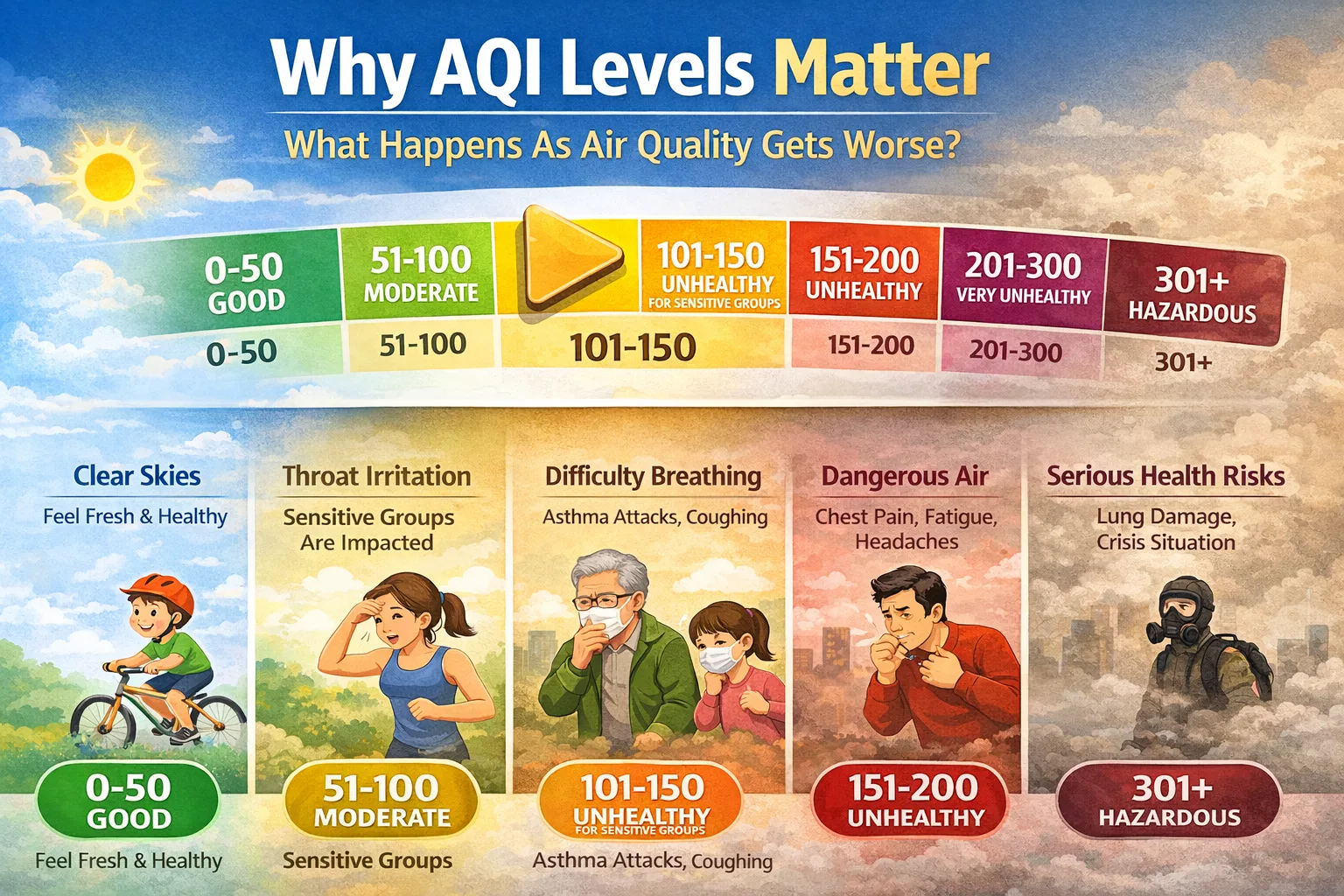
What Is AQI in Simple Terms?
AQI stands for Air Quality Index. It is a numerical scale used to communicate how clean or polluted the air is and what the associated health effects might be. Instead of presenting complex scientific data about dozens of pollutants, AQI simplifies everything into a single number that people can easily understand.
Think of AQI as a health thermometer for the air. Just as body temperature tells you whether you are normal, feverish, or critically ill, AQI tells you whether the air around you is safe to breathe or potentially harmful.

Also Read: Flights Delayed In winter
The AQI value is calculated using the concentration of major air pollutants, most commonly:
- Particulate Matter (PM2.5 and PM10)
• Nitrogen Dioxide (NO₂)
• Sulphur Dioxide (SO₂)
• Carbon Monoxide (CO)
• Ozone (O₃)
• Ammonia (NH₃) in some countries like India
Among these, PM2.5 often plays the most dominant role in pushing AQI into unhealthy zones, especially in urban India.
Why Was AQI Created?
Before AQI systems existed, air pollution data was available only in technical formats understood mainly by scientists. Governments realized that if people could not understand pollution levels, they would not change their behavior or support policy action.
AQI was created to serve three purposes.

First, to inform the public in a simple and immediate way.
Second, to guide daily decisions such as outdoor activity, school closures, and work advisories.
Third, to create accountability by making pollution levels visible and comparable across cities and time periods.
For students, AQI represents an excellent example of how science, policy, and public communication intersect.
How AQI Is Measured
Each pollutant has its own concentration measured in micrograms per cubic meter or parts per million. These raw values are converted into sub indices using standard formulas. The highest sub index among all pollutants becomes the AQI for that location and time.

This means AQI does not represent an average of all pollutants. It reflects the worst pollutant at that moment. If PM2.5 is extremely high while others are moderate, PM2.5 will dominate the AQI reading.
This is why two cities with the same AQI number might have different dominant pollutants and different long term health implications.
Also Read: Pollutions is Everyone’s Problem
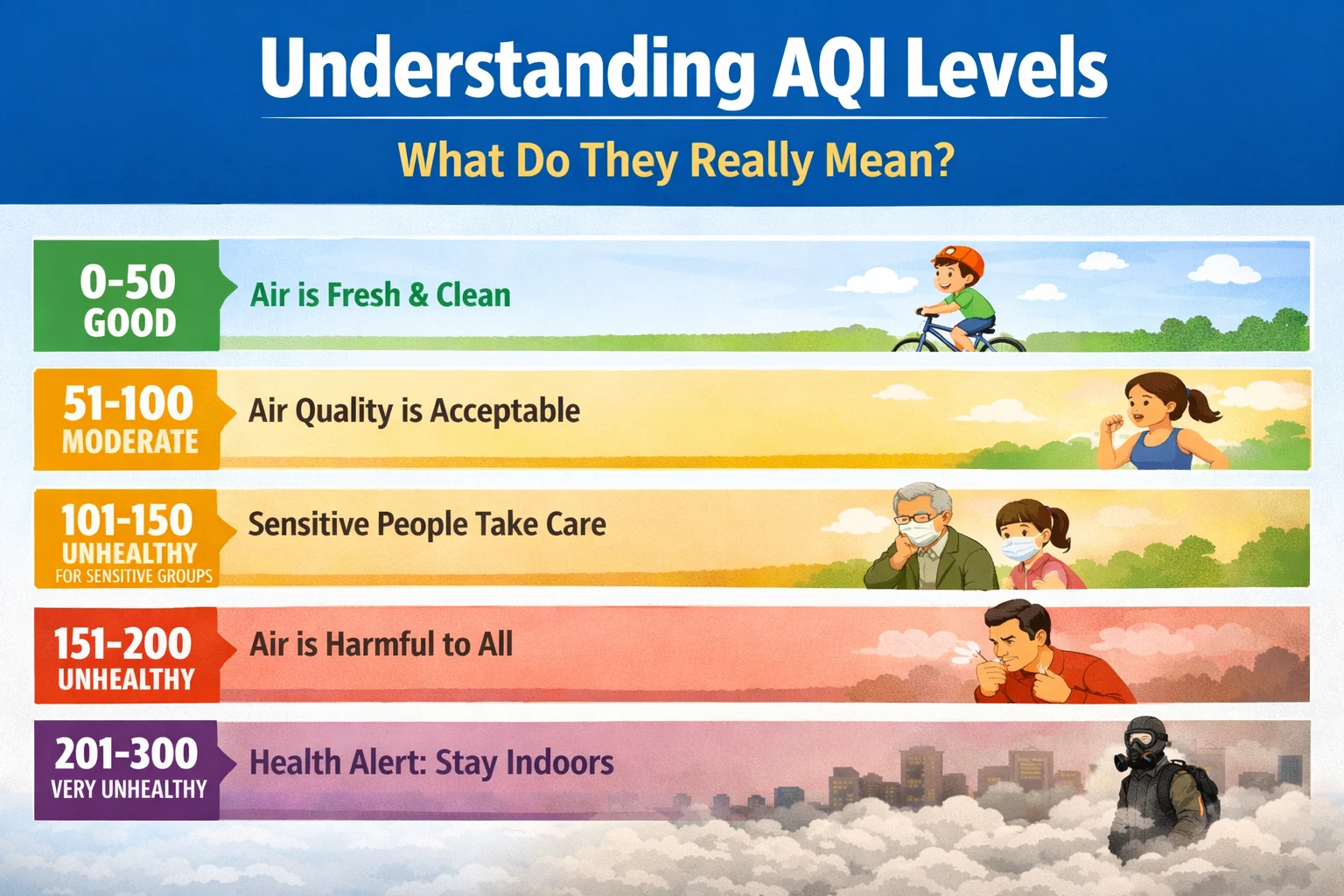
AQI Categories and What They Actually Mean
Understanding AQI numbers is the most important part of this discussion. Below is a practical explanation of each category, going beyond textbook definitions.
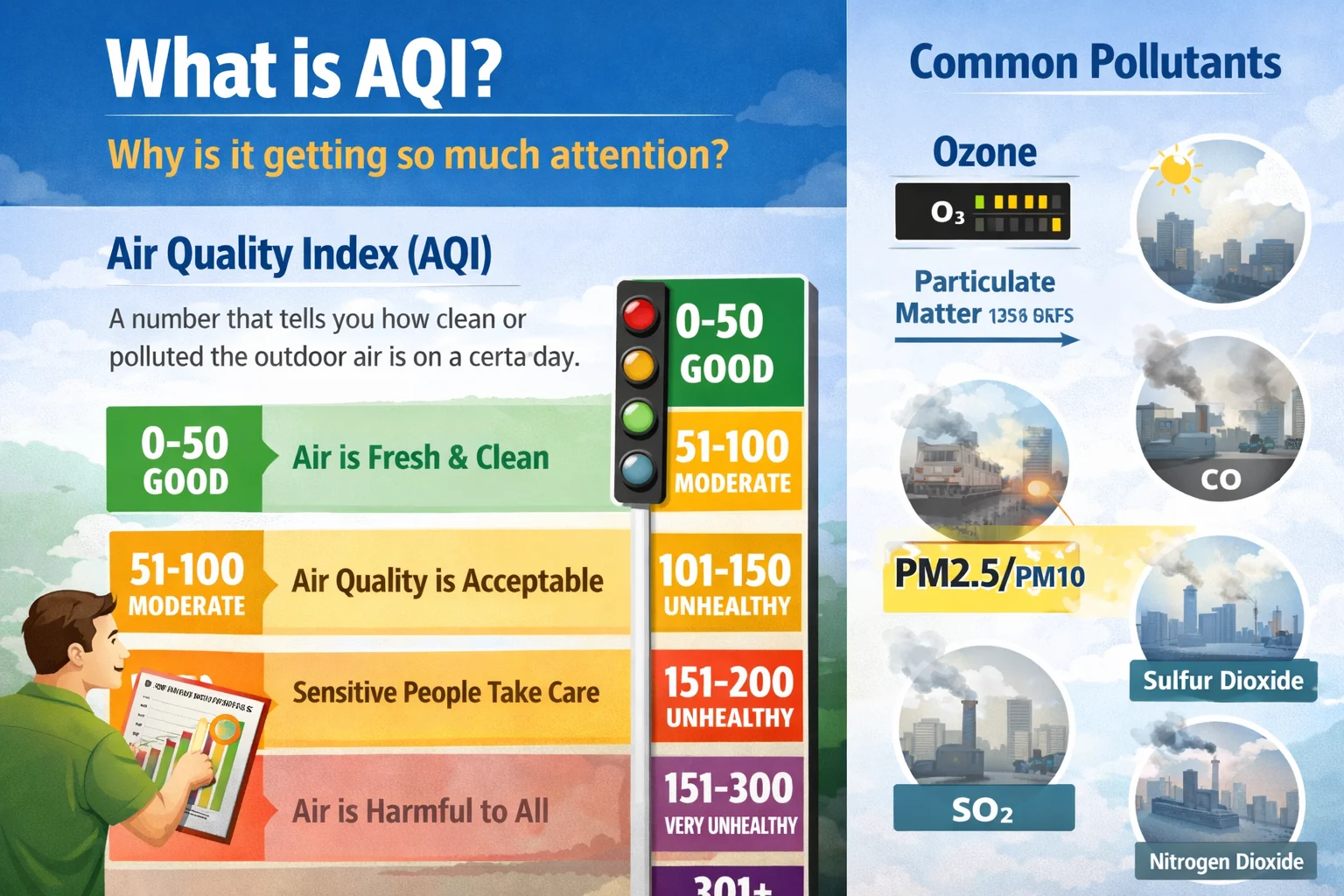
AQI 0 to 50 – Good
This is the ideal range. The air is clean and poses little or no risk to health.
What it actually means in daily life:
• You can breathe freely without irritation
• Outdoor exercise is completely safe
• Children, elderly, and people with asthma face no additional risk
For students, this level represents baseline environmental conditions and is often used as a reference point in exams.
AQI 51 to 100 – Satisfactory or Moderate
Air quality is acceptable, but some pollutants may slightly affect very sensitive individuals.
Real world meaning:
• Most people feel no impact
• People with severe asthma or allergies may feel mild discomfort
• Long outdoor workouts are still safe for the majority
This range often goes unnoticed, which is why pollution can quietly worsen without public alarm.
AQI 101 to 200 – Moderately Polluted
This is the first level where pollution begins to matter for a large population.
What people actually experience:
• Mild throat irritation or coughing after long exposure
• Reduced stamina during physical activity
• Increased use of inhalers among asthma patients
For students, this category is important because it marks the threshold where air quality begins to affect productivity, concentration, and attendance.
AQI 201 to 300 – Poor
Air quality is clearly unhealthy, especially for vulnerable groups.
Practical implications:
• Breathing discomfort even for healthy individuals
• Headaches, eye irritation, and fatigue become common
• Children and elderly should limit outdoor exposure
Schools may reduce outdoor activities at this level. Long term exposure can begin to affect lung function.
AQI 301 to 400 – Very Poor
This level indicates serious air pollution with significant health risks.
What this means in reality:
• Noticeable breathing difficulty
• Increased hospital visits for respiratory issues
• Outdoor exercise becomes unsafe
Students often experience reduced attention spans and higher absenteeism during prolonged exposure at this level.
AQI 401 to 500 – Severe
This is an air quality emergency.
Actual consequences:
• Health effects even for healthy individuals
• Sharp rise in respiratory and cardiovascular cases
• Schools may be closed
• Governments may implement emergency measures
At this stage, pollution is no longer an environmental issue alone. It has become a public health crisis.
Why PM2.5 Is So Dangerous
PM2.5 particles are extremely small, about 30 times thinner than a human hair. Because of their size, they bypass the nose’s natural filters and penetrate deep into the lungs, even entering the bloodstream.
Long term exposure to PM2.5 is linked to:
• Reduced lung capacity
• Heart disease
• Stroke
• Premature death
• Cognitive decline in children
This is why AQI discussions often focus heavily on PM2.5 levels.
Common Misconceptions About AQI
One common myth is that masks solve all problems. In reality, only certified N95 or similar masks offer meaningful protection, and even they are not a complete solution.
Another misconception is that indoor air is always safe. Indoor pollution from cooking, incense, smoking, and poor ventilation can sometimes be worse than outdoor air.
Students should note these misconceptions as they frequently appear in conceptual questions.
How AQI Affects Students Specifically
Polluted air affects learning in subtle but measurable ways.
- Reduced oxygen intake impacts concentration
• Increased absenteeism due to illness
• Higher fatigue levels during exams
• Long term exposure can affect lung development in children
Understanding AQI is therefore not just an academic topic. It directly relates to student health and performance.
What Individuals Can Do at Different AQI Levels
Awareness without action has limited value. Practical steps include:
- Monitoring daily AQI through reliable apps
• Adjusting outdoor activities based on AQI levels
• Using air purifiers indoors when necessary
• Improving ventilation instead of sealing rooms completely
• Supporting public transport and cleaner energy policies
These actions may seem small but collectively create pressure for systemic change.
Also Read: Why India Facing Coldest Winter in 2026
Why AQI Matters for the Future
AQI is not just about today’s discomfort. It is a signal of how sustainable our cities and lifestyles are. Rising AQI levels reflect unchecked urbanization, fossil fuel dependence, and weak environmental enforcement.
For students, AQI represents a living case study of climate change, governance, economics, and public health intersecting in real time.

Final Thoughts
AQI numbers are not abstract statistics. They represent the quality of every breath we take. Understanding what AQI levels actually mean empowers people to protect themselves, demand accountability, and make informed choices.
For The Vue Times, this topic fits perfectly into the mission of explaining complex national issues in a practical, and forward looking. When people understand AQI, they begin to understand why clean air is not a luxury but a basic right.
Clean air should never be a privilege. It should be the standard we measure progress against.