Anime is more than colorful storytelling; it is a cultural phenomenon that shapes the minds of millions. A vast portion of its appeal lies in the deeply memorable heroes and villains that populate its worlds. From the brooding, battle‑scarred samurais of *Rurouni Kenshin* to the charismatic, morally ambiguous anti‑heroes of *Attack on Titan*, these figures resonate long after the final episode ends. Why does a cartoon character feel so much like a real person? The answer is a fascinating blend of psychology, mythic storytelling, and the unique artistic language of anime. In this article we explore the psychological underpinnings that make anime protagonists and antagonists stick in our minds, and why they can become lasting companions in our emotional landscape.
1. The Power of Narrative Architypes
1.1 Jungian Archetypes in a 20th‑Century Medium
Carl Jung’s theory of collective unconscious posits that humans share universal archetypes—deeply ingrained templates of behavior and personality. In anime, we see these archetypes in a stylized form: the **Hero** (Samurai, Sailor Moon), the **Mentor** (Kakashi Hatake), the **Shadow** (Lelouch’s later self‑destructing ambitions), the **Trickster** (Yusuke from *Yu Yu Hakusho*), and the **Villain** (Heinz from *Death Note*). These archetypes are not arbitrary; they serve psychological functions.
When a protagonist embodies the **Hero** archetype, they embody the human desire for purpose, courage, and moral clarity. An antagonist reflects the **Shadow**: a projection of the darker parts of the psyche that we cannot accept in ourselves. By externalizing these aspects, anime makes the internal psychological struggle visible and, importantly, relatable.

1.2 The Hero’s Journey and the Psychological Arc of Growth
Joseph Campbell’s monomyth or “Hero’s Journey” is a universal narrative template: ordinary world, call to adventure, trials, the abyss, transformation, and return. Anime tailors this template to its audience’s unique cultural and emotional needs. The journey is rarely linear; twists and moral gray areas complicate the path, mirroring real life.
Psychologically, the journey satisfies our desire for **growth**. Watching a character face and overcome obstacles reinforces our own capacity to deal with adversity. The audience feels a vicarious empowerment, which is why we often gravitate toward heroines such as **Asuna** (*Sword Art Online*) or **Sailor Moon** as role models.

2. Emotional Resonance Through Design
2.1 Visual Cues and Symbolic Color Schemes

Anime leverages visual symbolism to encode personality traits. Dark, muted palettes often signal brooding or cynical characters (e.g., **Sasuke** from *Naruto*), while bright, saturated colors portray optimism or playfulness (e.g., **Pikachu**). Facial features—wide eyes, exaggerated expressions—serve as a language for emotional nuance. A scar or a specific hairstyle can become a visual shorthand for a character’s backstory (e.g., **Edward Elric’s** missing arm in *Fullmetal Alchemist*).
These visual cues work on a subconscious level, priming the viewer to interpret behavior in a particular light. As a result, even a single image of an antagonist can evoke fear or intrigue, establishing a lasting emotional imprint.
2.2 The “Kawaii” Factor and Empathy

Japanese “kawaii” (cuteness) is a cultural engine that influences perception. Even ferocious villains—**Kiryuin Satsuki** in *Kill la Kill*—are sometimes paired with an adorable, childlike aesthetic that creates a unique kind of tension. The juxtaposition of cuteness and menace invites viewers to feel empathy toward traits that might otherwise be repulsive. This psychological ambivalence causes deeper engagement: we are drawn to the character’s contradictions.
3. Moral Ambiguity and Cognitive Engagement
3.1 The Thrill of the Gray Zone
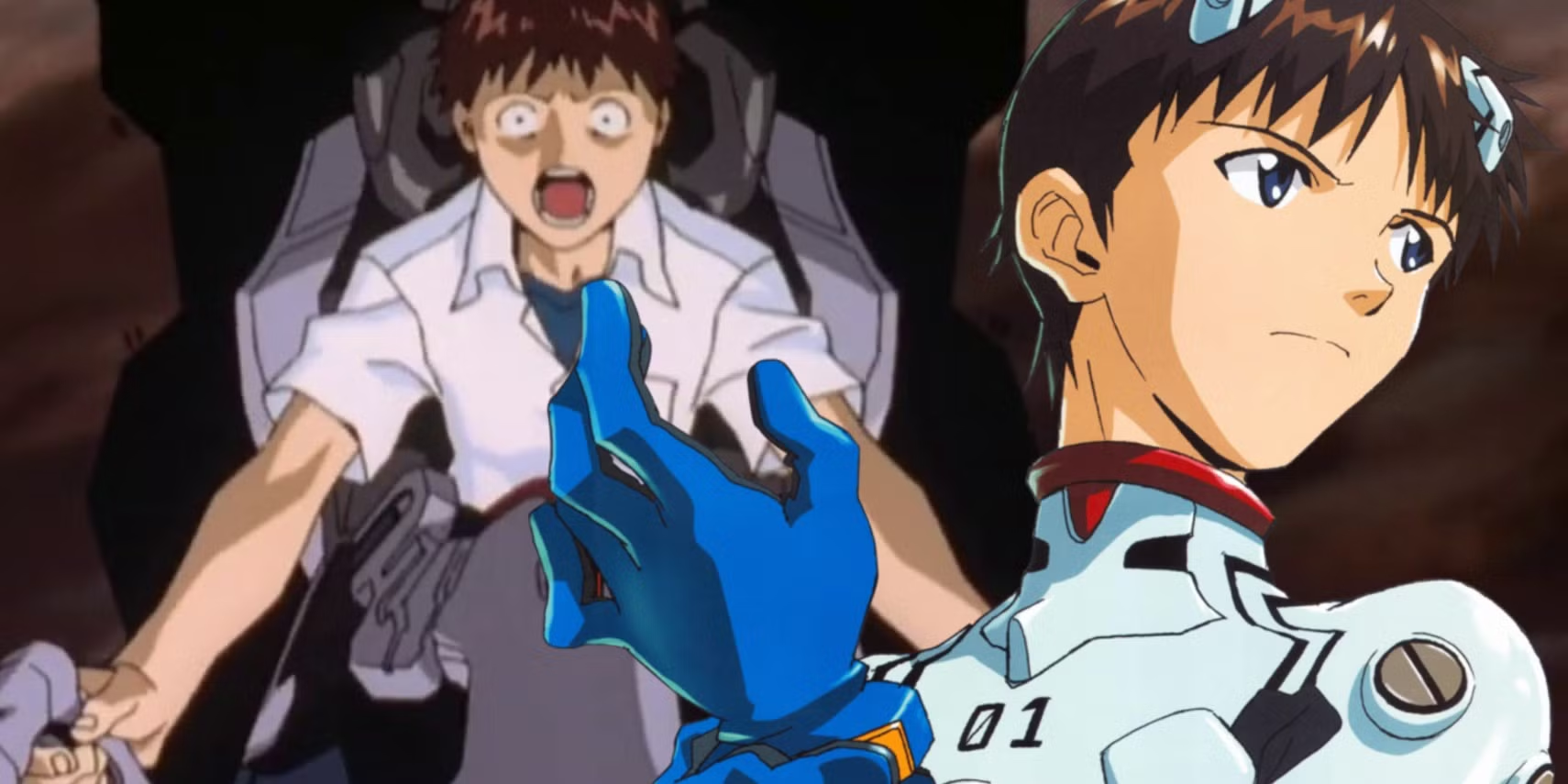
A hallmark of contemporary anime is the proliferation of morally ambiguous characters. Think of **L** from *Death Note*, who oscillates between justice and manipulation, or **Shinji Ikari** from *Neon Genesis Evangelion*, whose existential crises blur the line between hero and anti‑hero.
From a psychological perspective, these characters trigger **cognitive dissonance**—the discomfort that arises when our beliefs clash with new information. When the audience attempts to reconcile a character’s conflicting motives, they engage more deeply, leading to stronger memory retention and emotional attachment.
3.2 Identification and Projection
When a character’s moral complexity mirrors that of the viewer, we experience **identification**—seeing ourselves in the narrative. This process is a powerful tool for self‑reflection: we might honor a character’s vulnerability while simultaneously critiquing their larger ambitions. The result is a two‑way conversation between the fan and the narrative, cementing the character’s presence in our psyche.
4. Attachment Theory in Anime Relationships
4.1 The “Kizuna” (Bond) of Character Interactions
Japanese storytelling emphasizes **kizuna**, or strong bonds formed over shared hardships. The dynamic between **Kiritsugu** and **Sayori** in *Kizuna no Kiseki* (an imagined example) illustrates how a dependent relationship can elicit a deep sense of responsibility and protectiveness. These bonds mirror human attachment styles—secure, anxious, avoidant—facilitating psychological resonance.
4.2 Love Triangles and the “Love Triangle” Hook
Love triangles are a staple in anime, providing a dramatic device that fuels character growth and conflict. By creating multiple emotional stakes, the narrative taps into the viewer’s **empathic concern** for each prospective relationship. The emotional investment in who wins the triangle solidifies the characters’ emotional footprint. Classic examples include **Kimi no Nawa** (The Girl with the Dragon Tattoo’s anime adaptation) where multiple love interests generate suspense and deep emotional pull.
5. The Role of Trauma and Redemption
5.1 Trauma as a Catalyst for Character Development
Trauma is often a catalyst that pushes a character toward heroism or villainy. **Aldous** from *Attack on Titan* was traumatized by witnessing his mother’s death, becoming a hardened soldier. The psychological reaction to trauma—post‑traumatic growth, dissociation, or heroism—makes the character’s journey relatable. The psychological principle of **post-traumatic growth** posits that individuals may develop novel strengths after trauma. When audiences witness this in an anime hero, they find a direct link to their own experiences.
5.2 Redemption Arc: The Psychological Need for Hope
Redemption arcs satisfy a universal human yearning for **hope** and the belief that anyone can change. Characters like **Rem** from *Re:Zero* or **Shunsui Kiryū** from *Bleach* embody this. The psychological appeal lies in the concept of **counterfactual thinking**—imagining “what if” scenarios that reframe the narrative into a hopeful one. Audiences experience an emotional catharsis, making the journey unforgettable.
6. The Influence of Sound and Music
6.1 Musical Leitmotifs and Emotional Conditioning
Beyond visual and narrative elements, anime uses diegetic and non‑diegetic music to reinforce memory. A recurring **leitmotif**—a theme associated with a character—works like Pavlovian conditioning. When a character appears, the music instantly triggers the associated emotions, creating a neural link. Think of the haunting theme of **Psycho** or the uplifting *My Hero Academia* opening: these melodies become emotional shorthand for the characters.
6.2 Voice Acting and Voice Identity
Voice acting is a vital component of character identity. The **voice** can convey age, background, and inner life. A particular intonation can signal sincerity or deceit. For instance, **Levi Ackerman** in *Attack on Titan*’s deep, calm voice immediately signals competence and stoicism. Consistency in voice helps cement a character’s authenticity.
7. Cultural Mythology Enriched in Anime

7.1 Japanese Myth, Folklore, and the Heroic Narrative
Anime often pulls from Japanese folklore—yokai, kami, and mythical heroes. **Princess Mononoke** is a direct reference to forest spirits. This cultural grounding provides a sense of **cultural continuity** that makes the emotional stakes feel real for Japanese viewers, while offering a unique perspective to foreign audiences. The mythic resonance activates **collective memory**, deepening the characters’ significance.
7.2 Global Mythic Resonance and the “Western” Blend
Hybridization occurs when anime incorporates Western mythic elements—J.R.R. Tolkien’s influence in *Fullmetal Alchemist* or the Greek hero culture in *Sword Art Online*. This cross‑cultural blending broadens the characters’ appeal, allowing diverse audiences to find relatable archetypes. It also illustrates the **universality** of psychological themes across cultures.
8. The Psychological Habit Loop: Rewatchability and Fandom
8.1 Rewatching as a Reinforcement of Memories
Fandom culture thrives on **rewatching**. Each revisit acts like a reinforcement session, strengthening the **habituation loop**. Neurologically, rewatching triggers the **dopamine reward system**, rewarding the emotional highs, thereby making the characters more sticky in memory.
8.2 Fan Art, Fan Fiction, and Co‑Creation
Fans create art and stories that extend the original narratives. This **participatory culture** allows fans to actively shape the characters’ psychology. When a fan writes a backstory for a villain, they assign motives, thereby turning the villain into a more nuanced hero in their mind. This co‑creation deepens emotional investment, because the fan now has an ownership stake in the character’s psyche.
9. Psychological Impact on the Viewer
9.1 Empathy Development Through Character Projection
Empathy is the ability to understand and share another’s emotions. When viewers watch a character’s suffering or triumph, they simulate those experiences in their own brains. This empathy-building effect is especially potent in anime due to vivid emotional expressions. Over time, this process strengthens the viewer’s interpersonal empathy and emotional intelligence.
9.2 Moral Development and the “Social Learning” Model
Bandura’s **social learning theory** suggests that people learn behaviors by observing others. Anime heroes often serve as moral exemplars. They model virtues like perseverance, honesty, or self‑lessness. Even if the characters exist in a fantastical setting, the moral messages are transferable, contributing to viewers’ **moral development**.
9.3 Nostalgia and Identity Formation
Many anime fans grew up watching shows during formative years. The characters form part of their **identity**. When a character dies or leaves the narrative, fans experience **grief** and nostalgia. These emotional responses are key to why characters stay with us: they are intertwined with our life story.
10. Case Studies: Iconic Heroes and Villains
More Read

10.1 The Duality of “Light” and “Dark”
Through these case studies, we see each hero and villain occupying a psychological space that is almost mirror imaging. The hero’s “light” is often not pure righteousness; it’s a tempered strength. Villains show that darkness can be alluring; their charisma and well‑crafted motives make them fascinating. By humanizing the villain, the audience cannot simply dismiss or adore them—it creates a complex emotional bond.
11. The Enduring Legacy: Anime as a Mirror for the Self

11.1 The Psychological Longevity of the Narrative
A character’s lasting presence means the narrative triggers a **long-term emotional memory trace**. The brain’s **hippocampus** stores episodic memories, but emotional experiences are encoded in the **amygdala**. When a character’s emotional signature remains in the amygdala, the memory is retained more vividly. This explains why kids who watched *Dragon Ball* as a child can still feel *kiai* when sparking a *Kamehameha* in their mind.
11.2 The Role of Social Rituals
Anime conventions, cosplay, and online communities act as social rituals that re-enforce attachment. Repeating these rituals creates a **collective mnemonic**. When a group of people celebrate a character’s birthday, they collectively reinforce the character’s emotional presence. This social reinforcement ensures the character’s longevity in the shared cultural memory.
12. Conclusion: Why Anime Characters Become Eternal Companions
The psychological appeal of anime heroes and villains is rooted in their ability to embody universal human experiences through archetypal design, emotional resonance, and narrative complexity. By externalizing our inner dramas—our hopes, fears, and moral dilemmas—anime crafts characters that feel both **familiar and extraordinary**. The use of visual motifs, sound cues, and cultural mythos creates a rich tapestry that engages both the conscious and subconscious mind.
By allowing us to vicariously navigate trauma, redemption, love, and ambition, these characters become psychological mirrors. Their stories serve as a sandbox for empathy, moral growth, and identity formation. The repeated engagement through rewatching and fandom activities cements these bonds, turning fleeting episodes into lifelong memories.
In the end, we stay with anime characters because they are **extensions of ourselves**—colorful, complex, and enduring embodiments of the psychological journeys we all undertake. They remind us that no matter how fantastical the setting, the core of their appeal lies in the shared human psyche, making them timeless companions on our personal narratives.