In the 2025 Bihar Legislative Assembly elections, the political landscape has produced a split but telling signal from exit polls: while most pollsters forecast a victory for the ruling National Democratic Alliance (NDA) coalition, one prominent agency — Axis My India — projects that the Rashtriya Janata Dal (RJD) may emerge as the single-largest party even if the NDA forms the government. This nuance has stirred intrigue among political watchers, as it could reshape internal power dynamics within alliances and set the narrative for state and national politics.
Exit-Poll Snapshot
Exit polls released after polling concluded (on 6 and 11 November) show a broad trend of advantage for the NDA, yet with a key caveat: Axis My India’s methodology suggests the NDA may win the majority of seats, but the RJD could finish ahead of BJP and JD(U) individually. Key figures include:
- Axis My India projects the NDA at 121-141 seats in the 243-seat assembly, just past the 122-seat majority mark.
- In that projection, the RJD alone is expected to win 67-76 seats, while JD(U) gets 56-62 and BJP 50-56.
- Other pollsters (e.g., Dainik Bhaskar, People’s Pulse) project the NDA at ~145-160 seats, a clearer majority.
- The NDA is thus seen as likely to form government, but the precise seat-share and party-wise ranking could matter politically within the coalition.
What the Split Means
Governing alliance vs party dominance
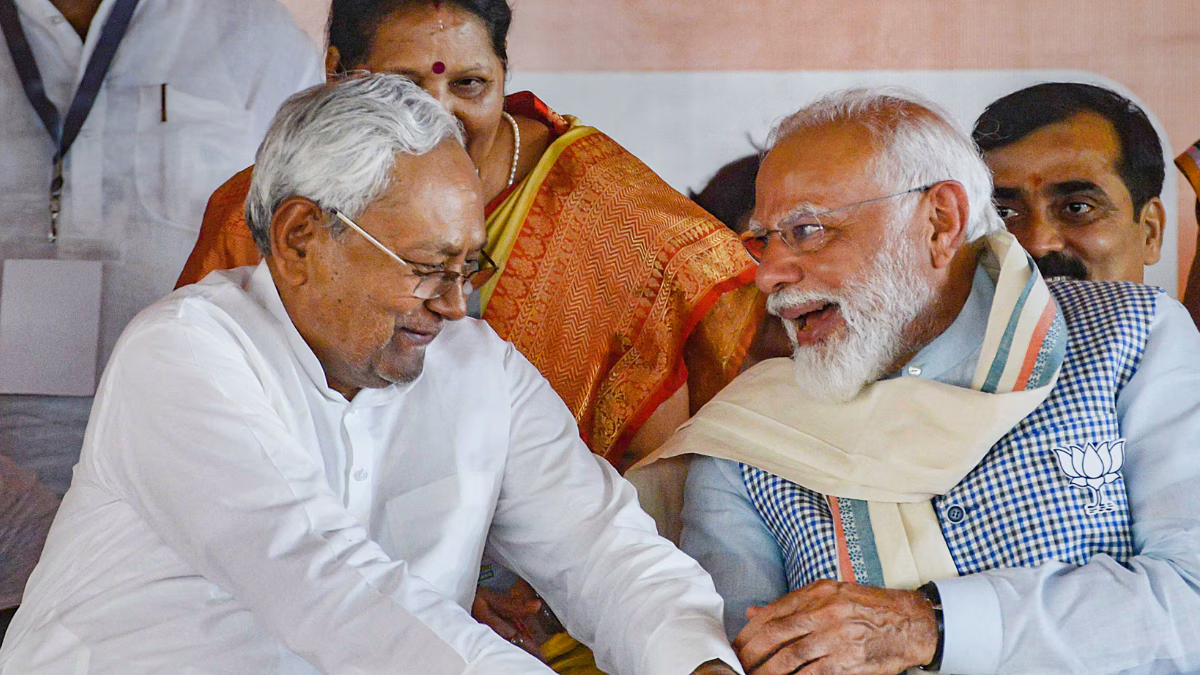

For the NDA, forming the government would be one thing — but having which party within the alliance dominate matters just as much. If RJD ends up the largest party in the opposition, or even within the alliance context (if it switched sides), that could affect who leads, how portfolios are distributed, and who drives the agenda.
In contrast, if the BJP or JD(U) ends up clearly ahead, they may assert stronger control over the coalition. The Axis My India projection suggests the RJD (in the opposition camp) could claim a moral win and argue for leadership even as the NDA forms government.
More Read

Narrative & momentum for the opposition
The RJD being single-largest party — even while trailing the NDA alliance — gives them a narrative boost: “we may not form government, but we lead the largest party” can help claim credibility, influence, and momentum for future elections. It may also boost the bargaining power of the RJD and its leader Tejashwi Yadav in post-poll negotiations, alliances or opposition leadership.
Internal alliance balance

Within the NDA, if seat shares are close among BJP, JD(U) and allied smaller parties, internal jockeying may intensify. The party with the largest share often claims the Chief Minister’s post, key ministries and future candidacies. A narrower win means these internal contests become more acute. The split signals could heighten such tensions.
Why the Polls Diverge
Methodological differences
Axis My India’s survey appears to emphasise party-wise seat projections rather than purely alliance outcomes. Their predictions specify seat ranges for each major party. Other pollsters focus on alliance seat totals, often projecting a big win for the NDA as a whole. This difference yields the nuance of “NDA wins, but RJD largest single party.”

Vote-share vs seat conversion
Some pollsters show the NDA getting ~43 % vote share, the opposition ~41 %. Despite the narrow gap, efficient distribution of votes (cluster wins) may give the NDA a clear seat advantage. Axis My India projects ~43% for NDA vs ~41% for MGB (Mahagathbandhan) but still RJD ahead party-wise.
Regional and caste dynamics
The divergence also reflects region-wise and caste-wise voting variations. For instance, Axis My India’s caste breakdown suggests NDA leads among women and non-Yadav OBCs, while RJD remains strong among Yadav/Muslim blocs. These micro-variations may affect party-level totals even as alliances remain competitive.
Political Context in Bihar

The alliances
- NDA: Led by JD(U) and BJP, along with smaller partners like HAM, LJP-RV etc.
- Mahagathbandhan (MGB) / INDIA bloc: Led by RJD, along with Congress, Left parties and others.
- There is also the newcomer–Jan Suraaj Party (JSP), led by Prashant Kishor — expected to contest but pollsters project minimal seats (0-5) given its first outing.
Prior performance
In the 2020 elections, the NDA had secured about 125 seats, and the RJD-led MGB had done well but fell short of power. Incumbent Chief Minister Nitish Kumar (JD(U)) leads the NDA in 2025 and campaigned on governance, stability and welfare; the opposition emphasised change, youth vote, and consolidation of Yadav/Muslim votes.
Key issues
- Record turnout (~67 %) across both phases indicates heightened voter engagement.
- Social welfare schemes by NDA government; opposition criticized governance lapses and promised change.
- Small parties and new entrants could hurt either alliance by splitting votes — though exit polls show limited impact for JSP.
- Caste bloc shifts: the Yadav/Muslim axis remains strong for RJD; non-Yadav OBCs, women voters and Dalits have been targeted by NDA via welfare/policies.
What to Watch
Counting Day (14 November): The actual seat break-up will clarify which projection holds true — axis survey or others.
Who becomes CM: If NDA wins but RJD is single-largest, there may be pressure for power sharing or nominations of CM from RJD (less likely but narrative-worthy).
Party vs Alliance leadership: Within NDA, if seats among BJP/ JD(U)/ allies are close, leadership conflict may arise over CM post, ministries, future candidacies.
Opposition strategy: If RJD ends up large while still out of power, it may rebuild momentum for 2029 general elections, assert opposition leadership in Bihar.
Voter dynamics for next elections: Which voter segments moved? How did JSP or other new entrants fare? Caste shifts will be analysed in detail post-results.
Benchmarks for national politics: Bihar is often treated as barometer for future national elections; a strong NDA showing may boost its narrative, while RJD’s relative strength may revitalise INDIA bloc efforts.
Implications
For governance
If NDA forms government with a decent margin, it will claim mandate for continuity, development, stability and welfare. A thinner margin means more cautious governance, potential alliances with smaller parties, and maybe more concessions. If RJD is single-largest in opposition, it may hold more sway in legislative dynamics, committees and public narrative.
For political alignment
The projection gives RJD a psychological edge: winning most seats for itself enhances its bargaining power within the opposition. It also means BJP/JD(U) must guard against internal splits and vote erosion. Minor parties and third-front actors (like JSP) may need to rethink strategy given weak showing in polls.
For future electoral trends

- Caste realignment: Non-Yadav OBCs, Dalits, women voters may be showing shifts.
- Welfare politics: The role of targeted transfers, women-oriented schemes, prohibition (in Bihar) may influence vote patterns.
- Youth / first-time voters: With high turnout, new voters may not align strictly to old caste-party formulas; their choices will shape next decade.
- Third-front viability: The projected 0-5 seats for JSP suggest limited immediate impact — but its vote-share (even if small) could be crucial in tight contests.
Risks & caveats
- Exit polls are not always fully accurate; they indicate trends, not final results. Analysts caution against over-reliance.
- Seat conversion depends on micro-factors: candidate strength, local issues, reserved seats, margin of victory.
- The difference between alliance vote-share and seat tally can be large; one party may dominate coalition seats even if vote-share is similar.
- Post-poll negotiations, defections or seat-sharing could alter formation dynamics regardless of initial simple majority.
Final Thoughts
The 2025 Bihar Assembly election is turning into a significant moment: the exit polls suggest the NDA is poised for a win, yet the political story is richer than a simple “victory”. The nuance that the RJD might end up single-largest party — even as the opposition alliance loses — underscores shifting party dynamics, evolving voter bases and complex alliance politics.
For the electorate, the high turnout signals that Bihar voters are engaged, aware and willing to make new choices. For political parties, the message may be: coalition management, local issues, candidate selection and caste-coalition engineering remain as important as ever.
And for viewers of national politics, the result will be a bellwether: whichever way Bihar swings, it will send ripples across India’s electoral landscape.