In a speech that sought to redefine America’s role in one of the world’s most volatile regions, former U.S. President Donald J. Trump declared what he called the “Historic Dawn of a New Middle East.” Speaking to an audience of diplomats, business leaders, faith representatives, and political supporters, Trump painted a sweeping vision of a transformed Middle East — one marked by peace agreements, new alliances, economic cooperation, and what he described as “an era of unprecedented hope.”
The speech, delivered in a packed Washington auditorium amid chants, applause, and several moments of protest, has since become one of the most talked-about political events of the season. While Trump’s supporters hailed it as proof of his unmatched diplomatic achievements, critics dismissed it as a self-congratulatory showpiece detached from the realities of the region.
Regardless of perspective, the evening symbolized Trump’s continuing ability to dominate the political conversation — and his bid to reclaim the global stage with a mix of defiance, charisma, and nationalist rhetoric.
The Setting: Pageantry and Political Precision
The event was choreographed with signature Trumpian flair. Red, white, and blue spotlights illuminated a large backdrop reading “Peace Through Strength — A New Middle East.” The hall was filled with American flags and images of historic handshakes between Israeli and Arab leaders from past peace summits.

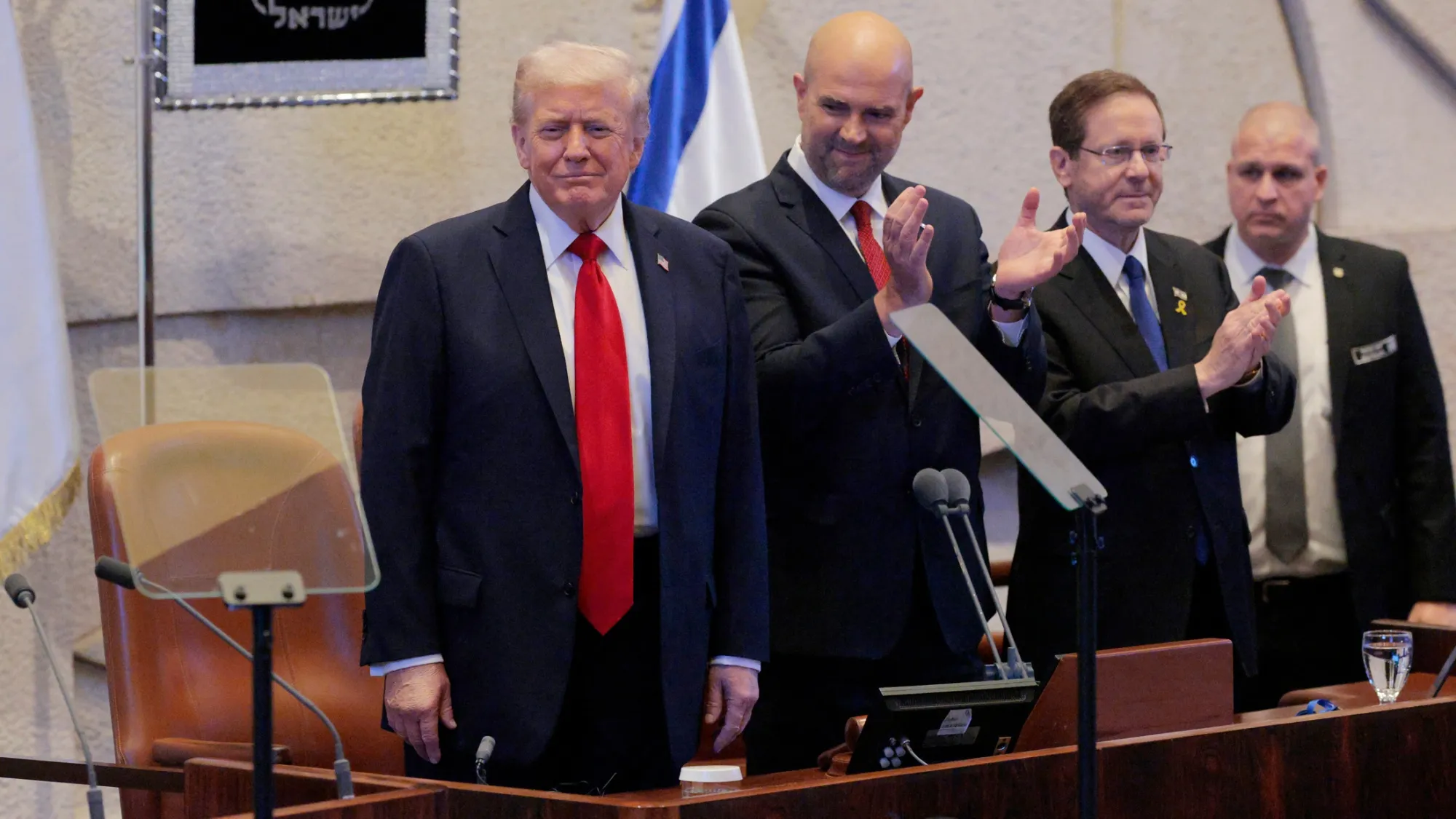
Trump entered to a standing ovation as the theme song from his 2020 campaign played. Television crews from around the world captured every moment.
Among the attendees were former ambassadors, American-Israeli lobbyists, business magnates, evangelical pastors, and conservative think-tank figures. Several Arab-American businessmen and two representatives from Gulf nations were also present.
Security was tight, with Secret Service agents stationed at every exit. Outside, a group of around 2,000 protesters gathered — holding banners reading “No Peace Without Justice,” “Stop Hypocrisy on Palestine,” and “Trump Lies, People Die.”
Inside, however, the atmosphere was electric. Trump walked to the podium, smiled, and said his opening line — “They said peace in the Middle East was impossible. We proved them wrong.” The audience erupted in applause.
The Core Message: “Peace Through Strength”
Trump’s speech revolved around a single central claim — that his presidency had ushered in a new era of peace in the Middle East by combining pressure, diplomacy, and economic incentives.

He cited the Abraham Accords, the normalization agreements signed in 2020 between Israel and several Arab states — including the United Arab Emirates, Bahrain, Sudan, and Morocco — as his administration’s “crowning achievement.”
We did what no one thought could be done,” Trump said, raising his voice for emphasis. “We brought nations together not through endless wars or lectures, but through respect, leverage, and common interest.
He described his strategy as one that rejected “the failed doctrines of appeasement” and “the swamp’s obsession with endless negotiations.” Instead, he claimed his policies had made the United States “respected and feared — and therefore effective.”
Trump also hinted at his broader vision for the future: a network of economic and security cooperation between Israel and Arab nations, a “Middle East Energy Corridor,” and a joint counterterrorism task force involving the U.S., Israel, and Gulf states.

“Imagine,” he said, “a Middle East where Israel and Saudi Arabia are partners in peace and prosperity. Imagine a region that exports innovation, not extremism. That future is possible — and it began when we had the courage to act.”

Standing Ovations: Praise from Supporters
The crowd rewarded him with repeated ovations, particularly when he claimed that his policies had “ended ISIS’s caliphate,” “contained Iran’s aggression,” and “brought American soldiers home.”
Among those cheering were retired generals and former diplomats who served during his administration. One retired U.S. Army colonel told reporters, “Say what you want about Trump — he got results. The Middle East was quieter under him than it’s been in decades.”
Evangelical leaders in attendance also praised his remarks, particularly his reaffirmation of Jerusalem as Israel’s capital. Trump said, “Moving the U.S. Embassy to Jerusalem was not just symbolic — it was a statement that truth will never bow to terror.”
Each time he mentioned Israel, the crowd erupted. The speech was peppered with biblical references — “blessed are the peacemakers” and “the land of promise” — which drew loud amens from evangelical attendees.
He also took direct aim at the Biden administration, accusing it of “weakness” and “betrayal of American allies.”
“Under Biden, chaos returned,” Trump declared. “Iran is emboldened. Hamas is rearming. And American prestige is once again being sold for oil and photo-ops.”
The statement triggered another standing ovation.
The Critics: Protests and Interruption
Yet outside the hall — and even briefly within it — dissent was loud and visible.
Protesters from human-rights organizations, Palestinian advocacy groups, and anti-war movements chanted slogans such as “Peace Without Justice Is Occupation” and “Trump Fueled Conflict, Not Peace.”
Midway through the speech, three activists interrupted Trump, shouting “Free Palestine!” before being escorted out by security. Trump responded with characteristic bravado:
“See, even the protesters can’t resist coming to my rallies — because they know I’m right.”
The audience laughed and cheered.
But outside, the tone was different. Several demonstrators told reporters they viewed Trump’s “New Middle East” as a “whitewashed fantasy.”
Leila Hassan, a Palestinian-American student, said:
“He’s trying to rewrite history. His so-called peace deals ignored the Palestinian question, armed autocracies, and silenced dissent. There’s no dawn here — only darkness for those living under occupation.”
International reaction was similarly divided. Supporters of Israel and some Gulf governments welcomed Trump’s renewed rhetoric, while many European diplomats called his vision “simplistic and self-serving.”

The Political Subtext: Campaign Overtones
Though billed as a global policy address, the speech unmistakably bore the hallmarks of a campaign rally. Trump has been gearing up for a return to the political forefront, and the Middle East theme offered him a chance to remind audiences of what he considers his foreign-policy victories.
Large screens behind him displayed images of the 2020 White House signing ceremony of the Abraham Accords — Trump, Israeli Prime Minister Benjamin Netanyahu, and the foreign ministers of the UAE and Bahrain smiling as they signed the historic documents.
Trump turned to the image and said:
“That was a day when the world saw real leadership. No scripts, no bureaucracy, no apologies. Just courage and results.”
Throughout the speech, he emphasized contrasts — peace versus chaos, strength versus weakness, leadership versus indecision. The subtext was unmistakable: only Trump could deliver the “new Middle East.”
Political analysts viewed the event as part of his effort to reshape his image from a domestic firebrand to a statesman capable of global vision. One commentator described it as “Trump’s bid to merge nationalism with international leadership — a message aimed at voters who want America strong abroad but cautious about war.”
The Contentious Legacy: Success or Spin?
Supporters of Trump’s foreign policy often point to the Abraham Accords as proof that unconventional diplomacy can work. Critics, however, note that these agreements largely involved nations that were never in active conflict with Israel — making them more symbolic than transformative.
Moreover, they argue that Trump’s approach ignored the Palestinian issue entirely, and that his withdrawal from the Iran nuclear deal in 2018 only heightened regional tensions.
While Trump framed his actions as restoring “respect,” his critics accuse him of militarizing diplomacy, reducing complex issues to transactional deals, and alienating traditional U.S. allies.
During the speech, Trump addressed this criticism directly:
“They said I didn’t understand the region. But I understood one thing — power. You make peace when your enemies respect you, not when they pity you.”
The line drew roaring applause — and instant backlash online, where thousands accused him of glorifying domination over diplomacy.
Economic Promises and Vision of Prosperity
Beyond geopolitics, Trump’s speech also laid out an ambitious economic blueprint. He proposed a “Middle East Prosperity Initiative,” promising to mobilize American private investment to develop technology zones, trade routes, and renewable-energy infrastructure connecting Israel with Gulf nations.
He cited the potential of energy collaboration — linking Israeli innovation with Saudi capital and American expertise — as “a trillion-dollar opportunity for the 21st century.”
“The same desert that once bred war,” he said, “can now generate clean power for the world.”
Critics countered that Trump was recycling old ideas without acknowledging the region’s deep political fractures. Nonetheless, his message resonated with investors in the audience, some of whom see normalization as opening vast new markets.
Emotional Appeal: Religion, Family, and Patriotism
Trump’s oratory blended religious overtones with patriotic emotion. He invoked the memory of American soldiers who died in Iraq and Afghanistan, saying their sacrifices should not be in vain.
“Our heroes fought so that future generations could live in peace. We honor them not by endless war, but by building a world where their courage leads to freedom, not futility.”
He thanked his son-in-law Jared Kushner, the architect of the Abraham Accords, calling him “a brilliant negotiator who did more for peace in the Middle East than decades of bureaucrats.” The audience applauded Kushner, who nodded modestly from the front row.
Trump also referenced his wife, Melania, saying, “She told me before this speech — ‘Donald, remember that peace begins in the heart.’ And she’s right.”
The moment of tenderness was brief but strategically placed, softening the otherwise combative tone.
Global Reactions: Mixed and Measured
While the speech electrified Trump’s domestic base, world leaders reacted with cautious statements. Israel’s Prime Minister praised Trump’s continued “commitment to peace and regional cooperation.”
The Saudi Foreign Ministry issued a neutral statement, noting that “the Kingdom welcomes all efforts that promote peace and mutual understanding.”
In contrast, Iranian officials dismissed the event as “political theater,” accusing Trump of “attempting to rewrite his failed record.”
Palestinian authorities condemned the speech as “an insult to the suffering of our people,” saying that Trump’s era had “legitimized occupation and silenced justice.”
European diplomats were more restrained but skeptical. One senior EU official said privately, “We appreciate the focus on peace, but these speeches ignore the structural roots of conflict — occupation, inequality, and governance failures.”
The Protests Intensify
As Trump left the venue, protests outside swelled. Demonstrators clashed verbally with his supporters, though police maintained control. Some burned effigies of Trump; others held posters depicting destroyed buildings in Gaza, accusing him of complicity in civilian suffering.
Yet many of Trump’s followers dismissed the protesters as “professional agitators.” Inside conservative social-media circles, the event was hailed as “a moment of destiny” and “proof that only Trump can restore America’s leadership.”
The polarized responses reflected not only the divisive nature of Trump’s persona but also the enduring complexity of the Middle East question — where every claim of progress triggers competing narratives of loss.
Analysis: The “New Middle East” Vision
What does Trump’s phrase “Historic Dawn of a New Middle East” really signify?
At its core, it represents a worldview that replaces traditional diplomacy with transactional realignment — where states cooperate not because of shared ideology but shared interests: trade, security, and technology.
It also signals a shift away from the centrality of the Palestinian issue in regional politics, focusing instead on normalization between Israel and Arab powers.
While this has produced tangible diplomatic ties, it has also marginalized the Palestinian question and heightened the divide between governments and their citizens in the Arab world.
If Trump’s vision prevails, the Middle East could indeed evolve into a pragmatic network of partnerships — but it might also entrench authoritarian regimes and leave justice unresolved for millions.
The Final Act: A Promise and a Warning
Trump closed his speech with a mixture of optimism and defiance:
“This is not just about the Middle East. It’s about America reclaiming its destiny as the world’s greatest peacemaker. Our enemies must know — peace is possible, but only when America is strong.”
The audience rose in thunderous applause, chanting “USA! USA!”
As he walked off the stage, Trump waved to the crowd, a familiar mix of satisfaction and showmanship in his expression. Outside, sirens wailed as protests continued into the night.