


How to Start Answer Writing for Government Exams
How to Start Answer Writing for Government Exams is not about writing more. It is about writing in a way that matches evaluation logic. Most aspirants begin preparation by reading and revising content, but they delay structured writing practice. When they finally start writing, they discover a gap between knowledge and marks.
This gap exists because descriptive government examinations in India are not testing memory alone. They assess interpretation, structure, prioritisation, and relevance under time constraints. Without a system, answer writing becomes inconsistent.
This article provides a structured, practical framework to begin Answer Writing for Government Exams with scoring clarity, aligned to modern exam strategy India pattern.

Problem Statement
Most aspirants face three predictable issues:
Writing Without Structure
Many students jump right into writing their answers the moment they read the question, without taking a moment to really break it down first. This often leads to answers that are overly long, tend to repeat themselves, and don’t quite address what was actually asked.
Confusing Knowledge with Marks
It’s also common for students to believe that packing in as much information as possible will get them the best marks. However, what actually counts is how relevant the information is and how well it’s organized.”
Delayed Practice
A lot of people hold off on practicing their writing until they feel they’ve finished studying everything on the syllabus. But by the time they actually start writing, they struggle with speed, clarity, and keeping their formatting neat and consistent.
What ends up happening is:
- They feel well-prepared
- They still get average scores
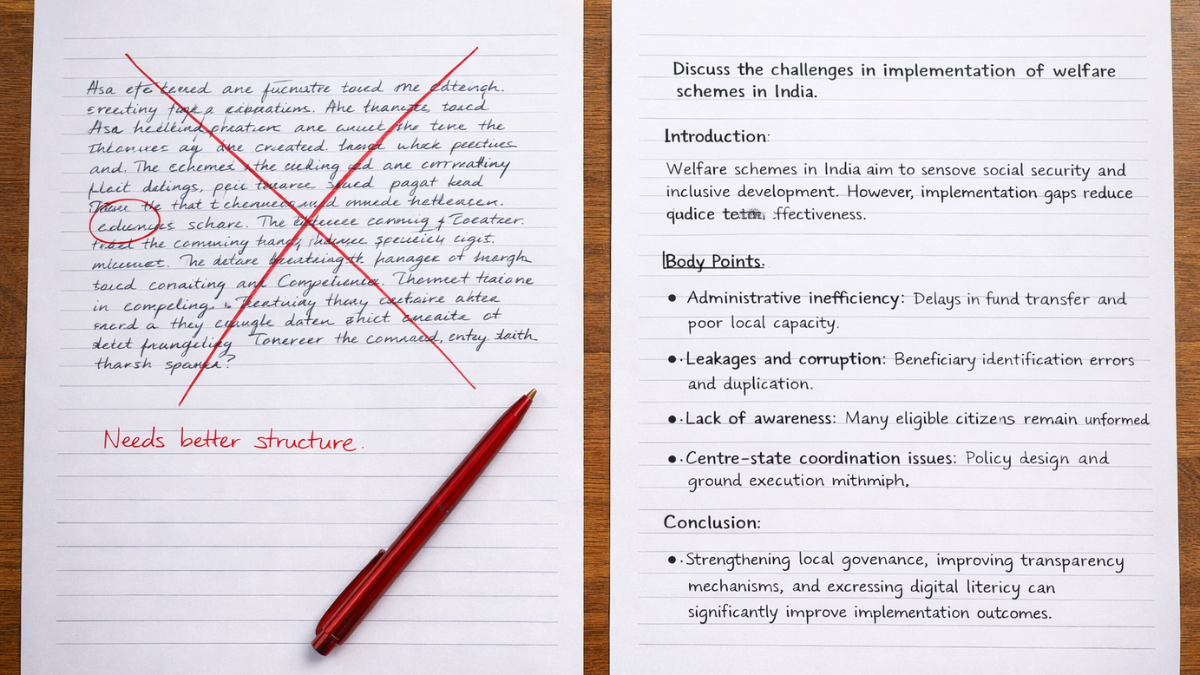
- They get feedback pointing out issues like “needs better structure”
The problem isn’t that they don’t have enough information to write about. It’s that they’re missing a proper approach or method for how to actually write it down effectively.
Concept Clarity
- Think of writing answers not just as something that happens when you’re prepared, but as a real skill you need to develop. Especially for government exams in India, like the mains-style papers, there’s a definite pattern you should follow. You’ll see questions that ask you to *do* something specific – like ‘Discuss,’ ‘Analyse,’ ‘Evaluate,’ or ‘Examine’ – and they come with clear instructions on word limits (like 150 or 250 words), how many marks are up for grabs, and an underlying structure they expect.
- Remember, the people marking your papers don’t have all day. They scan through answers quickly, looking for certain things: a clear start that tells them what you’re covering, a logical middle section with well-reasoned points, a balanced argument that considers different sides, a direct conclusion, and a neat, organized layout.
- On the flip side, they definitely aren’t impressed by pages of long stories, overly emotional language, random facts thrown in, or writing that jumps around without a clear structure.
Answer Writing for Government Exams must follow three principles:
Decode Before Writing
Understand directive + demand + dimension.
Structure Before Content
Outline mentally for 30–60 seconds before writing.
Relevance Over Volume
Every sentence must serve the question.
This approach defines effective exam strategy India for descriptive papers.
Practical Framework
This section provides a step-by-step method.
Decode the Question
Break the question into:
- Topic – What area?
- Directive – Discuss? Analyse? Critically examine?
- Scope – Social, economic, political, ethical?
- Word limit – 150 or 250 words?
Example Question:
“Discuss the challenges in implementation of welfare schemes in India.”
Breakdown:
- Directive: Discuss (balanced explanation)
- Topic: Welfare schemes
- Scope: Implementation challenges
- Not asking for history of schemes
Create a 30-Second Structure
Before writing:
- Introduction (2–3 lines)
- 4–5 body points
- Short conclusion
Mental outline:
Intro → Administrative challenges
→ Financial leakages
→ Awareness gaps
→ Federal coordination
→ Technology issues
Conclusion → Way forward
Follow Standard Answer Format
Ideal 150–250 Word Structure
Introduction (10–15%)
- Define or contextualize
- Directly connect to question
Body (70–75%)
- Organized points
- Headings or sub-points
- Examples or data if relevant
Conclusion (10–15%)
- Forward-looking
- Reform-based
- Directly linked
Model Answer Snippet (Short Format)
Question: Discuss the challenges in implementation of welfare schemes in India. (150 words)
Introduction:
Welfare schemes in India aim to ensure social security and inclusive development. However, implementation gaps reduce their effectiveness.
Body:
- Administrative inefficiency: Delays in fund transfer and poor local capacity.
- Leakages and corruption: Beneficiary identification errors and duplication.
- Lack of awareness: Many eligible citizens remain uninformed.
- Centre-state coordination issues: Policy design and ground execution mismatch.
- Technology barriers: Digital exclusion affects rural populations.
Conclusion:
Strengthening local governance, improving transparency mechanisms, and enhancing digital literacy can significantly improve implementation outcomes.
This format is clear, structured, and examiner-friendly.
Mistake vs Correct Approach Comparison
| Mistake | Correct Approach |
| Writing long introduction | Keep introduction brief and direct |
| Mixing points randomly | Group points under clear themes |
| Ignoring directive | Tailor content to “Discuss”, “Evaluate”, etc. |
| No conclusion | Always end with structured closure |
| Writing until word limit blindly | Prioritise clarity over filling space |
Time Discipline
For 150-word answer:
- 1 minute planning
- 6–7 minutes writing
- 30 seconds review
For 250-word answer:
- 1–1.5 minutes planning
- 8–9 minutes writing
- 30 seconds review
Time control is part of exam strategy India because descriptive exams are speed-sensitive.
No Paragraph Separation
Blocks of text that are too dense can make things hard to read.
To fix this: Try adding some space, using subheadings, or numbering your points.
Conclusion Repetition
A lot of people tend to just restate their introduction in the conclusion.
Here’s the fix: The conclusion should offer a forward-looking perspective instead.
Lack of Multi-Dimensional Thinking
Please focus your answers on just one aspect (either economic or political, but not both).
Correction:
Please include 2–3 different perspectives or dimensions where appropriate.
Writing Without Reviewing Question
Students tend to lose focus and veer off-topic halfway through their response.
Correction:
Make sure to re-read the question carefully before wrapping up your answer.
Tactical Application
How does structured Answer Writing for Government Exams improve marks?
Enhances Evaluator Clarity
Clear headings allow faster scanning. Examiners reward easily identifiable structure.
Prevents Content Wastage
Focused answers avoid irrelevant writing.
Improves Word Management
Structured format naturally controls length.
Increases Balance
Directive-based writing ensures critical thinking.
Builds Speed
Regular framework use reduces hesitation.
In competitive evaluation systems, marginal gains matter. A structured answer can convert a 4/10 response into 6 or 7 marks without additional knowledge.
That difference compounds across 20+ questions.
Improvement Plan
Starting Answer Writing for Government Exams requires disciplined execution.
First 2 Weeks
Goal: Structure Familiarity
- Write 2 answers daily (150 words)
- Focus only on structure, not perfection
- Practice introduction-body-conclusion format
- Self-check using checklist:
- Directive addressed?
- Clear points?
- Conclusion present?
Weeks 3–4
Goal: Directive Mastery
Each day:
- Choose one directive (Discuss, Analyse, Evaluate)
- Write 3 answers on different topics using same directive
- Compare difference in approach
Weeks 5–8
Goal: Time Control
- Simulate 1-hour mini tests
- Write 5–6 answers continuously
- Track time per answer
Weekly Review Method
Every Sunday:
- Re-read 10 written answers
- Identify repeated mistakes
- Rewrite one weak answer in improved format
This rewriting habit accelerates improvement.
Daily Practice Template
Day Plan (60–75 minutes)
- 10 minutes question analysis
- 30 minutes writing (2–3 answers)
- 15 minutes review
- 10 minutes improvement notes
Consistency matters more than volume.
Internal Resources
For structured preparation, refer to:
- How Questions Are Actually Framed in Government Exams
- Why Structure Scores More Than Content
- Internal Link: Time Management in Mains Papers
These connect directly with advanced exam strategy India patterns.
More Read

Conclusion
When it comes to preparing for government exams, writing answers isn’t just a final step—it’s actually key to scoring well. Even if you know your stuff, without organized answer writing, that knowledge won’t translate into marks. The right way to go about it includes:
- Understanding what the question is really asking
- Making a quick plan before you start writing
- Presenting your points in a clear, structured way
- Making sure your answer matches what the question is looking for
- Practicing regularly and keeping track of the time
When you treat answer writing as a system instead of just something you do casually, it becomes much more manageable. This kind of predictability in how you write your answers is what sets apart average performances from top scores in competitive exams across India. In the end, it’s how well you execute your answers—not just how much you know that really makes the difference in how you perform.