

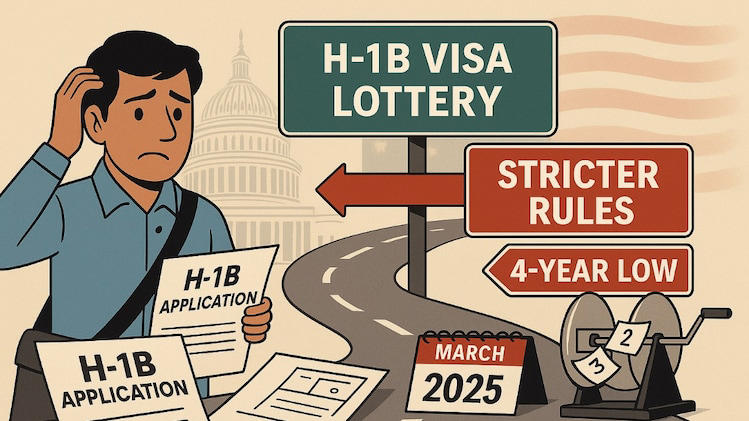
For decades, the H-1B visa has been the primary route for foreign professionals, especially from India, to work in the United States. Every year, tens of thousands of Indian engineers, software developers, data scientists, and healthcare professionals apply for this visa, competing for a limited number of slots. With demand constantly exceeding supply, the U.S. Citizenship and Immigration Services (USCIS) conducts a lottery to decide who gets selected.
In 2025, the H-1B lottery chances for Indians remain one of the most discussed topics in the global workforce. Why? Because Indians consistently make up the largest share of H-1B applicants, often accounting for 70% or more of total applications. In this blog, we’ll break down the lottery system, selection chances, challenges for Indian applicants, recent trends, and strategies to improve the odds of success.
Why Indians Dominate the H-1B Lottery
Several factors contribute to the high number of Indian applicants in the H-1B program:
-
Tech Industry Dependence
-
The U.S. technology sector relies heavily on Indian talent, especially in software development, IT consulting, data analytics, and artificial intelligence.
-
Indian IT giants like TCS, Infosys, Wipro, and HCL file thousands of H-1B petitions annually for Indian professionals.
-
-
Educational Strength
-
India produces one of the largest pools of STEM graduates in the world.
-
Many Indian students also pursue Master’s and Ph.D. degrees in the U.S., qualifying them for the advanced-degree cap (20,000 reserved slots).
-
-
Wage Competitiveness
-
Indian professionals are often seen as both highly skilled and cost-effective compared to U.S. domestic labor.
-
-
Cultural & Business Ties
-
The Indian diaspora in the U.S. is significant, creating strong professional networks that encourage more applications.
-

Understanding the H-1B Lottery System
Because the demand for H-1B visas exceeds the annual cap, USCIS uses a random lottery selection system. Here’s how it works in 2025:
-
Annual Cap
-
65,000 visas under the regular cap.
-
20,000 visas under the advanced degree exemption (for U.S. Master’s or higher degrees).
-
Total cap: 85,000 visas per year.
-
-
Registration Process
-
Employers submit electronic registrations for workers during a short window (usually March).
-
Each registration costs $10.
-
-
Lottery Rounds
-
Round 1: USCIS selects 20,000 advanced degree holders first. Those not chosen drop into the regular pool.
-
Round 2: USCIS randomly selects 65,000 from all remaining registrations.
-
-
Petition Filing
-
If selected, employers have 90 days to file a full petition (Form I-129 + documents).
-
H-1B Lottery Chances for Indians in 2025
Indians account for the majority of H-1B registrations. In some years, reports suggest over 400,000 Indian applications out of 750,000+ total registrations. Because the selection process is random, Indians face tough odds despite high qualifications.
General Selection Odds
-
If USCIS receives 750,000 applications for 85,000 visas, the overall chance is around 11–12%.
-
For Indians, who often file the bulk of applications, the odds are the same—but the sheer volume means hundreds of thousands are rejected each year.
Advanced Degree Advantage for Indians
-
Many Indian students complete Master’s in Computer Science, Data Science, or Engineering in the U.S.
-
These applicants get two chances in the lottery (first in the 20,000 advanced degree pool, then again in the regular pool).
-
This can increase effective chances to around 15–20%.

Trends in Recent Years
1. Spike in Multiple Registrations
-
USCIS observed a sharp rise in duplicate filings for the same beneficiary, often by different employers.
-
Indians, being the majority of applicants, were most affected when USCIS tightened rules to prevent fraud.
2. Higher Demand from Tech Firms
-
U.S.-based tech companies (Google, Microsoft, Amazon, Meta) file fewer applications than Indian IT firms but usually offer higher salaries, which USCIS prefers.
3. Shift Toward Skilled, High-Wage Roles
-
Recent policy shifts prioritize higher-paying jobs and specialized skills to discourage misuse of the program for entry-level roles.
4. Increased Scrutiny of IT Consulting Firms
-
Many Indian applicants work for IT service providers. USCIS often issues Requests for Evidence (RFEs) questioning specialty occupation claims, lowering approval rates.
Challenges for Indians in the H-1B Lottery
-
Oversubscription
-
With Indians making up 70%+ of the applicant pool, the competition is fierce.
-
-
Employer Dependence
-
Workers cannot self-apply; they must rely on employers for sponsorship.
-
-
Uncertainty
-
Highly skilled candidates may be rejected purely due to chance, not merit.
-
-
Visa Denials & Delays
-
Even after lottery selection, USCIS may deny petitions for inadequate documentation or wage issues.
-
-
Green Card Backlog
-
Many Indians stuck on H-1B face decades-long waits for green cards, adding pressure.
-
How Indians Can Improve Their H-1B Chances
Although the lottery is random, some strategies can indirectly increase the odds:
-
Pursue a U.S. Master’s Degree
-
This gives applicants two chances in the lottery, boosting selection probability.
-
-
Choose Employers Carefully
-
Established tech firms with strong compliance records face fewer RFEs and rejections.
-
-
Apply with Multiple Employers (Legally)
-
Multiple employers can register the same candidate, increasing odds—but it must be legitimate, not fraudulent.
-
-
Consider Higher Wage Levels
-
USCIS tends to favor petitions with salaries above the prevailing wage.
-
-
Prepare Strong Documentation
-
Detailed job descriptions, degree equivalency evaluations, and employer financial records strengthen the petition.
-