The global order is shifting, and this time, it’s not subtle. A proposed bill in the United States threatening a crushing 500% tariff on countries that continue trading Russian oil has ignited serious debate worldwide. What pushed this issue from background noise to front-page urgency is one detail that cannot be ignored: Donald Trump has reportedly given the bill his approval.
This isn’t just another political headline. It’s a stress test for international alliances, economic independence, and the future of global trade. And India, one of the world’s fastest-growing economies, has suddenly found itself at the center of a geopolitical storm that could reshape how nations interact for years to come.
Let’s be clear from the start: a 500% tariff is not diplomacy. It’s domination.
Understanding the Bill: What’s Really Being Proposed?
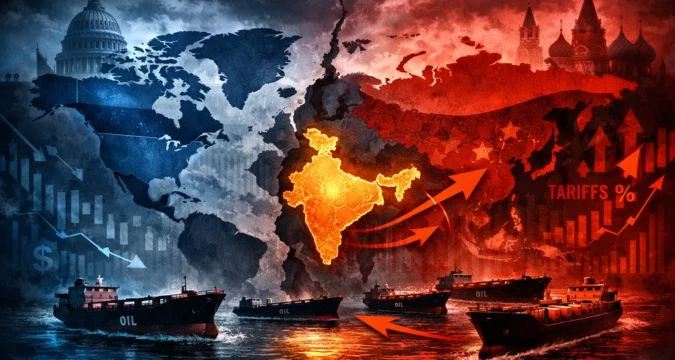
At its core, the bill seeks to impose extreme tariffs on any nation that continues to purchase Russian oil. The stated objective is straightforward cut off Russia’s revenue streams and weaken its ability to sustain the ongoing war. On paper, it sounds like a moral stand. In practice, it’s an economic sledgehammer.

Unlike targeted sanctions, this proposal doesn’t discriminate based on intent, scale, or context. It’s a blanket punishment. If a country buys Russian oil, it pays the price, literally.
India, which has dramatically increased its imports of Russian crude since the start of the Russia-Ukraine conflict, becomes one of the most visible targets. Not because it’s violating any international law, but because it refuses to align blindly.
That distinction matters.
Why India Turned to Russian Oil in the First Place
To understand India’s position, you need to understand its realities.
India is home to over 1.4 billion people. Its economy is expanding rapidly. Energy demand is exploding. Fuel prices directly affect inflation, food costs, transportation, and social stability. For India, energy security isn’t optional, it’s existential.

When Western nations imposed sanctions on Russian energy exports, Russia responded by offering crude oil at heavily discounted rates. India saw an opportunity to stabilize domestic fuel prices and protect its economy from global volatility.
This wasn’t ideological support for Russia. It was a calculated economic decision.
India did not violate any UN mandate. It did not break any international treaty. It simply acted in its own interest—something every major power claims the right to do.

Trump’s Nod: Why It Changes Everything
Donald Trump’s support for the bill takes the situation to another level entirely.
Trump is not just a former president. He is a political force who continues to shape Republican thinking, especially on trade, foreign policy, and economic nationalism. His endorsement signals that this bill aligns with a broader worldview—one that prioritizes loyalty, compliance, and leverage over multilateral cooperation.
This is classic Trump-era strategy:
- Maximum pressure
- Zero patience for neutrality
- Economic tools used as weapons
With Trump’s nod, the bill stops being a fringe idea and starts looking like a potential future policy direction—especially if political power shifts in Washington.
For India, this means the risk is no longer hypothetical.
Neutrality Is Becoming a Liability
For decades, India has followed a foreign policy rooted in strategic autonomy. It works with multiple power centers without becoming dependent on any single one. This approach has allowed India to maintain relationships with the US, Russia, Europe, and emerging economies simultaneously.
But the world has changed.
In today’s polarized geopolitical climate, neutrality is increasingly viewed as non-alignment, and non-alignment is being reframed as opposition.
The bill sends a blunt message:
If you’re not with us, you’re against us.
That’s a dangerous precedent.
The Economic Impact on India: Beyond Headlines
If enforced, a 500% tariff would be catastrophic.

Indian exports to the US span multiple critical sectors:
- Pharmaceuticals
- Textiles and garments
- Automotive components
- IT services
- Engineering goods
A tariff of this magnitude would instantly make Indian products uncompetitive in the US market. Companies would bleed. Jobs would be lost. Investor confidence would take a hit.
This wouldn’t be a short-term shock, it would be structural damage.
And rebuilding trust after such an aggressive move? That takes years, not months.
The US Won’t Walk Away Unscathed
Here’s the part that often gets ignored: tariffs hurt both sides.
American companies rely heavily on Indian pharmaceuticals, software services, and skilled labor. Supply chains are deeply integrated. A sudden disruption would raise costs for US businesses and consumers alike.
Higher tariffs mean higher prices. Inflation doesn’t care about political messaging.
In trying to punish India, the US could end up punishing itself.
A Strategic Contradiction for Washington
This bill exposes a major contradiction in US foreign policy.
On one hand, the US sees India as a key strategic partner in countering China’s influence in Asia. On the other hand, it’s willing to threaten India with economic devastation over energy choices.
You can’t claim partnership while practicing coercion.
Pushing India into a corner risks driving it closer to alternative alliances, something Washington should be actively trying to avoid.
The Russia Factor: Is the Strategy Even Effective?
Let’s ask the uncomfortable question: will this actually weaken Russia?
Russia has already adjusted to sanctions. It has diversified buyers, rerouted trade, and leaned into alternative markets. Penalizing buyers like India may reduce some revenue, but it won’t isolate Russia entirely.
What it will do is destabilize global energy markets and alienate key economies.
That’s not strategy; that’s collateral damage.
The Bigger Picture: Trade Is Becoming a Weapon
This bill is part of a larger trend that should worry everyone.
Trade is no longer about efficiency, growth, or mutual benefit. It’s becoming a tool of enforcement. Tariffs, sanctions, and restrictions are now used to force political alignment.
This marks a shift away from globalization toward economic blocs and loyalty-based commerce.
For developing and middle-income countries, this is deeply problematic. Many rely on flexible trade relationships to survive global shocks. Forcing binary choices undermines economic resilience.
India’s Likely Response: Compliance or Resistance?
If history is any guide, India won’t cave easily.
India has weathered sanctions before. It has diversified its trade partners. It has built domestic capacity in key sectors. While a 500% tariff would hurt, it wouldn’t break India.
More likely, India would:
- Accelerate trade diversification
- Strengthen alternative markets
- Reduce dependency on the US over time
That outcome doesn’t benefit anyone.
The Diplomatic Fallout
Beyond economics, the diplomatic consequences could be severe.
Years of trust-building between India and the US would be undone. Strategic dialogues would lose credibility. Cooperation on defense, technology, and climate would become harder.
Once a country feels coerced, goodwill evaporates.
What This Means for the Global South
India isn’t alone in this dilemma.
Many countries across Asia, Africa, and Latin America continue trading with Russia, not out of loyalty, but necessity. Affordable energy keeps economies running. Cutting it off without alternatives is unrealistic.
If this bill sets a precedent, it sends a clear warning to the Global South: your economic needs come second to geopolitical agendas.
That’s not a message that builds alliances.
Is There a Better Way Forward?
Yes, but it requires restraint.
Instead of punitive tariffs, the US could:
- Offer energy alternatives
- Incentivize gradual diversification
- Respect national sovereignty
- Engage through diplomacy, not threats
Pressure may deliver headlines, but partnership delivers results.

More Read

Final Thoughts: A Crossroads Moment
This bill is more than a policy proposal. It’s a signal of where global politics might be headed.
A world where trade is conditional.
Where neutrality is punished.
Where economic power replaces diplomacy.
India’s response will matter. So will Washington’s next move.
One thing is certain: a 500% tariff is not strength. It’s a gamble, one that risks breaking alliances, destabilizing markets, and accelerating the fragmentation of the global economy.
The question isn’t whether India can withstand the pressure.
It’s whether the global system can survive this kind of power play.
And honestly? That’s the real story everyone should be paying attention to.