In a high-stakes, tension-filled contest at the D.Y. Patil Stadium in Navi Mumbai, the India women’s national cricket team delivered a wildly impressive performance to book their spot in the semifinals of the 2025 Women’s World Cup, defeating the New Zealand women’s national cricket team by 53 runs (DLS method).
Here’s a detailed look at how that match unfolded, why it matters, and what lies ahead for India.
Setting the stage
India came into this match under pressure. After losing three consecutive group games, they had little margin for error; the semi-final berth was on the line. New Zealand, meanwhile, were pushing to solidify their own knockout hopes.
The toss was won by New Zealand and they elected to bowl first, underlining the expectation that India would need to post a big total.

India’s batting explosion
From the opening overs, India’s top order seized control. The partnership between Smriti Mandhana and Pratika Rawal was nothing short of spectacular. They added a record-opening stand of 212 runs.
-
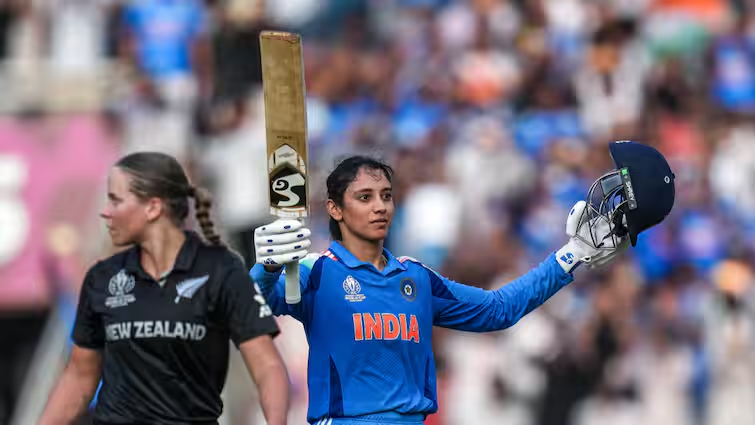
Smriti scored 109 – marking her 14th ODI century.
-
Pratika made 122 – her first World Cup hundred and a major milestone.
-
After these two departed, Jemimah Rodrigues came in and smashed an unbeaten 76 off 55 to provide the late flourish.
India ended their innings at 340 for 3 in 49 overs, though rain intervened and the target was revised via DLS.
Some key take-aways from India’s batting:
-
The opening pair set a platform – strong technique, attacking mindset and dominance against both pace and spin.
-
Smriti and Pratika threatened to take the game away early, removing pressure from the middle order.
-
The late acceleration by Jemimah ensured India’s total was both imposing and psychologically intimidating.
-
This big total gave India both the scoreboard advantage and the breathing room to apply pressure with the ball.
New Zealand’s response & India’s bowling counter
Chasing a par score, New Zealand faced a tricky assignment. The target was revised to 325 in 44 overs after rain.
Although New Zealand batted with intent, India’s bowlers controlled key phases:

-
Early wickets, especially of crucial batters like Sophie Devine, helped to keep New Zealand’s chase in check.
-
Later, despite a fight from Brooke Halliday (81) and Isabella Gaze (65 not out), the mounting required rate and disciplined Indian bowling proved decisive.
-
India’s fielding and tactical discipline meant there were limited loopholes for New Zealand to exploit.
In the end, New Zealand finished at 271/8 in 44 overs, well short of the revised target.
Significance of the win
This victory carries multiple layers of importance for India:
-
It ended a three-match losing streak, restoring confidence at the most critical juncture.
-
It booked India a precious place in the semifinals — meaning they have kept their title hopes alive.
-
It demonstrated India’s capability to dominate both with bat and ball — a combined performance of top-order batting, late acceleration, and disciplined bowling.
-
It sends a message to other teams in the tournament: India are dangerous when they fire as a unit.
From a tournament logistics perspective, India’s qualification also benefitted from the way DLS and points/tie-breaker rules worked out in their favour.

Individual heroes & what they mean
Smriti Mandhana
Mandhana’s century came at a vital time. Her 109 shows her class and the ability to deliver when the stakes are high. The start she gave allowed others to play with more freedom.
Pratika Rawal
Emerging in this match with a big hundred, Pratika showcased that she can lead from the front. Her knock of 122 will be talked about for some time, especially as it came in a must‐win game.
Jemimah Rodrigues
Her unbeaten 76 added the finishing touches to India’s innings. Having top order settle the game, the middle order finishing strongly is a healthy indicator for India’s depth.
Bowling & fielding collective
While batting headlines dominated, the bowlers and fielders did their job when it mattered. Be it early strikes to unsettle New Zealand, or limiting partnerships later, the discipline was visible.
Challenges ahead
Even with this big win, India’s journey is far from over and there are still areas to watch:
-
Maintaining consistency: the three losses before this match show that India can falter. Semi‐finals bring renewed pressure.
-
Bowling under sustained pressure: Against a strong side, if the batting fires, the bowlers will be tested.
-
Handling knockout cricket: Semifinals are entirely different choreography — opponents will study India’s strengths and plan accordingly.
-
Staying injury-free and managing fatigue: With high intensity matches, recovery and fitness will matter.
Looking ahead: What’s next for India

Having secured the semifinal berth, India can approach their remaining group game (against Bangladesh women’s national cricket team) with some relief, but also focus on the bigger prize. The semi-final will test their mettle under high pressure.
For fans and analysts, questions now include:
-
Who will India face in the semifinal — the winner of another group match (likely involving Australia women’s national cricket team or South Africa women’s national cricket team)?
-
Can India reproduce this dominant performance — big total + disciplined bowling — when it matters most?
-
Will the momentum from this win carry them into the final and potentially challenge for the title?
Final thoughts
The match against New Zealand will be remembered as a turning point for India in the 2025 Women’s World Cup. With dominant batting from Mandhana and Rawal, anchored by solid teamwork, India showed what they are capable of when firing on all cylinders.
If they can bring that level of performance into the knockouts, they have a real opportunity to go deep — perhaps even lift the trophy. For now, though, the focus must shift quickly from celebration to preparation. The semifinal awaits, and the path to glory demands both confidence and composure.