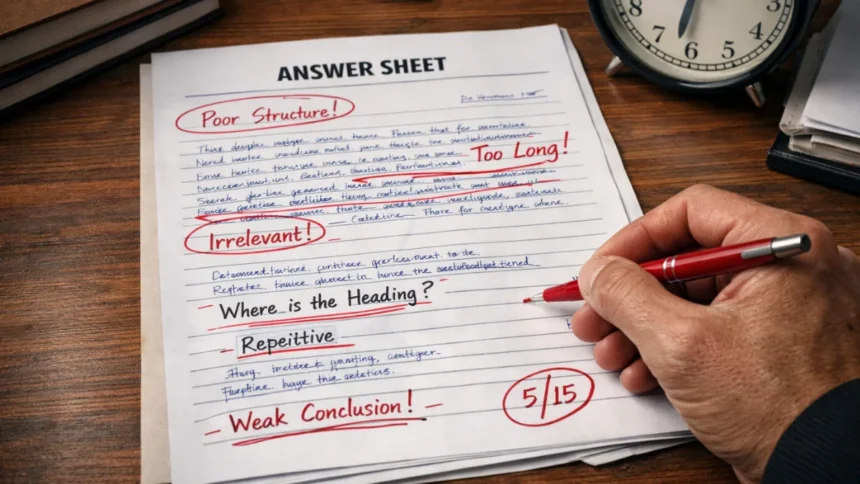
Problem Statement: Why Students Lose Marks In Government Exams
One of the most misunderstood realities of competitive preparation is this: students do not primarily lose marks due to lack of knowledge. They lose marks due to Government Exam Mistakes that occur during presentation, structuring, interpretation, and alignment with evaluation standards.
Across major Indian government examinations conducted by bodies such as the Union Public Service Commission (UPSC), Staff Selection Commission (SSC), and Institute of Banking Personnel Selection (IBPS), answer scripts are evaluated under time pressure. Examiners are not reading for intellectual depth alone; they are reading for clarity, relevance, structure, and decision-making ability.
Students often assume:
- “I wrote everything I knew.”
- “My answer was factually correct.”
- “I covered all points.”
Yet the marks remain average.

The gap lies in how answer sheet evaluation operates versus how students think it operates.
This article breaks down where marks are actually lost, what evaluators look for, and how to systematically eliminate Government Exam Mistakes.

Concept Clarity: What Actually Reduces Marks
To correct mistakes, you must understand the evaluation lens.
How Answer Sheet Evaluation Really Works
Examiners assess:
- Relevance to the question
- Structure and organization
- Clarity of argument
- Coverage within word limit
- Balance and neutrality
- Conclusion quality
- Presentation efficiency
They do not reward:

- Length without structure
- Emotional language
- Repetition
- Random examples
- Over-explaining known concepts
The Core Misalignment
Students prepare content-heavy answers. Examiners reward structure-heavy answers.
This is the foundation of most Government Exam Mistakes.
If the question asks:

“Discuss the challenges in implementation of welfare schemes in India.”
Students often:
- Write a long introduction.
- Explain what welfare schemes are.
- List 10 unrelated challenges.
- End abruptly.
The evaluator instead expects:
- Context
- Categorized challenges
- Administrative perspective
- Structural analysis
- Practical conclusion
Without alignment, marks drop.
For deeper understanding of structure alignment, see:
- How Questions Are Actually Asked
- Writing Correctly vs Writing Effectively
- Why Structure Trumps Content
Practical Framework to Avoid Government Exam Mistakes
This section gives a usable structure.
Step-by-Step Approach
Decode the Directive
Identify the command:
- Discuss
- Examine
- Critically analyze
- Evaluate
- Compare
Each directive changes the answer format.
Example:
“Discuss” → Balanced explanation
“Critically analyze” → Strengths + weaknesses + judgment
Students lose marks when they ignore directive meaning.
Build a 4-Part Structure
Use this consistent template:
- Context (2–3 lines)
- Core Body (Categorized points)
- Analytical Layer (Impact or evaluation)
- Conclusion (Forward-looking)
Categories Points
Instead of random bullet points, group them:
For welfare schemes:
- Administrative challenges
- Financial challenges
- Social challenges
- Technological challenges
Categorization improves answer sheet evaluation speed.
Stay Within Word Limit
If 150 words:
- Intro: 20–25 words
- Body: 100 words
- Conclusion: 20–25 words
Exceeding word limit signals poor control.
Model Answer Snippet (Short Format)
Question: Discuss challenges in implementation of welfare schemes in India. (150 words)
Answer:
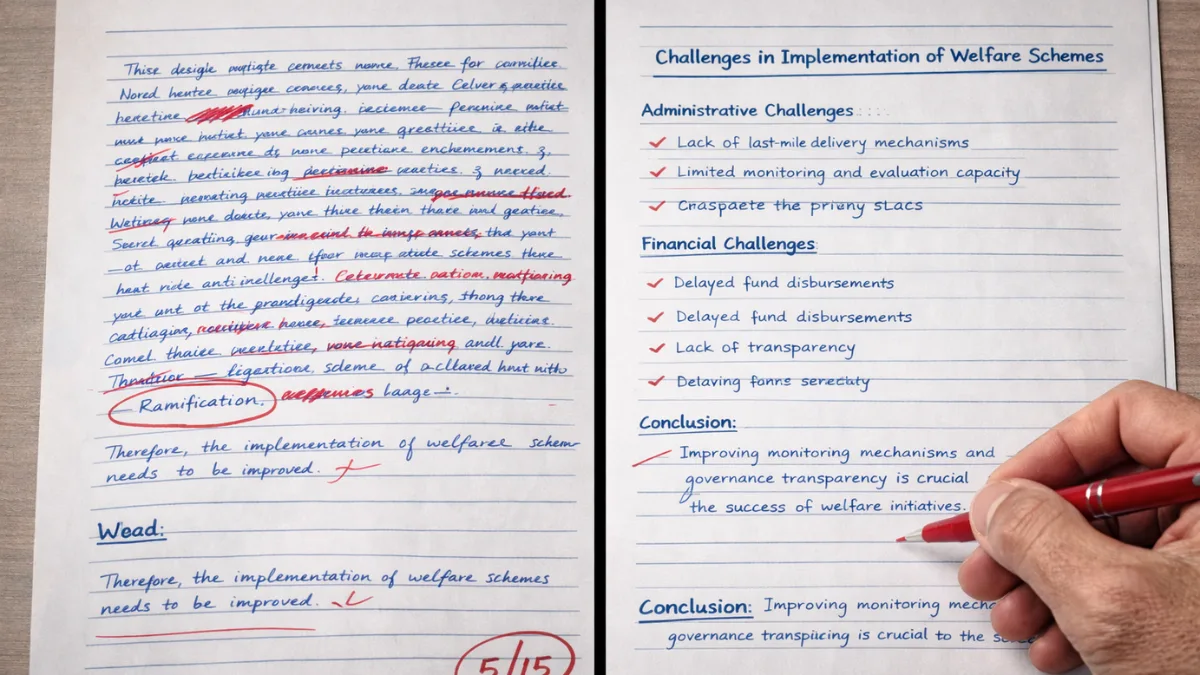
Welfare schemes in India aim to improve socio-economic equity but face structural implementation constraints.
Administrative challenges include weak last-mile delivery and inadequate monitoring mechanisms.
Financial issues arise from delayed fund disbursement and leakage.
Technological barriers such as digital exclusion limit access in rural areas.
Social factors including lack of awareness reduce scheme uptake.
Unless governance reforms strengthen accountability and digital infrastructure, implementation gaps will persist despite policy intent.
Notice:
- Categorized structure
- No storytelling
- No repetition
- Clear closure
This is what improves marks.
Mistake vs Correct Approach Comparison
| Mistake | Correct Approach |
| Long introduction | 2–3 line context |
| Random points | Categorized headings |
| Emotional language | Administrative tone |
| No conclusion | Structured closing line |
| Over-length answers | Word control discipline |
| Definition-heavy | Analysis-focused |
This comparison directly addresses Government Exam Mistakes.
Common Errors That Reduce Marks
Writing Everything You Know
Students often think that writing more means writing better.
The truth is, what counts is how relevant your answer is.
Giving too much information can actually make your answer less focused and clear.
Ignoring Question Keywords
If the question asks about “challenges,” stick to discussing difficulties, not benefits.
And if it says “critically,” make sure to include some negative points, not just the good ones.
Using the wrong keywords is one of the biggest mistakes people make in government exams.
Poor Structuring
Large blocks of text without breaks can make things harder to read, lead to mental exhaustion when reviewing, and diminish overall clarity. On the other hand, using structure actually makes your work seem more polished and professional.
No Analytical Layer
Instead of just listing problems like this:
Not the best:
- Corruption
- Delay
- Lack of staff
Try explaining the impact of each issue, like this:
Better approach:
- Corruption drains public funds, weakening government finances and damaging people’s trust in authority.
- Delays in projects mean they take longer to finish, which could mean missed chances or higher expenses.
- And when there aren’t enough staff members, things slow down, and the quality of services can suffer.
- Explaining the real-world effects of each point will really help you make a stronger impression!
Weak Conclusions
It looks like many answers tend to end with something like: “So, the government needs to get better at carrying out its plans.” But that feels pretty general. A more impactful way to wrap things up would be something like: “It’s essential to strengthen oversight systems and put in place decentralized accountability measures to bridge the gap between policy goals and what actually happens on the ground.” These more specific conclusions generally make a stronger impression.
Overuse of Data
Throwing statistics without context wastes space.
Use only if relevant and accurate.
Handwriting and Layout Neglect
Though not officially graded, poor presentation affects answer sheet evaluation subconsciously.
Spacing, underlining, and clear headings matter.
Tactical Application: How This Improves Marks
When you eliminate Government Exam Mistakes, three measurable improvements occur:
Faster Examiner Processing
Structured answers reduce reading time.
Clear categorization increases clarity.
Higher clarity = higher consistency in marking.
Improved Content Density
Short, sharp, analytical sentences increase scoring efficiency.
Instead of 10 vague points, 6 strong points score more.
Directive Alignment
Answer matches command word.
Evaluators reward instruction compliance.
Perception of Maturity
Administrative tone signals governance awareness.
This is critical in exams like those conducted by UPSC.
Balanced Evaluation
Especially in “critically analyze” or “evaluate” questions, balanced answers avoid extreme positions.
Neutral analytical tone aligns with government exam standards.
Improvement Plan: Weekly Execution Strategy
Eliminating Government Exam Mistakes requires systematic correction.
Daily Practice (30–45 Minutes)
Choose any two questions from the list.
Take three minutes to organize your thoughts before you start writing.
Make sure your response fits within the given word limit.
Check your work against this list:
Did I follow all the instructions?
Is my structure clear and easy to follow?
Does my conclusion offer insightful analysis?
Did I stay within the word count?
Weekly Review
For your Weekly Review, revise three of your previous answers.
Focus on improving these aspects:
How well you categorize information.
The sharpness of your introduction.
The precision of your conclusion.
Compare the revised versions to the originals to see the improvements.
Evaluation Checklist Template
Before you wrap up your answer, let’s quickly check:
- Have you addressed the main instruction (the directive)?
- Have you organized your points clearly?
- Is there a good explanation that shows your thinking?
- Have you avoided repeating yourself?
- Do you have a clear conclusion?
If you’re missing three or more of these things, your score might be affected.
Structured Practice Method
Week 1:Just focus on getting the structure right.
Week 2: Make sure your answer lines up perfectly with what was asked.
Week 3: Dig deeper and add more analysis.
Week 4: Put it all together.
We’ll keep cycling through these weeks.
Monthly Simulation
First, complete a full mock test while sticking to the time limits. Afterward, focus your review specifically on three key areas:
- Making sure the structure flows logically and consistently,
- Checking that the conclusion is strong and effectively wraps things up, and ensuring the content stays relevant and focused on the topic at hand.
- This targeted approach really helps improve how well your answers are received and assessed.

Conclusion
A lot of students prepping for competitive exams automatically blame their low scores on not knowing enough. However, what usually happens is that the structure of their answers or how well they match what the examiners are looking for is off.
Mistakes in government exams aren’t typically about not knowing the material. More often, they stem from things like:
- Not following the instructions given
- Poorly organizing their points
- Weak or incomplete conclusions
- Writing too much unnecessary stuff
- Not analyzing the question deeply enough
If you understand how answer sheets are evaluated, you can figure out what the scorers are really looking for. When your answers are well-structured, directly address the question, show good analysis, and are to the point, your marks tend to go up consistently.
Government exams don’t really reward how much effort you put in. They reward clear thinking and good answers, even when you’re under pressure.
Therefore, cutting down on these common mistakes isn’t just a good idea, it’s essential. It’s often the key difference between getting an average score and actually being competitive.