India has a crossroad with its gig economy in 2025.
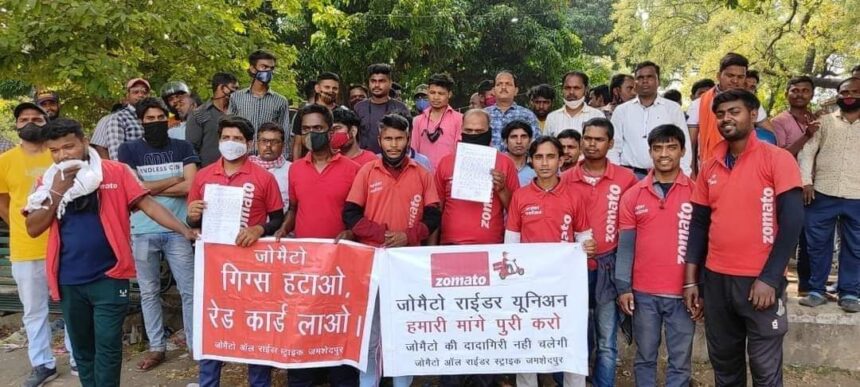
What started as a hope of working flexibly, earning fast and using technology to get opportunities, now it is a national debate regarding how to pay people, their dignity of labour and social security. In big cities of India and some Tier-2 towns, the movement of protest by gig workers is on the rise – not as a one-off event, but as an issue in the structure of app-based work.
Riders of food delivery companies and drivers of ride-hailing startups were also targeted in concerts by warehouse pickers, logistics partners, as the price of survival has been increasing more quickly than their wages, not to mention the lack of guarantees.
It explainer reduces to when and where gig workers are demonstrating in 2025, the actual causes of the anger, the grey areas, and its implications on the future India workforce.

Are Gig Workers Protesting in India in 2025?
The protests do not have just one day or strike call. Waves of coordinated actions have rather been witnessed in the year 2025.
Timeline of Protests in 2025
January-February 2025
Metropolitan delivery workers initiate local strikes at peak time, and they want to see more open pay algorithms and minimum earnings per order.
March 2025

Multi-day app log-outs are arranged by ride-hailing drivers, especially when the fuel prices are changed and the incentives are reconfigured.
April-May 2025
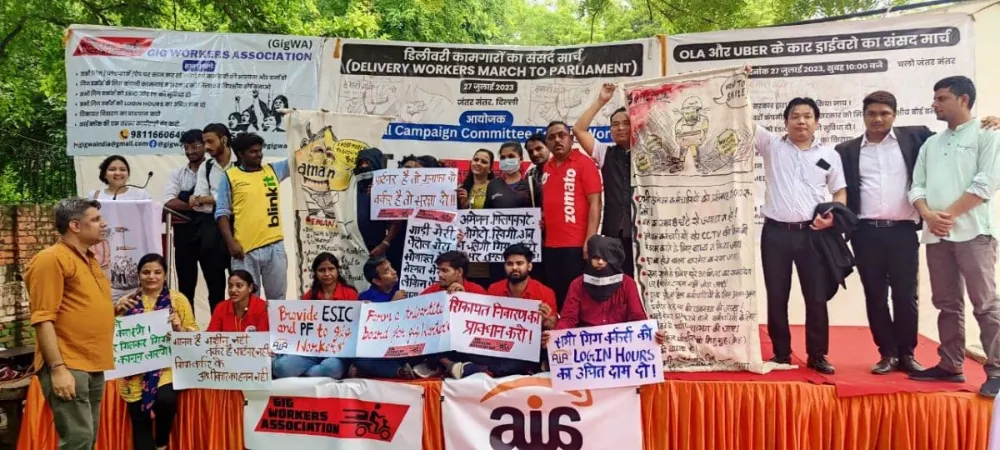
Unionization and group of platform workers declare countrywide protest days and organize demonstrations at the same time, in all states, to agitate in favor of social security.

Ongoing through mid-2025
Protests in the form of roll-ins, petitions, and local shutdowns are still going on, particularly when it comes to festival seasons and work goes up and the same payouts do not.
The trend indicates that the protests are long-term rather than ritualistic.
But Where are the Gig Worker Protests?
India The gig worker strike movement cuts across the metros and non-metros.
Major Protest Locations
- Delhi NCR– Mega assembles of food delivery riders and cab drivers.
- Bengaluru – Technological hub that has excellent platform worker groups.
- Mumbai and Pune – Protests regarding logistics, warehouse and ride-hailing.
- Hyderabad and Chennai – App-based delivery worker protests.
- Kolkata – Ride-share and e-commerce logistics protest.
Tier-2 cities, where coordinated action is being witnessed first time – Jaipur, Lucknow, Indore, Kochi.

What is interesting about 2025 is the fact that protests cease to be the prerogative of urban elites. Even smaller cities that rely on the use of apps in delivery have gotten into the trend.
Who Are India’s Gig Workers?
Policy estimates have placed India with more than 7.7 million gig and platform workers today and by 2030, it is expected to exceed 23 million workers.
They include:
- Food and grocery delivery customer partners.
- Ride-hailing drivers
- eCommerce warehouse personnel.
- Service providers that are hyperlocal.
- Last-mile delivery workers and logistics.
Most gig employees are not employees but rather considered as independent contractors, although on a vast scale.
This one classification is the core issue of the protests.
The Bottom Reasons behind the Gig Worker Protests
Declining Profits even when Hours of Work Increase.
Among the most recurrent complaints in the protest movements on gig workers wages is the falling real income.
Key reality in 2025:
- There has been an increase in fuel costs, rent and food costs.
- The incentive structures have been decreased or made difficult to get.
- Commission per order or per ride has been either stagnant or decreased.
Most of the delivery workers say that they work 10-12 hours every day only to make what they used to get in 7-8 hours.
Algorithmic Pay: The Siren of the Boss
Gig employees do not bargain with human managers. They bargain with computers.
Major complaints include:
- The abrupt alterations in the calculations of payout.
- None of the explanations of diminished incentives.
- Punishment in case of rejection of orders or poor acceptance rate.
- Deactivations on a rating basis, not appealed.
This is what has made algorithms a cause of fear and frustration that has driven protest movements by app-based workers.
Social Security, No, Safety Net, No
Maybe the most powerful catalyst of the gig economy strike in 2025 will be the lack of fundamental safety mechanisms.
The majority of the gig workers are not provided with:
- Provident Fund (PF)
- Health insurance
- Paid sick leave
- Accident compensation
- Old-age security
In a situation where informal work is already the leading one, gig workers claim that technology has simply digitalized the informality rather than addressing it.

Increasing Work Hazards, No Responsibility
Delivery workers face:
- Road accidents
- Extreme weather conditions
- Physical exhaustion
- Verbal abuse from customers
However, compensation policies are usually vague, slow or arbitrary.
In 2025, a number of protests were triggered by the death and severe injuries of workers, and families were unable to get platform assistance.
Categorical Crisis: Partner or Employee?
Sites demand that gig workers are partners.
Workers argue:
- They cannot set prices
- They cannot negotiate terms
- They may be switched off without a notice.
This contradiction now is the leading theme in labour rights gig workers movements.
The Legal Situation: What the Law will say in 2025
The policy of gig workers has been recognized in India, but implementation is poor.
Code on Social Security
The Social Security Code acknowledges gig and platform workers as a separate category and asserts:
- The registration to a national portal.
- Access to welfare schemes
- Co-operative responsibility between platforms and government.
However, in 2025:
- The coverage of registration is not even.
- Financing procedures are not clear.
- Numerous employees complain of non-benefit award.
This inconsistency between pledge and performance is a key protest movement factor.

Markers of Government Data and Policy
The significance of the gig economy has been emphasized on many occasions by policy bodies:
- It brings about a lot of employment.
- It promotes last-mile delivery of service.
- It takes in the youth and migrant labour.
However, gig workers believe that it is exploitation to make an economic difference without dignity.
True Life Story: The Reality of a Delivery Rider
Having lost a factory job, a 28-year-old Hyderabad delivery worker Ravi joined an app platform.
Initially, he earned well.
By 2025:
- His per-order pay dropped
- Fuel costs rose
- Rewards were no longer predictable.
Following a small accident, he did not get a paid leave. The incident drove him to participate in a protest of city level.
His tale resembles the thousands in India.
Why 2025 Is a Turning Point
This year matters because:
- Gig employees are uniting on the national scale.
- Demonstrations do not end but rather continue.
- It is already legal recognition, but it has to be enforced.
- There is a change in the public opinion towards the rights of the workers.
The news on gig workers in India is not convenient anymore, but is about fairness.
What Gig Workers will be demanding in 2025
Core Demands
- Basic assured wages per job.
- Open algorithmic pricing.
- Accident insurance. And health insurance.
- Social security coverage
- Equal grievance redressal systems.
- Arbitrary deactivation protection.
Those are not extreme requirements – they reflect fundamental labour standards.
What Platforms Say
Platforms argue:
- The level of flexibility would be minimized when the workers are treated as employees.
- Increased expenses could affect the prices of services.
- The innovation relies on the contractor models.
But, it is protested that flexibility cannot be held without stability.
What the Future of the Gig Economy in India Holds
Possible Scenarios
- Tighter regulation and composition of welfare.
- Hybrid classification models of workers.
- Social security pools funded on a platform basis.
- More collective bargaining and unionization.
The gig economy in India will not fall but will evolve.
Actions that Workers, Policymakers, and Citizens Can Take
For Gig Workers
- Enroll on formal websites.
- Join verified collectives
- Hours and income of documents.
For Policymakers
- Enforce existing laws
- Requirement of transparency standards.
- Ensure benefit portability
For Citizens
- Support ethical platforms
- Accept gig labour as a fact.
The other acute reason why gig workers will protest in the year 2025 in India is a gap between the expansion of platforms and the income of workers. As India is growing its gig economy at an alarming pace, with urban consumption, fast commerce, and services based on an app driving it, the incomes of workers have not been simultaneously increasing. Platoons record increased volumes of orders, yet employees report no improvement in per-task pay or a decrease therein. This unequal distribution has intensified the sense among the gig workers that they are picking up the risk associated with growth without the benefits. The dream of gaining more by working has become a turn of diminishing returns of exhaustion to many.
The demonstrations have also highlighted the gendered nature of gig work. Female gig employees especially in home care, delivery and care based jobs are exposed to other difficulties including safety issues, unpaid waiting, and maternity absence. By 2025, platform workers started to enlist more and more women workers in their protests to demand not only a fair payment but also the minimum of protection such as insurance cover and regular working hours. Their involvement has changed the discourse to capture a narrow wage conflict to a larger discourse on dignity, safety and inclusion in digitised labour economy in India.
The gig economy has also increased inequality in the region, which subsequently contributed to the anger of the workers. Whereas high cost of living is a problem facing metro-based workers, another issue facing gig workers in Tier-2 and Tier-3 cities is low order density and uneven demand. Employees in these areas are also ready to walk farther to do fewer jobs, and the earnings per hour are lowered to very low levels. With platforms aggressively penetrating the smaller cities, employees claim that the one-size-fits-all algorithms do not take into account local realities. This has seen the protest movements of the gig economy workers more geographically diverse in 2025 than ever before.
Lastly, the unrest among gig workers in India is taking place in the context of similar occurrences in the global sphere. Platform workers are challenging the algorithmic management across Europe to Southeast Asia and are seeking legalization. Indian gig workers are becoming more conscious of such global debates which makes them stronger in determination. The 2025 protests are indicative of the emerging opinion that India needs to have its own pattern- one that balances creativity and security of the workers. The consequences of these demonstrations will define not only the labour policy, but the ethical base of the platform-based future of India, as the country makes itself a digital and economic powerhouse.
More Read

Final Takeaway
- The 2025 gig worker protests are never anti-technology.
- They are pro-fairness, pro-dignity and pro-future.
- The labour market of India is changing.
Whether it will develop its protections along with it is the question.