
The “Vocal for Local” Movement in India’s Business & Economy
The “Vocal for Local” movement, introduced as part of the Atmanirbhar Bharat (Self-Reliant India) campaign in 2020, has evolved from a catchy slogan into a full-fledged economic policy driver. It urges citizens to choose Indian-made products, empowering MSMEs, artisans, startups, and farmers while reducing reliance on imports.
In 2025, as India emerges as one of the fastest-growing economies, this initiative remains central to business policy, trade strategy, and cultural revival.
Issue Background & Statistics
-
According to the Ministry of Commerce & Industry, India’s MSME sector contributes nearly 30% to GDP and 40% to exports.
-
Over 11 crore Indians are employed in small and medium enterprises.
-
After COVID-19 disruptions, local production was recognized as vital for supply chain resilience.
-
Imports of non-essential goods (like toys, electronics, processed foods) dropped as domestic production scaled up under Vocal for Local campaigns.
Fact: In FY 2023–24, India’s exports touched $778 billion, partly due to MSME growth.
Government Policy Impact
The Indian government has backed “Vocal for Local” with strong policies:
-
Atmanirbhar Bharat Abhiyan – financial stimulus packages to support domestic businesses.
-
Make in India 2.0 – incentives for manufacturing, electronics, defense, and green energy.
-
PLI Schemes (Production-Linked Incentives) – offered to sectors like mobile manufacturing, EVs, textiles.
-
Startup India Mission – encouraging entrepreneurship in tech and rural industries.
-
One District One Product (ODOP) – boosting local crafts and export potential.
Example: Under ODOP, Varanasi silk and Lucknow chikankari were promoted globally, giving rural artisans international exposure.
Role of Indian Industries
-
Startups: D2C (Direct-to-Consumer) brands like Mamaearth, Boat, and Lenskart leveraged Vocal for Local to compete with global rivals.
-
Agriculture & Food Processing: Companies like Amul, Patanjali, and ITC became case studies in how local products dominate the FMCG sector.
-
Technology: India’s mobile manufacturing units grew rapidly—India now produces 97% of its mobile phones domestically.
-
Textiles & Handicrafts: Exports of handicrafts rose by 20% in 2023, with Vocal for Local campaigns driving awareness.
International Comparisons
-
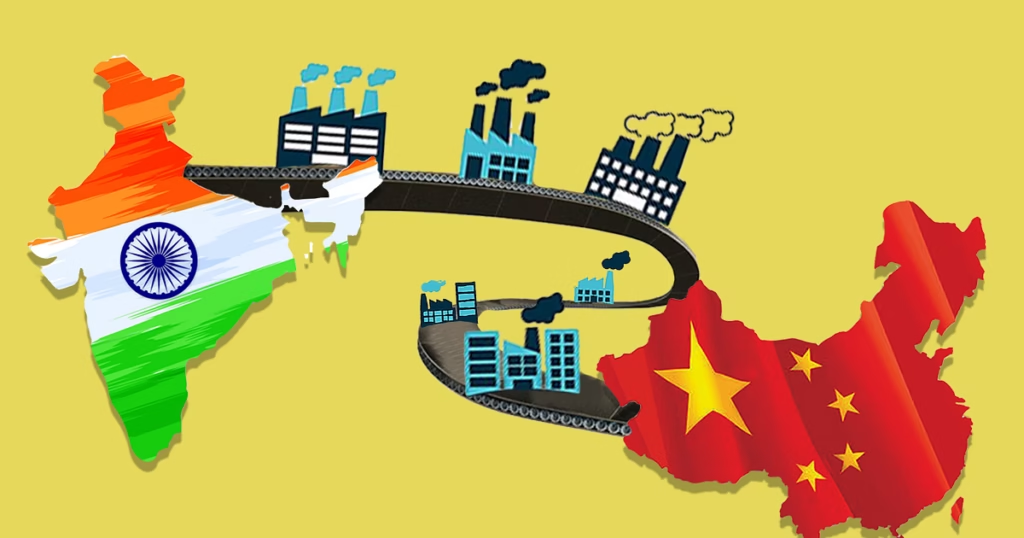
China’s “Made in China 2025” mirrors India’s Make in India push, but with more aggressive global supply chain strategies.
-
Japan’s post-WWII model emphasized supporting domestic manufacturing before opening to global trade.
-
South Korea’s chaebols (Samsung, Hyundai) show how local industries can become global giants with state support.
India’s challenge: balancing local production with global competitiveness.
Future Projections & Expert Commentary
-
By 2030, India aims to become a $10 trillion economy, with local industries expected to contribute a significant share.
-
Experts at NITI Aayog highlight that if MSMEs digitize supply chains, they can boost India’s GDP by 1.5% annually.
-
Vocal for Local will evolve from a campaign into an institutionalized policy, focusing on sustainability, exports, and digital trade.
“Supporting local is no longer just about patriotism; it’s about global competitiveness and national security,” says a recent report by the Confederation of Indian Industry (CII).
 “Supporting local is no longer just about patriotism; it’s about global competitiveness and national security,” says a recent report by the Confederation of Indian Industry (CII).
Indian Context & Real-Life Stories
-
Khadi revival: Khadi sales hit record highs as PM Modi’s endorsement boosted youth interest in eco-friendly, local clothing.
-
Tech startup adaptation: Boat (earphones) captured over 35% market share by branding itself as “Indian alternative to Chinese products.”
-
Farmer cooperatives: Organic farmer groups in Maharashtra entered global markets with Vocal for Local branding.