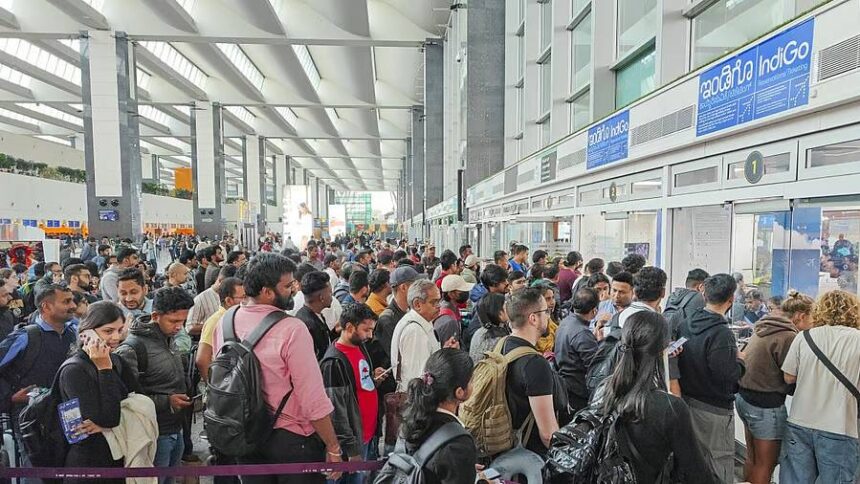
The Indian aviation industry has burst into a whirlwind– not due to weather. In December 2025, the largest domestic carrier in the country, IndiGo, came to a near-stop. Hundreds of flights were cancelled or constantly delayed. Thousands of passengers ended up being stranded, plans spoilt and budgets shattered. On the one hand, DGCA safety regulations try to combat pilot fatigue. On the other: what seems to be a monumental planning, staffing and preparedness failure by IndiGo.
This post will de-pack the crisis, the sources of the crisis, the fall, and how regulators and the government reacted. We discuss how a regulation that was meant to benefit ended up being one of the most disastrous operations in Indian aviation history. We also look at the implications of this with regard to passengers, airlines and policy, and whether this may be a wake-up call of the rest of the industry.
The Background: The Reason behind the development of FDTL Rules
- DGCA modified the flight-crew standards in the context of safety and to prevent the fatigue of pilots within the framework of Flight Duty Time Limitations (FDTL).
- Some of the major developments were the expansion of time dedicated to weekly pilot rest and limiting night-duty landings. Weekly rest in the new set of rules increased to 48 hours as compared to 36 hours.
- Night landing was limited to two a week (previously six a week), and the definition of night hours had been extended by an hour.
- Crew rostering was also required to be frozen at the least of 15 days ahead and the airlines were expected to develop enough built-in reserve in manpower say 10-20 percent supplanted crew strength in order to accommodate the augmented demand.

They did not just impose regulations overnight. The update process has started as early as January 2024, allowing the airlines sufficient lead time.
These rules were in principle sensible. Pilot fatigue has been a safety concern, since time immemorial. International standards include long rest periods and norms within the crew rotation.
The demands of tighter norms promoted by DGCA reflected the world best practices.
To make the rules effective, however, airlines required time – man power and most importantly, planning.

What Went Wrong: The Demise of IndiGo Operations
Shortages in Staffing and Hiring freeze.
The two year window notwithstanding, IndiGo allegedly did very little to increase its pilot strength. Pilot associations and insiders say that the airline had a hiring freeze despite the fact that it was quickly growing its fleet and flight network.
Other buffer crew levels, typically kept at approximately 4% in the case of exceptional circumstances, were seemingly worn down in the build up to the change in norms, with no room to bend.
Effective: as the new FDTL norms became operational, IndiGo did not have sufficient pilots to meet the new standards, yet it maintained its intensive high-frequency flight operations–a formula that was bound to fail.
Crew Roster Rigidity + High Demand Season.
One such stage of FDTL norms would be active on 1 November 2025 when winter sharply increases travel in India.
Having necessary rest periods, night-duty limits and roster inflexibility, the crew-rotation system of the airline lacked the wigling flexibility necessary to accommodate delays or last-minute changes, as well as sudden demands.
The consequence: pilots constantly exceed their duty-time limits, and many flights do not have legally authorised crew.
Poor Planning & Misjudgement
According to Admission by IndiGo the crisis was caused by misjudgment and gaps in planning the rollout of Phase-2 FDTL.
And having such a high proportion of domestic traffic, commonly quoted at 60-65 percent, any massive crew shortage was inevitably going to have a far-reaching effect on the airline network.

Snowball Effect: Flight Cancellations and Passenger Mayhem.
What followed could well have been expected. At the beginning of December 2025, flights began to be cancelled en masse. On the darkest days, major hubs, such as Delhi, Mumbai, Bengaluru, Hyderabad, etc. grounded or delayed hundreds of flights.
On-time performance (OTP) – which is a virtue of the IndiGo brand – dropped to about 67-68 percent as compared to approximately 84 percent in October 2025.
The experience of the passengers was characterized by hours-long queues, frequent cancellations, uneven refunds, and disorderly scenes at the airports. On the Internet, social media groups and Reddit’s threads are going crazy:
“My flight was to take off at 9.00 pm, our boarding was at 12.30. The Delhi flight of my colleague was cancelled.”
It felt almost like the personnel serving the customers was being rotated to create an impression that something needed to be done.
Customers had grieved about inadequate communication, lengthy floor-camping queues in airport grounds and disorderly flight-booking activity. The multiplier effect struck – other airlines were reporting higher load, airfares between big cities shot up and holiday travel plans were in disarray.

Government/ Regulator Response: Damage Control in the Here and Now
DGCA Interventions Partial Waiver and Norm Rollback
DGCA acted quickly under pressure. It repealed a major provision of the FDTL norms which had prohibited the replacement of leave by weekly rest. Now leave (casual, earned, etc.) may be considered week rest, with immediate effect.
Furthermore, DGCA provided IndiGo with an exception against night-duty and other night-landing limits – on its A320 fleet – until 10 February 2026 subject to review.
These actions were intended to provide the airlines- particularly, IndiGo- with room to restructure crew lists and balance the schedule without breaking safety requirements.
Recovery Plan and Submission of IndiGo to DGCA.

IndiGo had forwarded an official mitigation plan in a meeting with the Civil Aviation Ministry. The plan includes:
- Increased rate of crew recruitment and training.
- Restructuring of the roster and a better approach to fatigue/safety-risk assessment.
- The reduction of operations controlled (since December 8) to facilitate the accumulation of buffers and reestablish a schedule without excessively promising the flights.
Conclusion that full operational normalcy will be established by 10 February 2026.
The airline has recognized that the cause of the problem was the miscalculation of the crew demand in the course of the FDTL rollout – accepting that inner crew demand was greater than projected.
Was This Crisis Avoidable? What Went Wrong on Planning
In retrospect, there were a number of red flags, which showed that IndiGo was heading in the wrong direction – but they were overlooked.
Red Flag No.1: Minimal Crew Buffer.
Having a low crew buffer of only about 4% in an airline that was rapidly developing networks and fleets was never a safe bet.
Since new fatigue regulations would mean more crew, and the situation was unstable at the very beginning due to the hiring freeze or slow recruitment.
Red Flag 2: Seasons of the Peak + Winter Destruction.
The introduction of more stringent rest-duty norms, immediately before winter, when the traffic is at its peak, was a strategic mistake. Rather, crew demand and seasonality ought to have been considered.
Red Flag 3: Low Quality Long-term workforce Planning.
The window available to IndiGo was two years long – that is ample time but seemingly they did not manage to onboard/train pilots in adequate numbers. This is a pointer of an overall failure of workforce planning in the long term.
Red Flag 4: Single Airline Domestic Air Traffic.
The collapse of IndiGo affected the domestic market particularly because IndiGo was reportedly controlling a larger part of the domestic market reaching up to 60-65%. That too implies a weak, monopolistic organizational framework that is not redundant.

What It Means to Passengers, Industry and Policy
For Passengers
- The broken travel plans, postponed or cancelled flights and lost finances, missed occasions or holidays.
- Higher distance fares on alternative routes.
- Danger of congestion or inefficient service during recovery period – pressurization and apprehension.
For the Aviation Industry
- Lack of trust: The lack of trust can make passengers reassess their booking regarding IndiGo or even with low-cost airlines.
- Ripple effect on the industry: Overworked alternative airlines, pricing, load capacities.
- Regulatory precedent: It is possible that now airlines can relax a bit when it comes to compliance review in the future.
For Policy & Regulators
- The new FDTL norms were timed and implemented badly. This crisis could provoke the overall reconsideration of the manner of implementing safety regulations.
- It highlights the necessity to enhance more strict staffing, crew buffers, and compliance preparedness prior to rollouts in air-spaces on a wide-basis.
- Questions the existence of monopolistic or dominant airlines – such a large share of airlines poses systemic risk.

Could This Happen Again? Early Warning Signs & Risk Factors
Yes – and without a certain amount of systemic change, it can repeat itself. Key risk factors that remain:
- Growing the fleet without equal crew recruitment.
- Close crew margins, even when regulations are changing.
- Dependence on a single air company to carry a huge proportion of local flights.
- High demand rigidities (e.g., festive seasons, holidays, winter).
- Now bad transparency and communication in times of crisis.
Throughout, unless airlines and regulators develop redundancy, buffer staffing, staggered rollouts and contingency plans, it is likely that similar breakdowns will arise again.
What Should IndiGo and Government Do – How are their Concrete Steps
- not reactive, but proactive in terms of recruiting and training pilots. Increase the number of hires to get a bigger pool.
- Hand bigger crew cushion (10-15%), particularly when major regulatory change is being instigated.
- Implement regulatory impact assessment preceding significant CAR/FDTL modifications – assess the readiness of the airlines.
- Delayed execution of airlines and aircrafts additions to prevent full network meltdown.
- Foster competition in the market – do not rely too much on a carrier. Empowering mid-size and regional airlines will decrease systemic risk.
- Enhance passenger-rights measures and transparency – disruption transparency, compensation/refund policy.
- Check monitor compliance, fatigue compliance, but to a realistic scale, i.e. between the safety norms and the reality of operations.

Suggestions to Indian Aviation – and the Bigger Picture
- Safety norms are uncompromising- yet should be implemented with a wise approach.
- The aviation ecosystem will be weak when a single airline has a domineering market share. Competition and diversification are much needed.
- The only way to reduce this is through regulatory bodies and airlines being responsible: the former sets the rules, and the latter has to enforce them conscientiously.
- It is not only the travelers who are affected by the crisis but also public trust which was once a faithful brand such as IndiGo is now fighting a redemption issue.
- It should be systemic resilience, and not efficiency, that becomes the aim.
Meaning it is not only an IndiGo problem but it depicts as a wake-up call to Indian aviation.
Final Thoughts & What’s Next
More Read

So far with the partial rollback of duty-norms by DGCA and the recovery-plan submitted to it by IndiGo, there is hope. However, to recover total stability, to reestablish staff, to regain passenger confidence, efficient work going on, is going to need time. By 10 February 2026, IndiGo has guaranteed resumption in full.
To travellers, the near term represents prudence: be careful of flight status, take up other airlines wherever feasible and be prepared to make last minute changes. This crisis should be a wake-up call to industry observers and policy-makers: improved fatigue-management rules, gradual adoption of safety standards, and most importantly effective planning of the workforce.
This is likely to be a breakthrough in Indian aviation. The future of the issue is determined by how stakeholders proceed whether it results in the establishment of safety and reliability or a saga of regulatory oversights and corporate mismanagement.