

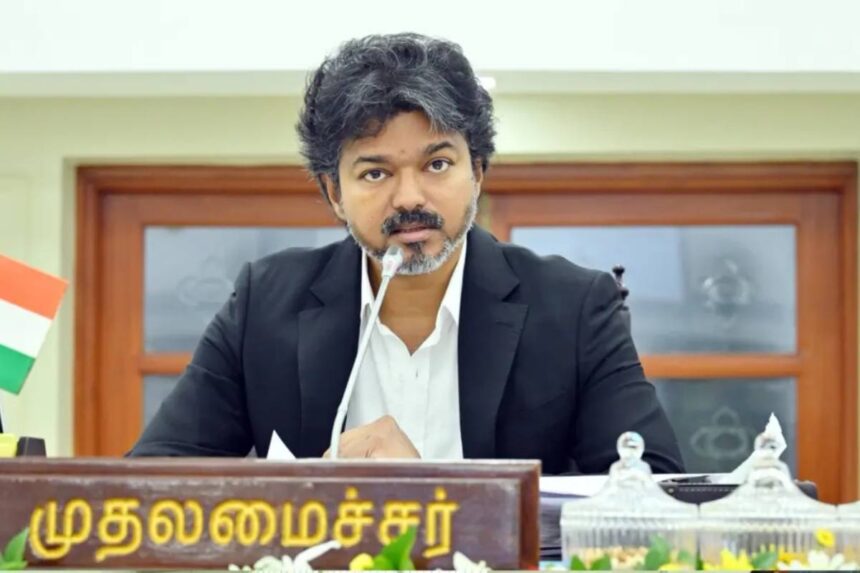
The TVK Government Conspiracy has triggered one of the biggest political controversies in Tamil Nadu since actor-turned-politician Vijay assumed office as Chief Minister. Authorities have arrested three individuals after allegations surfaced that a ₹35 crore bribe was offered to a legislator in an alleged attempt to destabilize the newly formed Tamilaga Vettri Kazhagam (TVK) government. Investigators are examining claims that the conspiracy was part of a broader effort to engineer defections within the ruling party and bring down the government before it could consolidate its mandate.
The alleged plot has intensified political tensions across the state, with the ruling TVK accusing opposition leaders of attempting to undermine the democratic mandate through inducements rather than electoral politics. Opposition parties, however, have rejected the allegations and demanded a fair and transparent investigation before any political conclusions are drawn.
How the Alleged TVK Government Conspiracy Unfolded
According to investigators, the controversy began after a ruling-party MLA reportedly informed authorities about an alleged offer of ₹35 crore in exchange for switching political allegiance. The complaint led to a police investigation that culminated in the arrest of three suspects, who are now being questioned regarding their alleged roles in the conspiracy.
Investigators are examining financial records, digital communications and other evidence to determine whether the alleged bribery attempt was an isolated incident or part of a coordinated strategy to weaken the government by encouraging multiple legislators to defect. Officials have not ruled out the possibility of additional arrests if fresh evidence emerges during the investigation.
The case has quickly become one of the most closely watched political investigations in Tamil Nadu, with both supporters and critics of the government awaiting further disclosures.
Political Stakes for Vijay’s Government
The alleged conspiracy comes at a politically sensitive time for Chief Minister Vijay, whose victory marked a dramatic shift in Tamil Nadu’s political landscape. After decades of politics dominated by the state’s traditional Dravidian parties, the emergence of TVK as the governing party represented a significant political realignment.
The controversy comes just months after actor-turned-politician Vijay formed the government, marking one of the most significant shifts in state politics. Our earlier analysis of Vijay’s rise in Tamil Nadu politics explores how his party emerged as a formidable electoral force.
Political observers believe that any attempt to destabilize a newly elected government could have far-reaching implications for governance, investor confidence and public trust in democratic institutions.
Could Defections Bring Down a Government?
One of the central questions raised by the alleged TVK Government Conspiracy concerns the role of political defections in Indian democracy.
The alleged plan reportedly involved persuading ruling party legislators to switch allegiance, raising fresh questions about India’s anti-defection law and whether existing safeguards are sufficient to prevent political horse-trading.
The Tenth Schedule of the Constitution, commonly known as the Anti-Defection Law, was enacted to discourage elected representatives from changing political parties for personal or financial gain. While the law has reduced instances of individual defections, political crises involving groups of legislators continue to test its effectiveness, particularly in closely contested assemblies.
Legal experts note that any evidence of bribery or inducement could invite criminal investigation in addition to proceedings under legislative rules governing defections.
Political Reactions Intensify
The alleged TVK Government Conspiracy has sparked a war of words between the ruling party and the opposition. TVK leaders have described the alleged bribery attempt as a direct attack on the democratic mandate delivered by the people of Tamil Nadu, calling for a comprehensive investigation into everyone involved.
Leaders from the opposition have denied any involvement and accused the government of attempting to politicize an ongoing criminal investigation. They have urged investigators to rely solely on evidence rather than political narratives, emphasizing that responsibility can only be determined through due legal process.
As the investigation continues, political observers expect the controversy to dominate public discourse in Tamil Nadu, particularly if further evidence links the alleged conspiracy to influential political figures.
TVK Government Conspiracy Renews Debate on Defections
One of the most significant questions raised by the TVK Government Conspiracy concerns the continuing challenge of political defections in India.
The Anti-Defection Law, incorporated into the Constitution through the Tenth Schedule, was introduced to discourage elected representatives from changing political parties for personal or financial gain. While the law has reduced instances of individual defections, political controversies involving allegations of inducement continue to test its effectiveness, particularly when governments hold slender legislative majorities.
For readers seeking a detailed legislative explanation, PRS Legislative Research provides an accessible overview of how the Anti-Defection Law operates, its constitutional basis and the legal challenges that continue to surround its implementation.
What Happens Next?
Investigators are continuing to examine financial transactions, electronic communications and witness statements connected to the alleged bribery attempt. Authorities have indicated that the investigation remains at an early stage and that additional action may follow depending on the evidence collected.
If investigators establish that the alleged conspiracy extended beyond the three arrested individuals, the case could evolve into one of the most significant political corruption investigations in recent Tamil Nadu history.
Regardless of the outcome, the controversy has already reignited debate over political ethics, electoral mandates and the mechanisms designed to protect democratically elected governments from attempts at destabilization.
Conclusion
The alleged TVK Government Conspiracy represents more than a criminal investigation into an alleged bribery attempt, it has become a broader test of political accountability and democratic resilience in Tamil Nadu. While the investigation is ongoing and the allegations remain subject to judicial scrutiny, the case has once again highlighted the continuing challenges posed by political defections, corruption allegations and power struggles within India’s electoral democracy.
Whether the investigation ultimately substantiates the allegations or not, its findings are likely to shape Tamil Nadu’s political landscape for months to come.