

Poco M8 Power Price in India: What That 8,000mAh Battery Actually Costs You

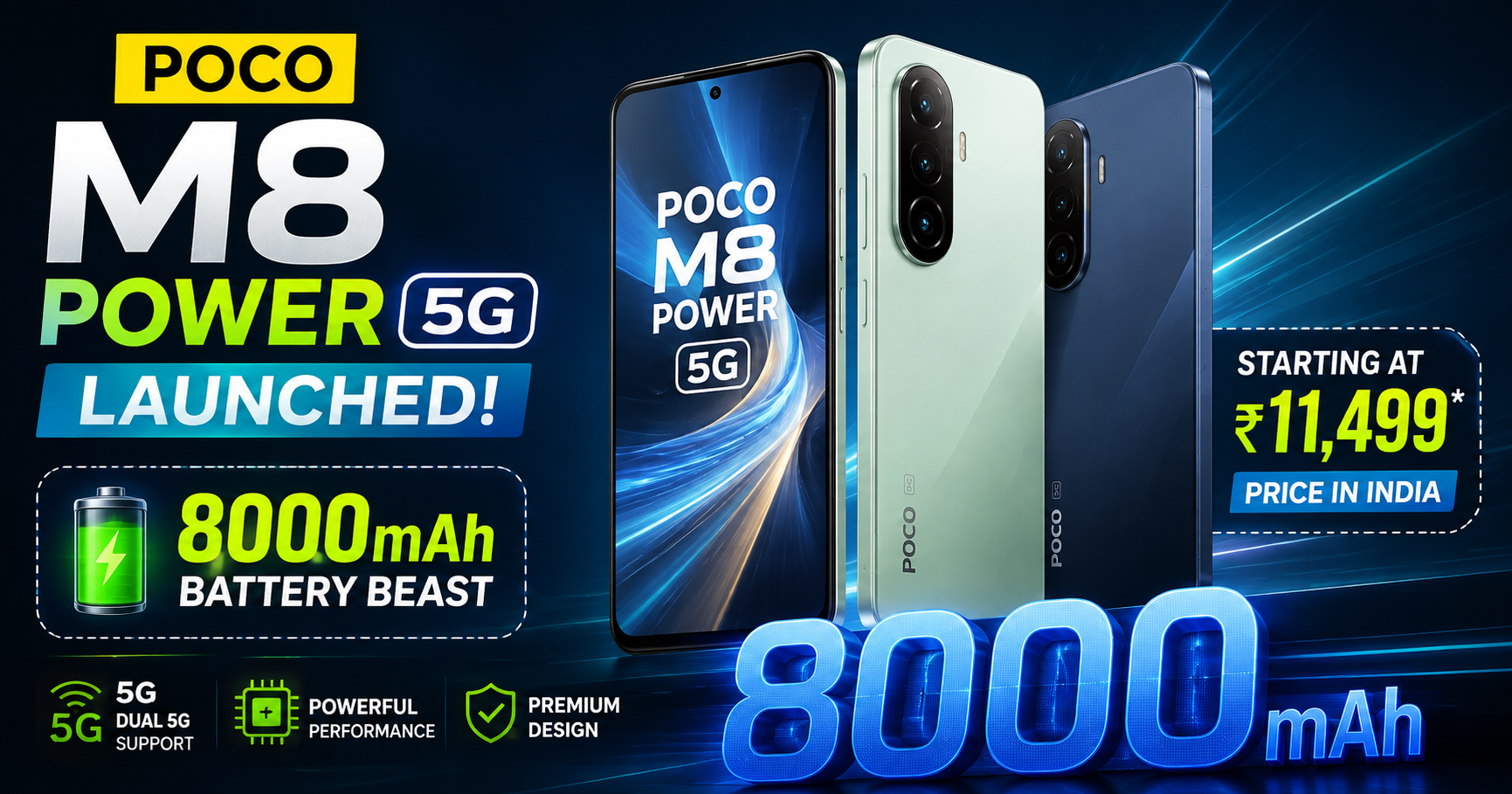
What is the Poco M8 Power?
The Poco M8 Power is a budget 5G smartphone from Poco, the online-first sub-brand owned by Xiaomi. It sits above the regular Poco M8, which arrived in India in January 2026.
Think of the "Power" suffix the way you'd think of a family-pack at a kirana store. Same product, bigger container, marginally better value per unit. Here, the container is the battery.
Poco has confirmed exactly one launch date: 4 August 2026, 12:00 PM IST, on Flipkart. The company revealed this through a dedicated Flipkart microsite and its own social channels.
Here's what the microsite has already confirmed, as reported by Gizmochina and Notebookcheck:
- 8,000mAh battery with 45W wired charging and 22.5W reverse charging
- 6.9-inch flat AMOLED display, FHD+ resolution, 120Hz refresh rate
- 1,800 nits peak brightness, 1,200 nits in high-brightness mode
- 240Hz touch sampling rate, in-display fingerprint sensor
- Qualcomm Snapdragon 4 Gen 4 chipset, LPDDR4x RAM, UFS 2.2 storage
- HyperOS 3 based on Android 16
- Four Android OS upgrades and six years of security patches
- 50MP rear camera, 8MP front camera
- Corning Gorilla Glass 7i, IP65 rating, roughly 8.45mm thick
- Colours: Blaze Orange, Green, Black
That is an unusually complete spec sheet for a phone that hasn't launched. Which tells you something about how Poco sells phones now. The specs are the marketing. The price is the surprise.
Why is Poco betting everything on battery?
Because Indians stopped caring about megapixels around 2023, and brands noticed.
Look at the pattern. In August 2025, Poco launched the M7 Plus 5G with a 7,000mAh battery at ₹13,999. In January 2026, the Poco M8 arrived. Now the M8 Power pushes to 8,000mAh.
Battery size has become the easiest specification to advertise. You don't need a reviewer to explain it. A bigger number is simply better, and every buyer understands that instantly.
There's a harder commercial reason too.
Chipsets in the budget segment have stopped improving fast enough to sell a phone. The Snapdragon 4 Gen 4 is a competent chip. It is not a story. An 8,000mAh battery is a story.
And there's a third reason, which Poco won't advertise. The M8 Power is widely expected to be a rebadged Redmi Note 17, which Xiaomi is launching in India on 6 August 2026, two days later. Same parent company. Two brands. Two price points. Two shots at the same customer.
How the 8,000mAh battery actually works
An 8,000mAh cell in a phone 8.45mm thick shouldn't be physically possible using the technology in your current handset. It is possible because of a change in chemistry.
Traditional lithium-ion batteries use a graphite anode (the negative electrode, where charge is stored while the battery is full). Silicon holds far more lithium per gram than graphite does. So manufacturers have begun blending silicon into the anode. This is called silicon-carbon battery technology, and Poco already used it in the M7 Plus 5G in 2025.
The practical result: more stored energy in the same physical space.
Here's the step-by-step of what happens when you plug it in:
- The 45W charger negotiates with the phone over USB-C to agree on a safe voltage.
- Charging runs fast until roughly 60–70% capacity, then slows deliberately to protect the cell.
- Heat is the enemy. The phone throttles charging speed if it gets too warm.
- Reverse charging at 22.5W lets you plug another device into your phone and drain your battery into theirs.
That reverse-charging figure is the genuinely interesting one. 22.5W is faster than the charger bundled with a lot of budget phones sold in India today. Your phone can charge your friend's phone faster than their own charger can.
One caveat worth knowing. Silicon-carbon cells swell slightly more during charge cycles than pure graphite cells. Manufacturers engineer around this. But it is why battery safety certification under BIS standards matters, and why buying grey-market imports of big-battery phones is a bad idea.
Gizmochina — Poco M8 Power specifications confirmed ahead of launch:
Digit — Poco M8 Power price leaks ahead of India launch
What the Poco M8 Power price means for you
Now the part that decides everything.
The Poco M8 Power price in India is unconfirmed. [VERIFY: replace with official figure after 4 August 2026, 12 PM IST]
What's in circulation right now:
| Source | Figure | What it actually is |
|---|---|---|
| Tipster Abhishek Yadav, reported by Digit | ~₹22,999 | Unverified leak |
| Cashify | ₹26,999 | Site's own "expected price" |
| Smartprix | ₹29,990 | Site's own "expected price" |
| Poco India | Not announced | The only one that counts |
Let's run the numbers for a real person. Take Priya, a 27-year-old sales executive in Ghaziabad earning ₹50,000 a month. She's on the road nine hours a day, running Google Maps, four WhatsApp groups and a CRM app.
Her current phone dies by 6 PM. She carries a power bank.
At ₹22,999, the phone costs her about 46% of a month's salary, or roughly ₹1,917 a month on a 12-month no-cost EMI. She stops carrying a 300g power bank. She gains maybe three hours of usable phone time per day.
At ₹29,990, the same phone costs her 60% of a month's salary. At that price she's competing against phones with better cameras and faster chips, and the battery advantage stops being enough.
That ₹7,000 gap is the entire story of this launch.
Now the second number nobody mentions: the six years of security patches.
If Priya keeps the phone five years instead of three, her cost per year drops from roughly ₹7,666 to ₹4,600. On a budget phone, software support duration is worth more rupees than the camera. Almost nobody calculates it.
Beebom Gadgets — Poco M8 Power India launch date confirmed
Here's the surprising bit. Launch prices in India are no longer stable. Poco raised prices across Poco M8 5G variants by up to ₹2,000 after launch, citing rising component costs, according to Smartprix's price tracking. The Poco M7 Plus launched at ₹13,999 in August 2025 and now lists around ₹15,499.
So the launch-day price isn't the price. It's the floor.
Poco M8 Power vs Poco M8 vs Poco M7 Plus
| Feature | Poco M8 Power | Poco M8 | Poco M7 Plus 5G |
|---|---|---|---|
| Launch | 4 Aug 2026 | 13 Jan 2026 | 13 Aug 2025 |
| Battery | 8,000mAh | 5,520mAh | 7,000mAh |
| Charging | 45W + 22.5W reverse | 45W | 33W |
| Display | 6.9" AMOLED 120Hz | 6.77" AMOLED 120Hz | 6.9" IPS LCD 144Hz |
| Peak brightness | 1,800 nits | Not confirmed here | 850 nits |
| Chipset | Snapdragon 4 Gen 4 | Snapdragon 6 Gen 3 | Snapdragon 6s Gen 3 |
| Software support | 4 OS + 6 yrs security | Not confirmed here | 2 OS + 4 yrs security |
| Water resistance | IP65 | IP65/IP66 | IP64 |
| Launch price | [VERIFY] | ₹20,465 (current) | ₹13,999 |
Read that table carefully and one thing jumps out.
The Poco M8 Power has a slower chipset than the cheaper Poco M8. Snapdragon 4 Gen 4 sits below Snapdragon 6 Gen 3 in Qualcomm's own naming hierarchy. You are trading processing power for battery capacity.
That's a real trade, not a free upgrade.
The other side: 3 problems with the Poco M8 Power price story
We don't publish one-sided explainers. Here's the case against.
1. The storage and memory are old. LPDDR4x RAM and UFS 2.2 storage are previous-generation standards. Competitors near ₹20,000 ship UFS 3.1. In daily use, this shows up as slower app installs and slower large-file transfers. It is a cost-cutting decision, and it is deliberate.
2. A big battery does not automatically mean long life. Battery life is capacity divided by consumption. A 6.9-inch 120Hz AMOLED panel pushing 1,800 nits consumes a lot. Poco's marketing has claimed up to three days of usage, but that is a manufacturer claim under manufacturer conditions. Independent testing will not exist until after launch. Treat the three-day figure as a headline, not a promise.
3. The phone will be heavy. Poco has not confirmed weight at the time of writing. For reference, the 7,000mAh Poco M7 Plus weighs 217g. An 8,000mAh phone is unlikely to weigh less. If you use your phone one-handed on a crowded local train, that matters more than any spec sheet suggests.
And the structural criticism: rebadging. If the M8 Power is a rebranded Redmi Note 17, you are choosing between two nearly identical phones from the same company, which reduces genuine competition while appearing to increase choice.
Common myths about the Poco M8 Power
Myth 1: "The price is already confirmed at ₹22,999." No. Digit's own report attributes that figure to tipster Abhishek Yadav and states plainly that the company has not confirmed these details. Price-comparison sites carry disclaimers that their listed figures may be inaccurate.
Myth 2: "8,000mAh means it charges slower." Charging time depends on charger wattage and thermal management, not capacity alone. The M8 Power ships with 45W charging against the M7 Plus's 33W, so a larger battery is paired with a faster charger.
Myth 3: "Bigger batteries degrade faster." Degradation is driven by charge cycles, heat and charging habits, not raw capacity. A larger battery covering the same daily usage completes fewer full cycles per year. Cell chemistry and thermal design matter far more than the mAh figure.
What happens next: the bigger picture
At noon on 4 August, one number appears on a Flipkart page and settles this entire debate. Watch for three things beyond the headline price.
First, the variant spread. If the 6GB/128GB model launches low and the 8GB/256GB model sits ₹4,000 higher, the advertised "starting at" price is marketing, not reality.
Second, the introductory offer window. Poco has run 12-hour launch-day pricing before. That is a discount with an expiry date, and it inflates the perceived value.
Third, watch 6 August. The Redmi Note 17 lands two days later. If it is meaningfully similar hardware at a different price, the M8 Power's positioning changes overnight.
The broader shift is this: India's budget segment has stopped competing on processing power and started competing on endurance. Battery is the new benchmark. Whether that serves you or simply papers over stagnant chip performance is the question worth holding onto.
















Comments (0)