
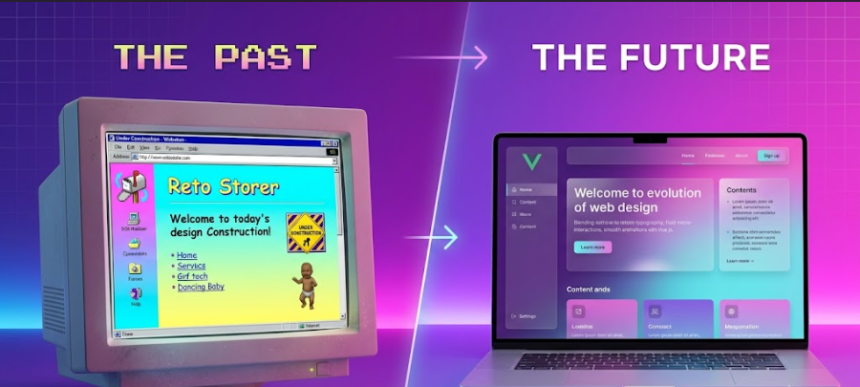
Retro web design UI is making a remarkable comeback, not because designers want to recreate the internet of the 1990s, but because users are growing tired of digital sameness. After years of minimalist interfaces dominating websites and applications, designers are rediscovering bold colours, desktop-inspired layouts, pixel art, glossy buttons, and playful animations that make digital experiences memorable again.
Pixelated icons. CRT-inspired colours. Desktop windows. Glossy buttons. Animated cursors. Taskbars. Browser chrome. Design elements that many believed disappeared with Windows 95 and the early internet are making an unexpected return.
This resurgence isn’t driven by nostalgia alone.
Google’s latest Think with Google consumer insights identified “The Nostalgic Remix” as one of the defining cultural trends shaping digital experiences. Rather than recreating the past, brands are remixing familiar aesthetics with modern technology to create products that feel distinctive in an increasingly crowded digital landscape.
For front-end developers, this presents an exciting opportunity.
Modern frameworks such as Vue.js and Tailwind CSS make it possible to recreate the personality of the early web while maintaining the speed, accessibility, and responsiveness users expect today.
The result is a new generation of retro web design UI, interfaces that look nostalgic but perform like modern applications.
Here are seven trends driving this movement.
1. Desktop-Inspired Interfaces Are Replacing Traditional Dashboards
One of the most noticeable shifts in retro web design UI is the return of desktop-inspired experiences.
Instead of static pages, developers are building applications that behave like operating systems.
Users can drag windows across the screen.
Open multiple applications simultaneously.
Minimise and maximise content.
Switch between floating panels.
Move files.
Even interact with virtual desktops.
This approach creates interfaces that feel interactive before users even begin exploring the product.
Creative portfolios now resemble Windows XP desktops.
Developer portfolios open inside simulated operating systems.
AI applications launch in movable dialog boxes instead of conventional cards.
The objective isn’t to imitate old software.
It’s to make navigation feel playful and memorable.
For startups competing against hundreds of similar SaaS products, this visual identity has become a powerful differentiator.
More importantly, modern frontend architecture makes these experiences practical.
Vue’s component system naturally supports modular windows, while state management libraries simplify dragging, resizing, and layering complex interface elements.
What once required hundreds of lines of custom JavaScript can now be built using reusable components.
Desktop interfaces are no longer experimental.
They’re becoming part of mainstream frontend design.
2. Pixel Art and Bitmap Icons Are Replacing Generic Illustrations
Open almost any website built between 2018 and 2024.
You’ll likely find the same illustration style.
Rounded characters.
Pastel gradients.
Flat vectors.
Minimal icons.
Designers are beginning to move away from that visual language.
Instead, pixel graphics and bitmap-inspired artwork are returning.
Tiny icons.
Low-resolution illustrations.
CRT-inspired gradients.
Game-inspired cursors.
8-bit loaders.
Rather than feeling outdated, these elements immediately give products personality.
Gaming platforms have embraced them.
Creative agencies are using them.
AI startups are beginning to experiment with them as a way of standing apart from increasingly uniform branding.
Unlike previous generations of pixel graphics, today’s assets are built as scalable SVGs or optimized vector illustrations, allowing developers to preserve the nostalgic aesthetic without sacrificing responsiveness or performance.
For frontend developers, this means the visual style feels vintage.
The implementation remains thoroughly modern.
3. Vue Animation Trends Are Bringing Old Interfaces Back to Life
Visual design creates nostalgia.
Animation makes users believe it.
This explains why Vue animation trends have become closely connected with the resurgence of retro-inspired interfaces.
Early operating systems felt satisfying because almost every interaction included subtle motion.
Windows expanded smoothly.
Menus unfolded naturally.
Dialog boxes faded into view.
Buttons responded instantly.
Those tiny interactions created an experience that felt alive.
Modern Vue applications are recreating those same behaviours.
Instead of abrupt page changes, developers are introducing desktop-style transitions that make applications feel more tactile.
Window-opening effects.
Minimise animations.
Floating notification panels.
Context menus.
Terminal cursors.
Loading screens inspired by Windows 98.
Folder-opening sequences.
These interactions can be built using Vue’s built-in <Transition> and <TransitionGroup> components, avoiding the need for large animation libraries while maintaining excellent performance.
The result is an interface that captures the emotional appeal of classic desktop software without inheriting its technical limitations.
This trend also reflects a broader shift in frontend development.
Developers are no longer treating animation as decoration.
They’re using it to reinforce navigation, improve feedback, and make applications more intuitive.
When combined with nostalgic visuals, these interactions transform ordinary interfaces into memorable digital experiences.
4. Tailwind CSS Is Making Retro Design Easier to Build
Not long ago, recreating a Windows 95-inspired interface meant writing hundreds of lines of custom CSS.
Every bevelled button, embossed border, and pixel-perfect shadow had to be handcrafted. Maintaining those styles across larger projects quickly became a challenge.
That is no longer the case.
Modern utility-first frameworks have made retro web design UI far more practical to implement. Among them, Tailwind CSS has become a favourite for frontend developers who want complete creative control without sacrificing maintainability.
The reason is flexibility.
Retro interfaces rely on highly specific visual details—hard borders instead of soft shadows, bold gradients instead of muted colours, and sharp spacing instead of fluid layouts. Tailwind allows developers to create these styles directly in the markup while keeping the codebase consistent and scalable.
Need a Windows 98-style button?
A taskbar with a subtle bevel?
A CRT-inspired colour palette?
A terminal-style command window?
Rather than writing lengthy CSS files, developers can compose reusable utility classes and extend Tailwind’s configuration to create an entire nostalgic design system.
This is one reason why frontend design trends are shifting towards highly customised interfaces.
Tailwind doesn’t impose a design language.
It enables developers to build one.
For teams working on Vue applications, the combination is particularly powerful. Vue manages interaction and state, while Tailwind provides the visual foundation, allowing designers and developers to iterate rapidly without compromising consistency.
5. Nostalgic Web Components Are Becoming Reusable Design Systems
Perhaps the biggest change in modern frontend development is not visual.
It’s architectural.
Instead of building every interface from scratch, developers increasingly rely on reusable component libraries that accelerate development and ensure consistency across applications.
That philosophy is now reaching retro-inspired design.
A growing number of open-source projects are introducing nostalgic web components that replicate familiar desktop experiences using modern technologies.
Window managers.
Taskbars.
File explorers.
Terminal emulators.
Context menus.
Classic dialog boxes.
Loading screens.
Pixel-inspired navigation.
Rather than existing as isolated UI experiments, these components are becoming complete design systems that developers can integrate into production applications.
This shift matters because it lowers the barrier to adoption.
A startup building an AI dashboard no longer needs to recreate a desktop interface from the ground up. Developers can assemble reusable components, customise them with Tailwind, and animate them using Vue transitions, all while maintaining a scalable codebase.
As these libraries mature, nostalgic interfaces are becoming less of a design trend and more of a practical development approach.
6. Y2K Meets Brutalism: The Internet’s Most Unexpected Design Fusion
One of the most interesting developments in retro web design UI is that it isn’t simply reviving the past.
It is blending multiple design movements into something entirely new.
Y2K aesthetics – chrome gradients, translucent panels, glossy buttons, neon colours, and futuristic typography are increasingly being combined with digital brutalism, a style known for oversized typography, bold layouts, sharp contrasts, and unconventional navigation.
At first glance, the two approaches appear contradictory.
One embraces maximalism.
The other rejects visual polish.
Together, however, they create websites that feel energetic, unconventional, and highly memorable.
This hybrid aesthetic is becoming increasingly common across creative portfolios, digital agencies, independent product launches, and experimental SaaS landing pages.
Instead of following predictable templates, designers are embracing asymmetry, oversized interface elements, layered windows, and expressive typography to create experiences that encourage exploration.
For users accustomed to minimalist layouts, the contrast immediately captures attention.
In a digital landscape where first impressions often determine whether visitors stay or leave, that distinction matters.
7. Great Retro UI Still Depends on Modern Performance
Nostalgia may attract visitors.
Performance keeps them.
This is perhaps the most important lesson behind the resurgence of retro web design UI.
The websites inspiring today’s designers may have looked distinctive, but they were rarely fast by modern standards. Heavy image files, table-based layouts, and inconsistent browser support often created frustrating user experiences.
Today’s developers have the opportunity to avoid those mistakes.
Vue’s efficient rendering engine enables smooth interactions without unnecessary overhead.
Tailwind eliminates unused CSS during production builds.
SVG graphics replace bulky bitmap assets.
Lazy loading improves page speed.
Modern image optimization reduces bandwidth without sacrificing visual quality.
At the same time, accessibility remains essential.
A retro-inspired website should still support keyboard navigation, semantic HTML, high colour contrast, screen readers, and users who prefer reduced motion.
The most successful implementations don’t choose between personality and usability.
They deliver both.
That balance is what separates professional frontend engineering from visual experimentation.
Why This Trend Matters for Businesses
For brands, design is no longer just about aesthetics.
It is about recognition.
Consumers encounter thousands of digital interfaces every week. Many share similar layouts, colour palettes, and interactions, making it increasingly difficult for companies to establish a memorable identity.
The rise of retro web design UI offers an alternative.
Nostalgic interfaces create emotional connections, encourage exploration, and increase the likelihood that users will remember a product after leaving the website.
For startups, this can be particularly valuable.
A distinctive interface can generate discussion on social media, improve direct traffic through word-of-mouth, and strengthen brand recall without significantly increasing marketing budgets.
For front-end developers, the opportunity extends beyond visual design.
Mastering Vue transitions, Tailwind CSS, and reusable nostalgic web components positions developers to build products that are technically robust while standing out in an increasingly competitive digital market.
As Google’s “The Nostalgic Remix” trend suggests, consumers are not looking to relive the past.
They are looking for experiences that reinterpret it in meaningful ways.
Readers interested in emerging design and technology trends can also explore our article on Top Viral AI Tools in 2025: ChatGPT Hacks, Canva AI Tricks & Midjourney Mastery, which highlights the latest innovations transforming digital creativity. For practical guidance on user experience and interface design, visit the Nielsen Norman Group, a leading authority on UX research and web usability.
Conclusion
The return of retro web design UI is not a rejection of modern design.
It is a response to digital sameness.
After years of minimalist interfaces dominating the web, designers and developers are rediscovering the value of personality, playfulness, and memorable interaction. Inspired by Google’s Think with Google insight on “The Nostalgic Remix,” this movement demonstrates that familiar aesthetics can become powerful innovation when combined with modern engineering.
For frontend developers, the trend represents more than visual experimentation. It is an opportunity to build interfaces that balance creativity with performance, using Vue transitions for fluid interactions, Tailwind CSS for scalable styling, and nostalgic web components for reusable, production-ready design systems.
The future of web design is unlikely to resemble the internet of 1999.
But it may borrow its most enduring quality, the ability to surprise users.
In a digital world where many websites look and feel alike, the products that create memorable experiences will have the strongest chance of earning attention, engagement, and loyalty.